

Why Sulfur Matters in Global Fertilizer Markets: Supply Chain, Demand Drivers and Industry Outlook 2026
Explore why sulfur plays a critical role in global fertilizer markets, how sulfur supports phosphate fertilizer production, and what buyers should monitor throughout 2026.
Last updated: July 3, 2026
Editorial standard
Reviewed by AurexInsight Research
Last updated: July 3, 2026
AUREXINSIGHT RESEARCH
Why Sulfur Matters in Global Fertilizer Markets: Supply Chain, Demand Drivers and Industry Outlook 2026
Explore why sulfur plays a critical role in global fertilizer markets, how sulfur supports phosphate fertilizer production, and what buyers should monitor throughout 2026.
Executive summary
Sulfur is one of the most important raw materials in the global fertilizer industry.
Although sulfur itself is not a fertilizer, it is the primary feedstock used to produce sulfuric acid—the essential chemical required for manufacturing phosphate fertilizers.
Because of this relationship, sulfur markets and fertilizer markets are closely interconnected.
Research method and limitations
This summary is based on the full AurexInsight report, trade and industry data, and reputable public sources. Market data may be delayed, incomplete, or methodologically inconsistent; independent due diligence is essential before commercial decisions.
Written and reviewed by: AurexInsight Research
Full report and sources: https://aurexinsight.com/en/insights/why-sulfur-matters-in-global-fertilizer-markets
Research method
This analysis triangulates reputable public sources, trade and industry data, institutional reports, and consistency checks. Material source conflicts, limitations, and uncertainty are stated explicitly.
Data limitations
Trade and market data may be delayed, incomplete, or methodologically inconsistent. This report does not replace independent legal, financial, procurement, or commercial due diligence.
Quick Answer
Sulfur is one of the most important raw materials in the global fertilizer industry.
Although sulfur itself is not a fertilizer, it is the primary feedstock used to produce sulfuric acid—the essential chemical required for manufacturing phosphate fertilizers.
Because of this relationship, sulfur markets and fertilizer markets are closely interconnected.
Changes in sulfur availability can influence fertilizer production costs, international trade flows, procurement strategies, and long-term agricultural supply chains.
For fertilizer producers, commodity traders, procurement teams, and market analysts, understanding sulfur markets is no longer optional—it is an essential part of fertilizer market intelligence.
For additional background, readers may also explore:
👉🏻 Global Sulfur Market Outlook 2026
👉🏻 Top Sulfur Exporting Countries in 2026
👉🏻 Global Urea Market Outlook 2026
Executive Summary
Food security begins long before crops are planted.
It begins with fertilizers.
Behind nearly every phosphate fertilizer produced worldwide lies another commodity that receives far less public attention:
Sulfur.
Most sulfur recovered during oil refining and natural gas processing is converted into sulfuric acid, which is then used to manufacture phosphate fertilizers.
This creates one of the world's most important industrial supply chains—linking energy production, chemical manufacturing, fertilizer production, agriculture, and ultimately global food systems.
Unlike nitrogen fertilizers such as urea, phosphate fertilizers depend directly upon sulfur availability.
Consequently, fertilizer producers monitor sulfur markets just as closely as they monitor agricultural demand.
Throughout 2026, sulfur continues to influence fertilizer markets through:
- sulfuric acid production
- phosphate fertilizer demand
- refinery activity
- natural gas processing
- international sulfur trade
- maritime logistics
Understanding these connections allows buyers to evaluate fertilizer markets from a broader Market Intelligence perspective rather than focusing solely on fertilizer prices.
For a deeper view of sulfur supply, export structure, and major supplier countries, see:
👉🏻 Top Sulfur Exporting Countries in 2026
Key Takeaways
- Sulfur is the primary raw material used to manufacture sulfuric acid.
- Sulfuric acid is essential for phosphate fertilizer production.
- Fertilizer demand remains the largest source of sulfur consumption worldwide.
- Energy markets indirectly influence fertilizer production through sulfur supply.
- Procurement teams should monitor sulfur markets alongside fertilizer markets.
- Logistics and sulfur trade flows affect fertilizer supply chains globally.
- Understanding major sulfur exporters is essential for evaluating fertilizer supply-chain risk.
Sulfur in the Fertilizer Industry Snapshot
| Market Factor | Importance |
|---|---|
| Primary Sulfur Use | Sulfuric acid production |
| Largest End-use Industry | Phosphate fertilizers |
| Supply Source | Oil refining & natural gas processing |
| Main Demand Driver | Agriculture |
| Strategic Importance | Very High |
| Supply Chain Link | Energy → Chemicals → Fertilizers |
Rather than functioning as an isolated industrial commodity, sulfur serves as one of the key links connecting global energy production with agricultural productivity.
Why Sulfur Is Essential for Fertilizer Production
Many people assume fertilizers are produced directly from mined minerals or natural gas.
While this is partially true, phosphate fertilizers require an additional critical input.
Sulfur.
Most recovered sulfur is converted into sulfuric acid.
Sulfuric acid is then used to process phosphate rock into commercially usable phosphate fertilizers.
Without sulfuric acid, large-scale phosphate fertilizer production would not be possible.
This makes sulfur indispensable to modern agriculture.
Unlike urea—which primarily depends on natural gas—phosphate fertilizer production depends heavily upon stable sulfur supply.
For additional insight into sulfur markets, readers may also explore:
👉🏻 Global Sulfur Market Outlook 2026
👉🏻 Top Sulfur Exporting Countries in 2026
👉🏻 Iran's Role in Global Sulfur Trade
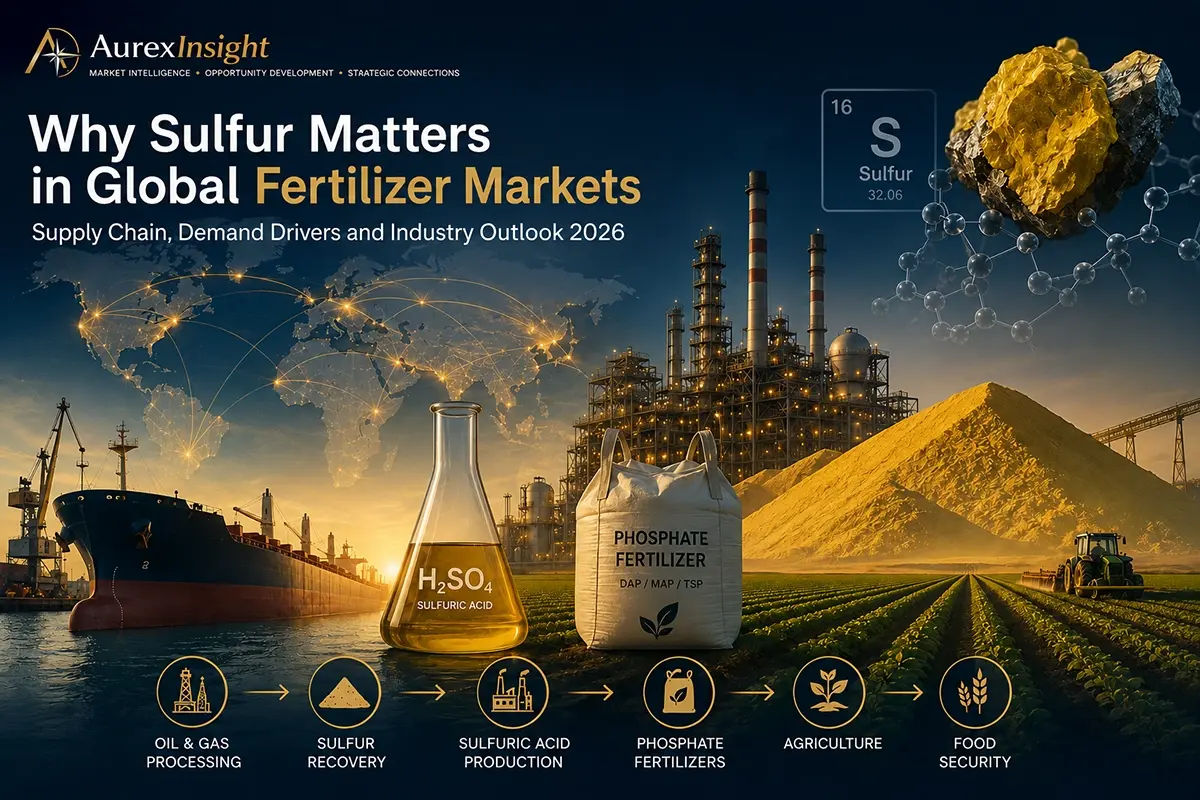
From Sulfur to Fertilizer
Understanding sulfur markets becomes much easier when viewed as a value chain.
Sulfur moves through several interconnected industrial stages before ultimately supporting agricultural production.
| Stage | Purpose |
|---|---|
| Oil & Gas Production | Hydrocarbon extraction |
| Sulfur Recovery | Removal during refining & gas processing |
| Sulfuric Acid Production | Industrial processing |
| Phosphate Processing | Fertilizer manufacturing |
| Agriculture | Crop production |
| Food Supply | Global consumption |
This chain illustrates why developments in energy markets frequently influence fertilizer markets—even when agricultural demand remains stable.
Global Sulfur Demand Structure
Global sulfur demand is heavily shaped by the fertilizer industry.
While sulfur is used across mining, chemicals, metals, industrial processing, and petroleum refining, fertilizer production remains the most important source of long-term sulfur consumption.
This is mainly because phosphate fertilizers depend on sulfuric acid, and sulfuric acid depends heavily on sulfur.
In simple terms:
- sulfur supports sulfuric acid production
- sulfuric acid supports phosphate fertilizer production
- phosphate fertilizers support agricultural productivity
- agricultural productivity supports global food security
This chain explains why sulfur should be viewed as a strategic fertilizer-market input rather than a secondary industrial material.
Why Phosphate Fertilizers Depend on Sulfur
Phosphate fertilizers are produced by processing phosphate rock into forms that plants can absorb.
Sulfuric acid plays a central role in this process.
Without reliable sulfuric acid supply, many phosphate fertilizer producers may face higher production costs, lower operating flexibility, or supply-chain pressure.
This makes sulfur especially important for fertilizer markets in regions where agricultural demand is rising.
Key phosphate fertilizer products linked to sulfuric acid include:
- DAP
- MAP
- TSP
- SSP
- phosphoric acid-based fertilizers
Because these products support crop production across major agricultural markets, sulfur availability can indirectly affect fertilizer affordability and supply security.
Sulfur vs Urea: Different Inputs, Same Food-Security Chain
Sulfur and urea influence fertilizer markets through different pathways.
Urea is a nitrogen fertilizer produced mainly from natural gas-derived ammonia.
Sulfur, by contrast, is not primarily used as a fertilizer product itself. Its main role is enabling sulfuric acid production, which supports phosphate fertilizers.
| Factor | Sulfur | Urea |
|---|---|---|
| Main market role | Input for sulfuric acid | Nitrogen fertilizer |
| Primary upstream link | Oil refining & gas processing | Natural gas & ammonia |
| Main fertilizer connection | Phosphate fertilizers | Nitrogen fertilizers |
| Key market driver | Phosphate demand | Crop nitrogen demand |
| Supply-chain risk | Recovery, logistics, sulfuric acid capacity | Gas prices, ammonia capacity, exports |
| Strategic value | Supports phosphate fertilizer production | Direct crop nutrient supply |
This distinction matters for procurement teams.
Monitoring only nitrogen fertilizer markets provides an incomplete picture of global fertilizer supply chains.
A stronger fertilizer-market strategy should monitor both nitrogen and phosphate-related inputs.
For additional context, see:
👉🏻 How Natural Gas Prices Affect Urea Markets
👉🏻 Top Urea Exporting Countries in 2026
👉🏻 Top Sulfur Exporting Countries in 2026
Major Fertilizer Producing Regions
Several regions play an important role in global fertilizer production and sulfur consumption.
Major fertilizer-producing and sulfur-consuming regions include:
- China
- India
- Morocco
- United States
- Middle East
- Southeast Asia
- Brazil
These markets differ in structure.
Some are major fertilizer producers.
Others are large agricultural consumers that rely heavily on fertilizer imports.
For sulfur markets, this creates a complex global trade network in which sulfur-producing regions are often not the same as fertilizer-consuming regions.
This difference increases the importance of logistics, maritime trade, and supplier reliability.
To understand which countries play the strongest role in supplying sulfur to this global trade network, read:
👉🏻 Top Sulfur Exporting Countries in 2026
How Global Sulfur Trade Supports Agriculture
Sulfur trade connects energy-producing regions with agricultural economies.
Many major sulfur exporters are located in regions with large refining and natural gas processing industries.
Many major sulfur consumers, however, are located in regions with large fertilizer plants or agricultural demand.
This creates a trade-flow structure where sulfur moves from industrial and energy hubs toward fertilizer-producing and agriculture-supporting regions.
Typical flows include:
- Middle East to Asia
- Middle East to Africa
- Central Asia to China
- North America to agricultural and industrial markets
- Russia and Eurasia to regional consumers
These flows are essential because fertilizer supply chains depend not only on production capacity, but also on the ability to move raw materials efficiently.
For a country-by-country view of sulfur exporters, trade flows, and Iran's strategic position, see:
👉🏻 Top Sulfur Exporting Countries in 2026

Figure 1. Sulfur’s role in global fertilizer markets, showing how sulfur recovered from oil refining and natural gas processing is converted into sulfuric acid, used in phosphate fertilizer production, and connected to agriculture, trade flows, logistics, and food-security value chains.
Why Logistics Matter for Fertilizer Supply Chains
Sulfur is typically traded in large bulk volumes, making logistics one of the most important contributors to delivered cost.
Even when sulfur production remains stable, fertilizer manufacturers may face cost pressure if freight rates rise, ports become congested, or export capacity becomes constrained.
For fertilizer producers and procurement teams, logistics directly affects:
- raw material availability
- sulfuric acid production costs
- phosphate fertilizer margins
- delivery reliability
- procurement timing
- final fertilizer pricing
For this reason, sulfur should never be analyzed only through supply and demand.
Trade-route accessibility, freight markets, port performance, and export infrastructure must also be considered.
For additional context on strategic shipping routes, readers may also explore:
👉🏻 Why the Strait of Hormuz Matters for Global Commodity Trade in 2026
To understand which exporting countries supply these fertilizer value chains, see:
👉🏻 Top Sulfur Exporting Countries in 2026
Why Fertilizer Buyers Should Monitor Sulfur Markets
Fertilizer buyers often focus primarily on finished products such as urea, DAP, MAP, or NPK blends.
However, upstream raw materials frequently generate early warning signals before fertilizer prices begin to change.
Sulfur is one of those indicators.
If sulfur availability tightens or sulfur prices rise, phosphate fertilizer producers may experience higher manufacturing costs.
Eventually this can influence:
- fertilizer prices
- procurement timing
- supplier negotiations
- regional product availability
- inventory planning
For this reason, sulfur-market intelligence should form part of every serious fertilizer procurement strategy.
Organizations seeking a broader understanding of sulfur supply should monitor both the overall sulfur market and the world's leading exporters:
👉🏻 Global Sulfur Market Outlook 2026
👉🏻 Top Sulfur Exporting Countries in 2026
Key Demand Drivers for Sulfur in Fertilizer Markets
Sulfur demand within fertilizer markets is shaped by several long-term structural factors.
These drivers extend far beyond short-term fertilizer price movements.
Instead, they reflect broader developments in agriculture, food security, industrial investment, and global supply-chain planning.
The primary demand drivers include:
- population growth
- food-security policies
- crop-yield improvement
- phosphate fertilizer consumption
- sulfuric acid production
- agricultural modernization
- mining and industrial demand
Because these factors evolve gradually, sulfur demand is generally influenced more by structural trends than by short-term market fluctuations.
Food Security and Agricultural Productivity
Food security remains one of the strongest long-term drivers of fertilizer demand.
Countries continue investing in fertilizers to improve agricultural productivity, increase crop yields, and strengthen domestic food security.
Sulfur plays an important role because it enables phosphate fertilizer production.
Phosphate fertilizers remain essential across modern agriculture.
In many regions, fertilizer availability directly influences:
- crop productivity
- planting decisions
- food production costs
- agricultural resilience
- food-import dependency
This explains why sulfur markets matter not only to chemical manufacturers but also to governments, agricultural economies, and long-term food-security planning.
Phosphate Fertilizer Demand
Phosphate fertilizers represent one of the largest sources of sulfur-related demand worldwide.
As phosphate fertilizer demand increases, sulfuric acid consumption generally rises as well.
That growth ultimately supports sulfur demand.
Major factors influencing phosphate fertilizer demand include:
- crop prices
- fertilizer affordability
- agricultural support policies
- planting seasons
- soil nutrient requirements
- food-import dependency
- regional agricultural investment
For procurement teams, phosphate fertilizer demand often serves as an early indicator of future sulfur consumption.
Sulfuric Acid as the Critical Link
Sulfuric acid forms the central bridge between sulfur supply and fertilizer production.
Most sulfur must first be converted into sulfuric acid before it can be used to manufacture phosphate fertilizers.
Consequently, sulfur markets are closely linked to sulfuric acid production capacity.
If sulfuric acid production becomes constrained, phosphate fertilizer producers may face operational limitations even when sulfur itself remains available.
Important indicators include:
- sulfuric acid plant utilization
- phosphate fertilizer operating rates
- sulfur feedstock availability
- industrial acid demand
- regional sulfuric acid trade flows
For commodity analysts, sulfuric acid often represents the single most important connection between sulfur markets and phosphate fertilizer output.
Regional Fertilizer Demand Patterns
Sulfur-related fertilizer demand differs considerably across world regions.
Some countries are major fertilizer producers.
Others are primarily agricultural consumers.
As a result, sulfur-market exposure varies significantly.
| Region | Fertilizer Market Role | Sulfur Relevance |
|---|---|---|
| China | Major producer and consumer | High sulfur and sulfuric acid demand |
| India | Large fertilizer importer | Strong phosphate demand sensitivity |
| Morocco | Global phosphate hub | Significant sulfuric acid requirement |
| Brazil | Large agricultural market | Heavy fertilizer import dependence |
| Southeast Asia | Growing agricultural region | Rising fertilizer demand |
| Africa | Long-term growth market | Food-security-driven fertilizer demand |
These regional differences matter because sulfur demand is not evenly distributed worldwide.
Countries with large agricultural sectors or phosphate industries generally show greater sensitivity to sulfur availability and sulfur-price movements.
For a detailed analysis of the countries supplying these markets, readers may also explore:
👉🏻 Top Sulfur Exporting Countries in 2026
How Sulfur Supply Risk Affects Fertilizer Producers
Sulfur supply risk can affect fertilizer producers through several interconnected pathways.
Its impact extends well beyond raw-material pricing and may influence production planning, plant utilization, operating margins, and procurement strategies.
Potential consequences include:
- higher sulfuric acid production costs
- reduced phosphate fertilizer margins
- delayed production schedules
- increased procurement uncertainty
- greater need for supplier diversification
- higher exposure to freight and logistics disruptions
As a result, leading fertilizer producers increasingly monitor sulfur markets as part of broader supply-chain risk management.
Understanding where sulfur originates is equally important.
Procurement teams should evaluate not only market conditions but also the reliability and competitiveness of major exporting countries.
For a detailed country-by-country analysis, see:
👉🏻 Top Sulfur Exporting Countries in 2026
Procurement Implications for Fertilizer Buyers
For fertilizer buyers, sulfur may appear far upstream from the finished product.
In reality, overlooking sulfur can create significant blind spots within procurement strategies.
Organizations purchasing phosphate fertilizers should understand whether sulfur markets are:
- stable
- tightening
- oversupplied
- experiencing logistics constraints
Important procurement questions include:
- Are sulfur supplies stable across major exporting countries?
- Are sulfuric acid producers operating normally?
- Are freight rates affecting delivered costs?
- Are phosphate fertilizer manufacturers facing raw-material pressure?
- Are agricultural markets increasing fertilizer demand?
- Are trade routes or export terminals creating supply-chain risks?
Answering these questions allows buyers to anticipate market developments before changes become fully reflected in fertilizer prices.
For a broader understanding of supplier diversity and export concentration, readers may also explore:
👉🏻 Top Sulfur Exporting Countries in 2026
AurexInsight Risk Matrix: Sulfur and Fertilizer Markets
| Risk Factor | Probability | Potential Impact |
|---|---|---|
| Higher sulfur prices | Medium | Higher phosphate fertilizer costs |
| Freight-market volatility | High | Higher delivered raw-material costs |
| Port congestion | Medium | Shipment delays |
| Lower refinery utilization | Medium | Reduced sulfur recovery |
| Strong phosphate fertilizer demand | High | Increased sulfuric acid consumption |
| Regional export disruptions | Medium | Supply uncertainty |
| Sulfuric acid capacity constraints | Medium | Pressure on fertilizer production |
| Agricultural demand growth | High | Sustained fertilizer consumption |
These risks rarely occur independently.
For example, strong fertilizer demand may coincide with freight-market volatility or tighter sulfur availability.
Together, these developments can place significant pressure on the fertilizer value chain even while finished fertilizer supply appears relatively stable.
What Fertilizer Companies Should Monitor in 2026
Leading fertilizer companies increasingly evaluate sulfur markets through an integrated Market Intelligence framework.
The most important indicators include:
Sulfur Supply
- sulfur recovery volumes
- refinery utilization
- natural gas processing activity
- export availability
Sulfuric Acid
- sulfuric acid production
- phosphate fertilizer plant demand
- industrial acid consumption
- regional sulfuric acid availability
Fertilizer Markets
- phosphate fertilizer demand
- urea market trends
- agricultural commodity prices
- seasonal purchasing cycles
Trade & Logistics
- sulfur freight rates
- port performance
- vessel availability
- marine insurance costs
- trade-route accessibility
Supplier Intelligence
- export performance
- supplier reliability
- logistics capability
- geographic diversification
- long-term supply stability
Monitoring these indicators together provides significantly greater visibility into procurement risk than monitoring fertilizer prices alone.
Readers seeking a detailed understanding of the world's leading sulfur suppliers should also explore:
👉🏻 Top Sulfur Exporting Countries in 2026
AurexInsight Executive Insight
Sulfur matters because it sits at the intersection of four strategic industries:
- Energy
- Chemicals
- Agriculture
- International Trade
This is the central message of this report.
Sulfur is far more than a by-product of oil refining and natural gas processing.
It represents one of the world's most important industrial connectors between upstream energy systems and downstream food production.
From an AurexInsight perspective, fertilizer-market intelligence becomes substantially more valuable when organizations evaluate not only fertilizer prices but also the upstream markets that determine fertilizer availability.
Organizations capable of integrating:
- sulfur market intelligence
- sulfuric acid capacity
- phosphate fertilizer demand
- export competitiveness
- logistics intelligence
- supplier evaluation
- trade-flow monitoring
into a unified analytical framework will generally identify procurement risks earlier than organizations focused solely on fertilizer pricing.
For a complete understanding of sulfur's role across the value chain, we recommend reading this article together with:
👉🏻 Global Sulfur Market Outlook 2026
👉🏻 Top Sulfur Exporting Countries in 2026
👉🏻 Iran's Role in Global Sulfur Trade
Together, these reports provide a comprehensive picture of sulfur production, international trade, export competitiveness, and fertilizer-market dynamics.
Outlook for the Remainder of 2026
The relationship between sulfur and fertilizer markets is expected to remain strong throughout the remainder of 2026.
Although sulfur production will likely continue benefiting from refinery activity and natural gas processing, fertilizer markets will remain equally influenced by agricultural demand, sulfuric acid production, logistics performance, and international trade.
Several long-term trends are expected to shape market conditions:
- continued growth in global food demand
- sustained phosphate fertilizer consumption
- increasing importance of sulfuric acid production
- greater emphasis on fertilizer supply security
- stronger integration between energy and agricultural supply chains
- increasing importance of supplier diversification
- wider adoption of trade-flow intelligence
Organizations capable of monitoring these interconnected developments will be better positioned to respond to changing market conditions.
Frequently Asked Questions
Why is sulfur important in fertilizer production?
Sulfur is the primary raw material used to manufacture sulfuric acid, and sulfuric acid is essential for phosphate fertilizer production.
Is sulfur itself a fertilizer?
Sulfur can be applied directly in certain agricultural applications, but its largest contribution comes through sulfuric acid production for phosphate fertilizers.
How is sulfur connected to oil and natural gas?
Most commercial sulfur is recovered during crude oil refining and natural gas processing, making sulfur supply closely linked to energy-sector activity.
Why should fertilizer buyers monitor sulfur markets?
Changes in sulfur availability, logistics, or pricing can affect sulfuric acid production costs and ultimately phosphate fertilizer prices.
Which fertilizers depend most heavily on sulfur?
DAP, MAP, SSP, TSP, and other phosphoric-acid-based fertilizers rely heavily on sulfuric acid during manufacturing.
Which industries consume the most sulfur?
The fertilizer industry remains the world's largest sulfur consumer, followed by sulfuric acid production, mining, chemicals, metal processing, petroleum refining, and industrial manufacturing.
What should companies monitor during 2026?
Organizations should monitor sulfur supply, sulfuric acid production, fertilizer demand, refinery utilization, freight markets, major sulfur exporters, supplier performance, and international trade flows.
References
- International Energy Agency (IEA)
- U.S. Energy Information Administration (EIA)
- U.S. Geological Survey (USGS)
- International Fertilizer Association (IFA)
- The Sulphur Institute (TSI)
- UN Comtrade Database
- International Trade Centre (ITC) Trade Map
- World Bank – Commodity Markets Outlook
- Reuters Commodities
- World Trade Organization (WTO)
Related AurexInsight Research
-
Iran's Role in Global Sulfur Trade: Production, Export Potential and Market Outlook 2026
-
Why the Strait of Hormuz Matters for Global Commodity Trade in 2026
About AurexInsight
AurexInsight is an independent Market Intelligence platform focused on commodity markets, international trade, supplier evaluation, trade-flow analysis, and opportunity development.
Our mission is to help buyers, producers, traders, and decision-makers transform market intelligence into trusted business opportunities through data-driven research, practical market analysis, and strategic decision support.
Disclaimer
This report is provided for informational and market-intelligence purposes only.
It should not be considered investment, legal, financial, procurement, or commercial advice.
Commodity markets, sulfur supply, fertilizer demand, logistics conditions, and international trade dynamics can change rapidly. Readers should conduct independent research and professional due diligence before making business or investment decisions.
Written and reviewed by
AurexInsight Research
AurexInsight publishes market intelligence, supplier validation insights, trade-flow analysis and opportunity-focused research for international business decision-makers.
View profile and research standardsRelated Research
Continue exploring this market theme
These related insights help build a clearer view of the market context, supply-chain risks and commercial opportunities connected to this analysis.
Global Sulfur Market Outlook 2026: Prices, Supply Risks and Trade Flows
Where is the sulfur market heading in 2026? Explore price drivers, supply risks, fertilizer demand, trade flows, major exporters and the signals buyers should monitor.
Read insightMarket OutlookTop Sulfur Exporting Countries in 2026: Production, Trade Flows and Competitive Analysis
A market-intelligence analysis of the top sulfur exporting countries in 2026, covering production strength, export infrastructure, trade flows, competitive advantages, and buyer considerations.
Read insightMarket OutlookGlobal Bitumen Market Outlook 2026: Supply, Demand, Trade Flows and Price Drivers
An in-depth analysis of the global bitumen market in 2026, covering supply, demand, refining economics, trade flows, pricing drivers, major exporters, and the Strait of Hormuz risk factor.
Read insight