

Iran Urea Production and Exports in 2026: Capacity, Trade Routes and Buyer Risks
Explore why Iran remains an important player in global urea trade, examining production capacity, export potential, natural gas advantages, and its strategic position within the Persian Gulf fertilizer corridor.
Last updated: June 21, 2026
Editorial standard
Reviewed by AurexInsight Research
Last updated: June 21, 2026
AUREXINSIGHT RESEARCH
Iran Urea Production and Exports in 2026: Capacity, Trade Routes and Buyer Risks
Explore why Iran remains an important player in global urea trade, examining production capacity, export potential, natural gas advantages, and its strategic position within the Persian Gulf fertilizer corridor.
Executive summary
Iran matters in global urea trade because it combines three important advantages: access to natural gas resources, established petrochemical infrastructure, and a strategic position within the Persian Gulf fertilizer export corridor.
These factors support Iran's role as a significant urea producer and exporter in international fertilizer markets.
For buyers, traders, and market analysts, Iran should not be viewed only as a domestic fertilizer producer. It should be understood as part of a wider regional supply network that influences global urea availability, trade flows, and procurement strategies.
Research method and limitations
This summary is based on the full AurexInsight report, trade and industry data, and reputable public sources. Market data may be delayed, incomplete, or methodologically inconsistent; independent due diligence is essential before commercial decisions.
Written and reviewed by: AurexInsight Research
Full report and sources: https://aurexinsight.com/en/insights/why-iran-matters-in-global-urea-trade
Research method
This analysis triangulates reputable public sources, trade and industry data, institutional reports, and consistency checks. Material source conflicts, limitations, and uncertainty are stated explicitly.
Data limitations
Trade and market data may be delayed, incomplete, or methodologically inconsistent. This report does not replace independent legal, financial, procurement, or commercial due diligence.
Quick Answer
Iran matters in global urea trade because it combines three important advantages: access to natural gas resources, established petrochemical infrastructure, and a strategic position within the Persian Gulf fertilizer export corridor.
These factors support Iran's role as a significant urea producer and exporter in international fertilizer markets.
For buyers, traders, and market analysts, Iran should not be viewed only as a domestic fertilizer producer. It should be understood as part of a wider regional supply network that influences global urea availability, trade flows, and procurement strategies.
For a broader view of the global fertilizer environment shaping international urea trade, see:
👉 Global Urea Market Outlook 2026
Executive Summary
The global urea market depends on a relatively small number of producing and exporting regions.
Among these regions, the Persian Gulf plays a central role because of its natural gas resources, petrochemical production base, export infrastructure, and access to major agricultural import markets.
Iran is an important part of this regional fertilizer ecosystem.
The country's urea industry is supported by natural gas-based production economics, multiple petrochemical production facilities, and proximity to major demand centers across Asia, Africa, and Latin America.
However, production capacity alone does not define a country's market position.
In fertilizer trade, market influence depends on the ability to convert production into reliable export supply. This means that logistics, export infrastructure, documentation capability, market access, supplier reliability, and trade-flow stability are also critical.
For a broader overview of global fertilizer market conditions, see:
👉 Global Urea Market Outlook 2026
This report examines Iran's role in global urea trade, including its production base, natural gas advantage, export potential, regional position, competitive strengths, and what international buyers should monitor.
Key Takeaways
- Iran is an important urea producer within the Persian Gulf fertilizer corridor.
- Natural gas availability supports Iran's production economics.
- Production capacity matters, but export reliability and logistics are equally important.
- Iran's position should be analyzed within the wider Persian Gulf export ecosystem.
- Major import markets monitor Gulf supply because of its role in global fertilizer availability.
- Buyers should evaluate supplier reliability, documentation quality, logistics performance, and market risk alongside price.
- Iran's role in global urea trade is best understood through a combination of production capacity, feedstock economics, trade flows, and procurement risk.
Iran Urea Industry at a Glance
| Factor | Overview |
|---|---|
| Main Product | Urea |
| HS Code | 310210 |
| Production Base | Natural Gas-Based |
| Strategic Region | Persian Gulf |
| Industry Type | Export-Oriented Petrochemical Industry |
| Core Advantage | Feedstock Access and Regional Position |
| Market Relevance | Global Fertilizer Trade |
| Buyer Focus | Supply Availability, Reliability, and Trade Flow Risk |
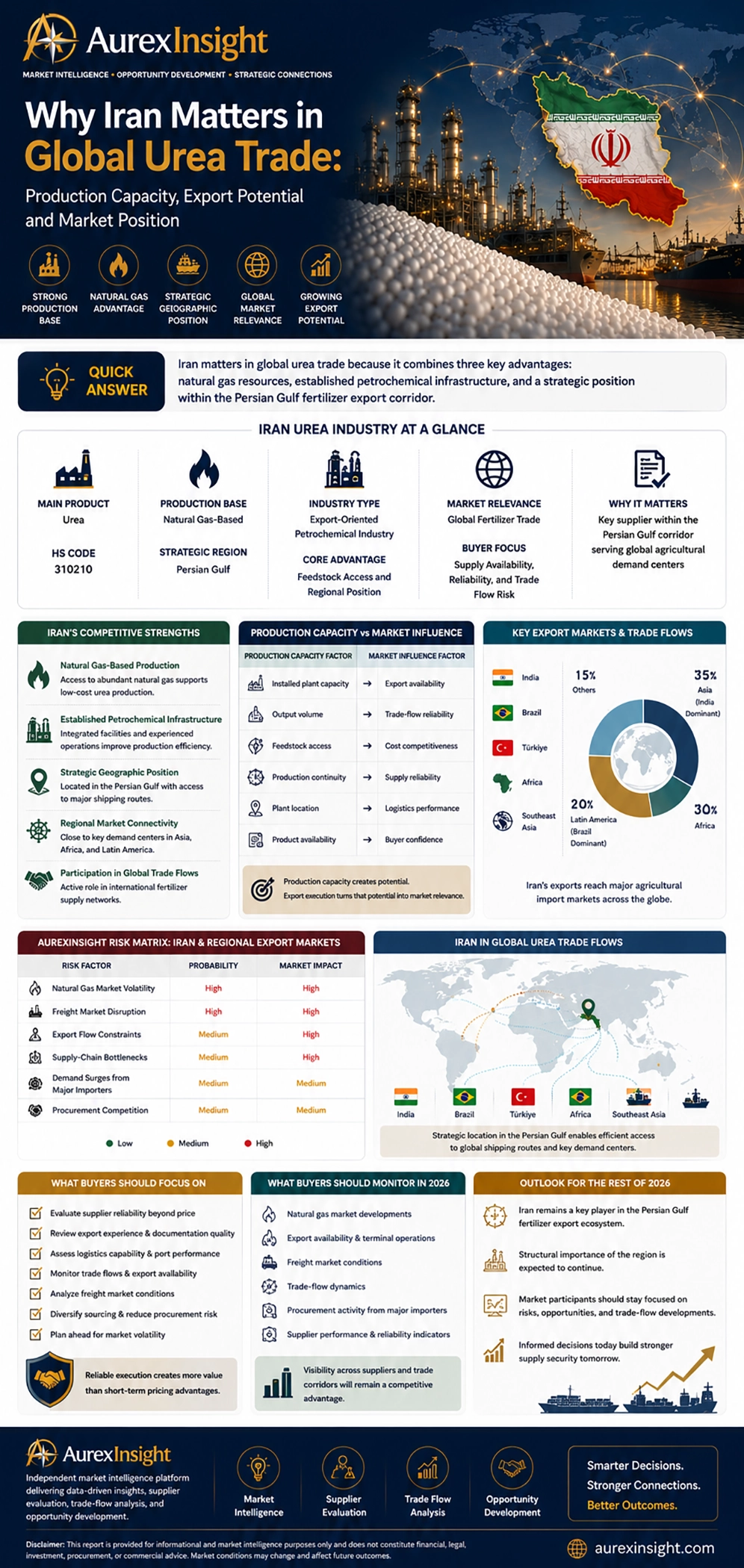
Figure 1. Iran's position in the global urea value chain, connecting natural gas resources, fertilizer production, export infrastructure, and major international demand centers.
Why Iran Became a Major Urea Producer
Iran's position in the urea market is not accidental.
Large-scale urea production requires several structural advantages, including access to feedstock, industrial infrastructure, technical capability, and export access.
Iran has developed its fertilizer and petrochemical sector around these conditions.
The production of urea begins with ammonia, and ammonia production depends heavily on natural gas. This makes access to gas resources one of the most important foundations of competitiveness in the nitrogen fertilizer industry.
Because of this structure, countries with strong natural gas availability often become important players in urea production.
Iran fits this pattern.
Its petrochemical industry has developed around natural gas-based production, allowing the country to participate in regional and international fertilizer trade.
Natural Gas Advantage
Natural gas is the foundation of urea production economics.
It serves two roles:
- It provides energy for industrial production.
- It acts as feedstock for ammonia production.
This dual role makes gas pricing and gas availability central to the cost structure of urea.
For Iran, access to natural gas supports the country's competitiveness in nitrogen fertilizer production.
This is especially important because urea is a cost-sensitive commodity. Buyers often compare offers from multiple regions, and feedstock economics can influence export pricing, supply availability, and producer competitiveness.
For a deeper explanation of the relationship between gas prices and urea markets, read:
👉 How Natural Gas Prices Affect Urea Markets
Understanding Iran's Production Capacity
Production capacity is one of the first indicators analysts examine when evaluating a country's role in global urea trade.
For a comparison with other major exporting countries, see:
👉 Top Urea Exporting Countries in 2026
However, production capacity should not be interpreted in isolation.
A country may have significant installed capacity, but its actual market influence depends on how much product can be produced, exported, shipped, documented, and delivered reliably.
For this reason, Iran's production capacity should be evaluated through several dimensions:
- Installed urea production capacity
- Operating rates
- Feedstock availability
- Plant reliability
- Export terminal access
- Logistics efficiency
- Ability to serve international buyers
In practical market intelligence, production capacity creates potential.
Export execution turns that potential into market relevance.
Production Capacity vs Market Influence
The difference between production capacity and market influence is important.
| Production Capacity Factor | Market Influence Factor |
|---|---|
| Installed plant capacity | Export availability |
| Output volume | Trade-flow reliability |
| Feedstock access | Cost competitiveness |
| Production continuity | Supply reliability |
| Plant location | Logistics performance |
| Product availability | Buyer confidence |
This distinction matters because fertilizer buyers do not purchase theoretical capacity.
They purchase delivered product.
For this reason, the real question is not only how much urea Iran can produce, but how effectively that production can reach international markets.
Why Production Capacity Still Matters
Although capacity is not the only factor, it still plays an important role.
High production capacity can support:
- Larger export volumes
- Greater regional influence
- More flexible supply response
- Stronger participation in international tenders
- Improved economies of scale
When major importing countries enter the market, exporters with meaningful capacity become more important.
This is especially true in fertilizer markets, where large buyers may influence short-term supply-demand balance through procurement activity.
Iran's production base therefore contributes to its visibility in global urea trade.
Iran's Position Among Global Urea Exporters
Iran is often discussed alongside other important urea-exporting countries, especially those located in the Persian Gulf and surrounding regions.
Major global urea exporters include:
- China
- Qatar
- Saudi Arabia
- Iran
- Egypt
- Russia
- Oman
These countries do not compete on exactly the same basis.
Some compete through production scale. Others benefit from natural gas economics, strategic geography, logistics infrastructure, or access to major demand markets.
Iran's position is shaped mainly by its natural gas-based production base and location within the Persian Gulf export corridor.
For a broader comparison of major exporting countries, see:
👉 Top Urea Exporting Countries in 2026
Export Potential and International Trade Position
Production capacity alone does not determine export success.
In global fertilizer markets, export performance depends on the ability to consistently move product from production facilities to international buyers through efficient logistics, documentation processes, and trade networks.
For this reason, export potential should be evaluated through a broader lens than production volume alone.
What Creates Export Potential?
Several factors influence the export potential of a urea-producing country:
- Production capacity
- Feedstock availability
- Export infrastructure
- Port access
- Freight connectivity
- Documentation capability
- Supplier reliability
- Access to major importing markets
Countries that combine these factors are often better positioned to participate in global fertilizer trade.
From a buyer's perspective, evaluating export potential often goes hand in hand with assessing supplier reliability and commercial execution capability.
👉 How to Evaluate Urea Suppliers in International Markets
The Strategic Importance of the Persian Gulf Corridor
Iran's role in global urea trade is closely linked to the broader Persian Gulf fertilizer ecosystem.
The Gulf region remains one of the world's most important fertilizer export corridors because it combines:
- Large-scale fertilizer production
- Natural gas availability
- Integrated petrochemical infrastructure
- Access to international shipping routes
- Proximity to major agricultural import markets
This regional ecosystem supplies significant volumes of fertilizer to:
- India
- Brazil
- Türkiye
- Africa
- Southeast Asia
For this reason, fertilizer buyers often evaluate the Persian Gulf as a regional supply hub rather than focusing on individual countries alone.
For a broader overview of how the Gulf corridor influences international fertilizer markets, see:
👉 Global Urea Market Outlook 2026
For a buyer-side comparison of how Iran differs from Qatar, Saudi Arabia, and Oman in actual procurement conditions, see:
👉 Middle East Urea Suppliers in 2026
Key Export Markets and Trade Flows
Global urea trade is driven by the movement of product from producing regions toward agricultural demand centers.
Major importing markets include:
| Import Market | Strategic Importance |
|---|---|
| India | One of the world's largest fertilizer importers |
| Brazil | Large agricultural demand base |
| Türkiye | Regional fertilizer consumer |
| Africa | Growing fertilizer demand |
| Southeast Asia | Expanding agricultural markets |
The ability to access these markets efficiently influences the competitiveness of exporting countries.
This is why trade-flow analysis has become an increasingly important part of fertilizer market intelligence.
Why Trade Flows Matter More Than Production Statistics
Many fertilizer market discussions focus on production volumes.
However, global trade is often shaped by the movement of product rather than production itself.
A country may maintain stable production while export flows become disrupted by:
- Port congestion
- Shipping delays
- Freight market volatility
- Documentation issues
- Infrastructure constraints
- Supply-chain bottlenecks
In such situations, buyers may experience supply uncertainty despite stable production.
This is one reason why trade-flow analysis has become a core component of procurement strategy.
To understand how global fertilizer trade corridors operate and which countries dominate exports, read:
👉 Top Urea Exporting Countries in 2026
Why Buyers Monitor Iran and the Persian Gulf
International fertilizer buyers do not monitor producing countries only because of production volumes.
They monitor them because changes in major producing regions can affect:
- Product availability
- Procurement planning
- Freight conditions
- Supplier selection
- Market sentiment
- Price expectations
Since the Persian Gulf remains one of the most important fertilizer export regions globally, developments affecting the region often attract attention from buyers and market analysts.
To understand how regional developments influence fertilizer supply chains and global procurement strategies, read:
👉 Global Urea Market Outlook 2026
Supplier Reliability Matters More Than Ever
In today's fertilizer market, supply reliability is increasingly important.
Many buyers have learned that the lowest price is not always the lowest-risk procurement option.
Supplier evaluation increasingly includes:
- Export experience
- Documentation quality
- Product consistency
- Logistics capability
- Communication responsiveness
- Ability to perform during volatile market conditions
As a result, procurement decisions increasingly combine price analysis with supplier validation.
For a detailed framework on assessing fertilizer suppliers, read:
👉 How to Evaluate Urea Suppliers in International Markets
Iran's Strategic Advantages in Global Urea Trade
| Strategic Factor | Why It Matters |
|---|---|
| Natural Gas Resources | Supports competitive urea production economics |
| Petrochemical Infrastructure | Enables large-scale fertilizer manufacturing |
| Persian Gulf Location | Provides access to major international shipping routes |
| Export Experience | Supports participation in global fertilizer trade |
| Regional Connectivity | Facilitates access to major importing markets |
Iran's Competitive Strengths in Global Urea Trade
Several structural factors support Iran's position within international fertilizer markets.
Natural Gas-Based Production
Access to natural gas supports production economics and helps maintain competitiveness within the nitrogen fertilizer industry.
Established Petrochemical Infrastructure
Existing industrial infrastructure supports fertilizer production and export activity.
Strategic Geographic Position
Location within the Persian Gulf provides access to major maritime trade routes.
Regional Market Connectivity
The Gulf corridor serves several of the world's largest fertilizer-importing regions.
Participation in Global Trade Flows
Iran remains part of broader international fertilizer supply networks connecting producers and buyers.
These advantages help explain why Iran continues to attract attention within global fertilizer market analysis.
Challenges That Buyers Should Understand
Every exporting region faces risks and challenges.
International buyers should evaluate:
- Supply-chain risk
- Freight market conditions
- Export logistics
- Supplier reliability
- Documentation quality
- Procurement timing
- Market volatility
The objective is not simply identifying a producing country.
The objective is identifying reliable supply under changing market conditions.
This distinction becomes especially important during periods of market uncertainty.
AurexInsight Risk Matrix: Iran and Regional Export Markets
| Risk Factor | Probability | Market Impact |
|---|---|---|
| Natural Gas Market Volatility | High | High |
| Freight Market Disruption | High | High |
| Export Flow Constraints | Medium | High |
| Supply-Chain Bottlenecks | Medium | High |
| Demand Surges from Major Importers | Medium | Medium |
| Procurement Competition | Medium | Medium |
These risks rarely occur independently.
In many cases, multiple variables combine to influence fertilizer availability, procurement conditions, and pricing.
Understanding these interactions is one of the key benefits of market intelligence.
What This Means for Buyers and Importers
For fertilizer buyers, understanding production capacity is only part of the equation.
Successful procurement decisions increasingly depend on understanding:
- Supplier reliability
- Export infrastructure
- Trade-flow dynamics
- Freight conditions
- Supply-chain risks
- Market competitiveness
In volatile markets, procurement teams that combine market intelligence with supplier assessment are often better positioned to reduce sourcing risk.
Several practical actions can improve procurement resilience:
- Monitor natural gas markets alongside fertilizer prices.
- Track major export corridors and trade flows.
- Evaluate supplier reliability beyond quoted prices.
- Review export history and logistics capability.
- Diversify sourcing strategies where possible.
- Maintain contingency procurement plans.
The cheapest supplier is not always the lowest-risk option.
In many cases, reliable execution creates more value than short-term pricing advantages.
AurexInsight Opportunity View
Periods of uncertainty often create opportunities for market participants that can provide visibility, reliability, and execution capability.
Producers
Producers with stable operations and reliable export performance may benefit from increasing buyer demand for supply security.
Traders
Market volatility increases demand for sourcing expertise, supplier intelligence, and trade-flow analysis.
Logistics Providers
As supply chains become more complex, companies capable of supporting dependable delivery may gain strategic importance.
Market Development Firms
Organizations that help buyers identify, assess, and connect with reliable suppliers can play a growing role in international trade.
New Market Entrants
Periods of disruption often create opportunities for alternative suppliers to establish new commercial relationships.
The most valuable opportunities frequently emerge from reducing uncertainty rather than simply offering lower prices.
AurexInsight Executive Insight
The most important takeaway from Iran's position in global urea trade is that market relevance is determined by more than production volume alone.
In today's fertilizer markets, competitive positioning increasingly depends on the combination of:
- Production capability
- Feedstock availability
- Export infrastructure
- Supply reliability
- Trade connectivity
- Market visibility
Countries that combine these elements often play a larger role in international fertilizer trade than production statistics alone may suggest.
For buyers, understanding where product comes from is important.
Understanding how reliably it can be sourced may be even more important.
Organizations that combine:
- Market Intelligence
- Supplier Validation
- Trade-Flow Analysis
- Risk Assessment
into a single decision-making framework are likely to make stronger procurement decisions in increasingly complex fertilizer markets.
Outlook for the Remainder of 2026
Iran is expected to remain an important participant within the broader Persian Gulf fertilizer export ecosystem throughout 2026.
Market participants should continue monitoring:
- Natural gas market developments
- Export availability
- Freight conditions
- Trade-flow dynamics
- Procurement activity from major importing countries
- Supplier reliability indicators
While market conditions may evolve throughout the year, the structural importance of the Persian Gulf region in global fertilizer trade is expected to remain significant.
For buyers, maintaining visibility across both suppliers and trade corridors will remain a competitive advantage.
FAQ
Why is Iran important in global urea trade?
Iran is important because it is part of the Persian Gulf fertilizer export corridor, one of the world's most significant fertilizer-producing and exporting regions.
Does Iran benefit from natural gas availability?
Natural gas supports fertilizer production economics and contributes to the competitiveness of nitrogen fertilizer production.
For a deeper understanding of this relationship, see:
👉🏻 How Natural Gas Prices Affect Urea Markets
How should buyers evaluate suppliers operating in exporting countries?
Buyers should assess supplier reliability, export experience, documentation capability, logistics performance, and communication quality in addition to pricing.
👉🏻 How to Evaluate Urea Suppliers in International Markets
Why do trade flows matter in fertilizer markets?
Trade flows determine how efficiently product moves from producing regions to importing markets. Disruptions can affect availability, freight costs, and procurement risk.
👉🏻 Top Urea Exporting Countries in 2026
What factors influence fertilizer export competitiveness?
Key factors include natural gas availability, production economics, export infrastructure, logistics capability, access to shipping routes, and supplier reliability.
What should fertilizer buyers monitor in 2026?
Buyers should monitor natural gas markets, export availability, freight conditions, trade-flow developments, supplier performance, and procurement activity in major importing countries.
Is Iran one of the world's largest urea exporters?
Iran is widely recognized as one of the important urea-producing and exporting countries within the Persian Gulf fertilizer corridor. Its market relevance comes from a combination of production capacity, natural gas-based feedstock economics, export infrastructure, and regional trade connectivity.
Sources Used in This Analysis
- International Fertilizer Association (IFA)
- UN Comtrade Database
- International Trade Centre (ITC) Trade Map
- Food and Agriculture Organization (FAO)
- World Bank Commodity Markets
- U.S. Energy Information Administration (EIA)
- International Energy Agency (IEA)
- Reuters Commodities Coverage
Internal Reading Recommendations
Related AurexInsight research:
About AurexInsight
AurexInsight is an independent Market Intelligence platform focused on international trade, supplier evaluation, market research, trade-flow analysis, and opportunity development.
Our research helps buyers, producers, traders, and decision-makers make more informed commercial decisions through data-driven analysis, supplier intelligence, and market insights.
Disclaimer
This report is provided for informational and market intelligence purposes only.
It should not be considered investment, legal, financial, procurement, or commercial advice. Market conditions may change rapidly and affect future outcomes.
Written and reviewed by
AurexInsight Research
AurexInsight publishes market intelligence, supplier validation insights, trade-flow analysis and opportunity-focused research for international business decision-makers.
View profile and research standardsRelated Research
Continue exploring this market theme
These related insights help build a clearer view of the market context, supply-chain risks and commercial opportunities connected to this analysis.
Top Urea Exporters in 2026: Trade Leaders, Supply Risks and What Buyers Should Watch
An analysis of the world’s leading urea exporting countries, global trade flows, supply-chain risks, and what fertilizer buyers should monitor in 2026.
Read insightMarket OutlookMiddle East Urea Suppliers in 2026: How International Buyers Should Compare Iran, Qatar, Saudi Arabia and Oman
A buyer-focused comparison of Middle East urea suppliers in 2026, examining how Iran, Qatar, Saudi Arabia, and Oman differ in reliability, logistics, compliance complexity, and destination-market fit.
Read insightMarket OutlookGlobal Urea Market Outlook 2026: Prices, Supply Risks and Trade Flows
A market intelligence outlook on rising urea prices, global fertilizer trade flows, supply-chain risks, and Iran's position within the Persian Gulf fertilizer corridor.
Read insight