

How to Evaluate Urea Suppliers in International Markets: A Buyer's Guide for 2026
A practical framework for evaluating urea suppliers in international markets, reducing procurement risk, and improving sourcing decisions in 2026.
Last updated: June 19, 2026
Editorial standard
Reviewed by AurexInsight Research
Last updated: June 19, 2026
AUREXINSIGHT RESEARCH
How to Evaluate Urea Suppliers in International Markets: A Buyer's Guide for 2026
A practical framework for evaluating urea suppliers in international markets, reducing procurement risk, and improving sourcing decisions in 2026.
Executive summary
Evaluating a urea supplier requires much more than comparing prices.
Reliable procurement decisions should consider supplier track record, export experience, documentation capability, logistics performance, production reliability, and overall supply-chain risk.
In volatile fertilizer markets, supplier validation is often just as important as price competitiveness.
Research method and limitations
This summary is based on the full AurexInsight report, trade and industry data, and reputable public sources. Market data may be delayed, incomplete, or methodologically inconsistent; independent due diligence is essential before commercial decisions.
Written and reviewed by: AurexInsight Research
Full report and sources: https://aurexinsight.com/en/insights/how-to-evaluate-urea-suppliers-in-international-markets
Research method
This analysis triangulates reputable public sources, trade and industry data, institutional reports, and consistency checks. Material source conflicts, limitations, and uncertainty are stated explicitly.
Data limitations
Trade and market data may be delayed, incomplete, or methodologically inconsistent. This report does not replace independent legal, financial, procurement, or commercial due diligence.
Quick Answer
Evaluating a urea supplier requires much more than comparing prices.
Reliable procurement decisions should consider supplier track record, export experience, documentation capability, logistics performance, production reliability, and overall supply-chain risk.
In volatile fertilizer markets, supplier validation is often just as important as price competitiveness.
Why Supplier Evaluation Matters
Many fertilizer buyers focus primarily on obtaining the lowest possible price.
However, international procurement decisions involve far more variables than pricing alone.
A supplier offering the lowest quotation may still expose buyers to risks related to shipment delays, inconsistent quality, documentation issues, limited export experience, or unreliable delivery performance.
As fertilizer markets become increasingly interconnected and supply chains more complex, supplier evaluation has become a critical component of procurement strategy.
For importers, traders, distributors, and procurement teams, selecting the right supplier can directly influence supply continuity, commercial performance, and operational risk.
Executive Summary
Global fertilizer markets in 2026 continue to face uncertainty driven by changing trade flows, freight volatility, natural gas market fluctuations, and evolving procurement patterns.
As a result, buyers are placing greater emphasis on supplier reliability and supply security.
While production capacity remains important, procurement success increasingly depends on identifying suppliers capable of delivering consistently under changing market conditions.
A structured supplier evaluation framework helps buyers:
- Reduce procurement risk.
- Improve supply reliability.
- Strengthen sourcing strategies.
- Avoid costly disruptions.
- Improve visibility across the supply chain.
- Make more informed commercial decisions.
This report outlines the key criteria buyers should consider when evaluating urea suppliers in international markets.
Key Takeaways
- Price alone should never be the primary supplier selection criterion.
- Export experience is a strong indicator of supplier capability.
- Logistics performance can be as important as production capacity.
- Documentation quality affects transaction efficiency.
- Supply-chain visibility improves procurement resilience.
- Supplier validation helps reduce commercial risk.
- Reliable suppliers often outperform low-cost suppliers during volatile markets.
Executive Snapshot
| Evaluation Area | Why It Matters |
|---|---|
| Export Experience | Indicates operational capability |
| Supply Reliability | Reduces procurement risk |
| Documentation Quality | Supports smooth transactions |
| Logistics Capability | Improves delivery performance |
| Production Capacity | Supports continuity of supply |
| Market Reputation | Provides confidence for buyers |
| Risk Management | Improves procurement resilience |
Why Supplier Validation Is Becoming More Important
In previous years, many procurement decisions focused heavily on price and product specifications.
Today, market conditions are different.
Supply-chain disruptions, freight uncertainty, export restrictions, and changing trade patterns have increased the importance of supplier reliability.
Buyers increasingly recognize that the true cost of procurement includes more than the invoice value of the product.
Additional costs may arise from:
- Shipment delays.
- Documentation errors.
- Contract execution failures.
- Quality inconsistencies.
- Supply interruptions.
- Logistics inefficiencies.
For this reason, supplier validation has become an essential component of international fertilizer sourcing.
For a broader understanding of global urea market conditions, see:
👉🏻 Global Urea Market Outlook 2026
For a deeper analysis of major exporting countries, see:
👉🏻 Top Urea Exporting Countries in 2026
For buyers sourcing from the Persian Gulf, understanding the strengths and limitations of individual exporting countries is equally important.
👉🏻 Why Iran Matters in Global Urea Trade
The Urea Supplier Evaluation Framework
A structured supplier evaluation framework helps buyers move beyond price comparisons and assess the true reliability of potential suppliers.
While individual procurement priorities may differ, most successful sourcing strategies evaluate suppliers across several core dimensions.
The following framework can be applied by importers, distributors, traders, procurement teams, and agricultural organizations evaluating international urea suppliers.
Visual Framework: How to Evaluate a Urea Supplier
The infographic below summarizes the seven core evaluation criteria discussed throughout this report.
Rather than focusing solely on price, buyers should assess suppliers across operational, commercial, logistical, and risk-management dimensions.
The strongest suppliers are typically those that demonstrate consistent performance across multiple evaluation categories rather than excelling in only one area.
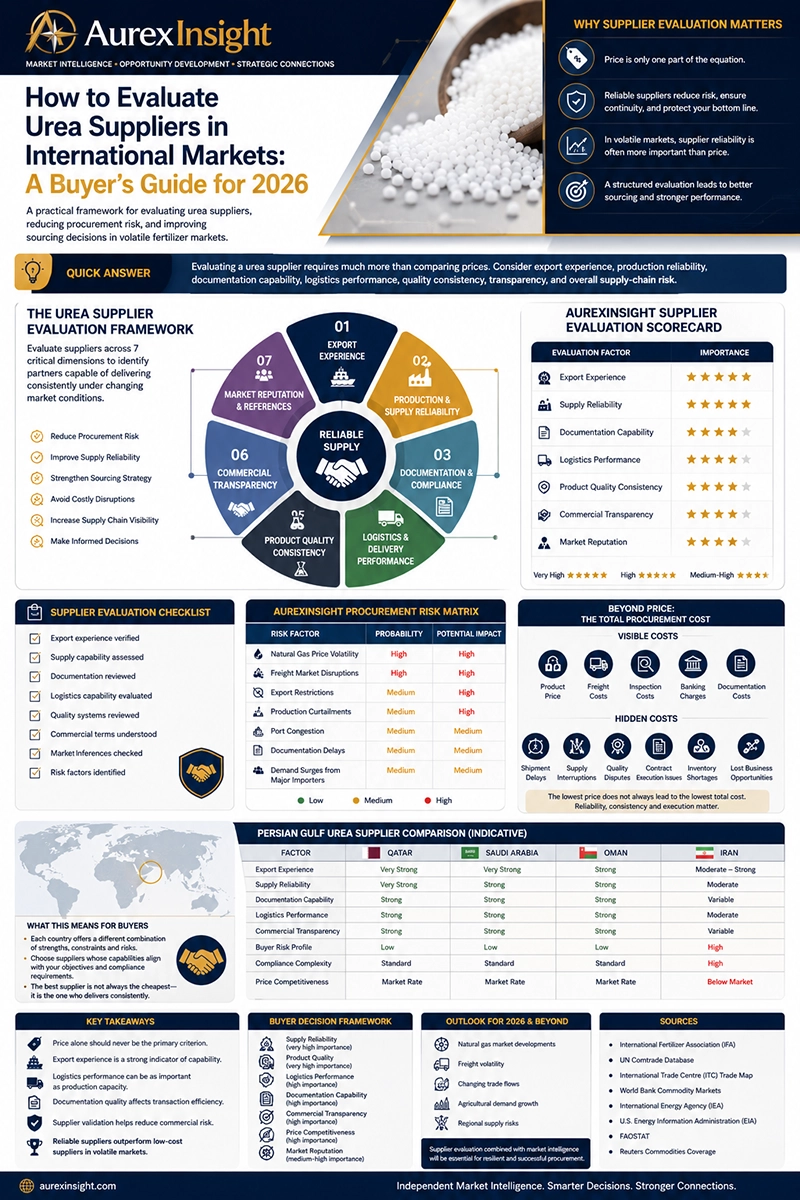
Figure 1. A practical framework for evaluating international urea suppliers based on export experience, production capability, documentation standards, logistics performance, quality consistency, commercial transparency, and market reputation.
1. Export Experience
Export experience is often one of the strongest indicators of supplier capability.
A supplier that regularly serves international markets is more likely to understand documentation requirements, logistics coordination, shipment procedures, quality expectations, and buyer communication standards.
Buyers should assess:
- Number of years in export markets
- Export destination diversity
- Experience with target markets
- Historical export performance
- Understanding of international trade procedures
Key Buyer Questions
- How long has the supplier been exporting urea?
- Which countries have they supplied?
- Do they have experience serving similar markets?
- Can they demonstrate previous export activity?
Suppliers with established export experience often present lower operational risk than new market entrants.
2. Production Capability and Supply Continuity
Production capacity alone does not guarantee supply reliability.
Buyers should evaluate whether the supplier can consistently fulfill commitments under changing market conditions.
Important considerations include:
- Production capacity
- Supply continuity
- Plant operating stability
- Access to feedstock
- Maintenance practices
- Ability to manage large-volume orders
Why This Matters
During periods of market volatility, suppliers with stable production capabilities are generally better positioned to fulfill contractual obligations.
This is particularly important when procurement involves long-term supply arrangements.
For a deeper understanding of how feedstock availability affects production economics, see:
👉🏻 How Natural Gas Prices Affect Urea Markets
3. Documentation and Compliance Capability
Documentation quality can significantly influence procurement efficiency.
Even when product quality and pricing are competitive, poor documentation management may create delays, additional costs, and contractual complications.
Buyers should evaluate:
- Export documentation procedures
- Certificate availability
- Inspection coordination
- Contract administration capability
- Regulatory compliance knowledge
Common Documentation Requirements
- Certificate of Origin
- Commercial Invoice
- Packing List
- Bill of Lading
- Certificate of Analysis
- Inspection Certificates
- Quality Certifications
Reliable documentation management reduces transaction risk and improves operational efficiency.
4. Logistics and Delivery Performance
International fertilizer trade depends heavily on logistics execution.
A supplier may offer competitive pricing, but poor logistics performance can undermine procurement outcomes.
Evaluation areas include:
- Port access
- Freight coordination capability
- Shipment scheduling
- Delivery performance history
- Logistics network strength
- Ability to operate during market disruptions
Logistics Risk Indicators
Potential warning signs include:
- Frequent shipment delays
- Limited logistics coordination capability
- Lack of freight market understanding
- Inconsistent delivery timelines
- Weak communication during shipment execution
For buyers, delivery reliability often becomes more important than small price differences.
5. Product Quality Consistency
Quality consistency is a fundamental component of supplier evaluation.
Buyers should assess whether product specifications remain stable across shipments and over time.
Key considerations include:
- Quality-control systems
- Laboratory capability
- Product consistency
- Inspection procedures
- Third-party verification availability
Buyer Validation Checklist
- Are product specifications clearly documented?
- Are inspection procedures available?
- Can the supplier provide historical quality records?
- Is third-party inspection supported?
Consistency is often more valuable than occasional performance peaks.
6. Commercial Transparency
Transparent suppliers generally create fewer procurement surprises.
Transparency helps buyers better understand risk exposure and make informed decisions.
Areas to evaluate include:
- Pricing clarity
- Contract transparency
- Communication responsiveness
- Disclosure of limitations
- Commercial professionalism
Positive Indicators
- Clear responses to buyer questions
- Realistic delivery commitments
- Transparent commercial terms
- Consistent communication
Warning Signs
- Unrealistic promises
- Vague shipment timelines
- Incomplete commercial information
- Delayed responses to critical questions
7. Market Reputation and References
Market reputation can provide valuable insight into supplier performance.
While reputation alone should not determine procurement decisions, it often serves as an important validation tool.
Buyers may consider:
- Customer references
- Industry reputation
- Market presence
- Trade participation
- Historical performance records
Key Validation Questions
- Are credible references available?
- Is the supplier known within the industry?
- Do previous buyers report positive experiences?
- Has the supplier demonstrated consistency over time?
Strong market reputation often reflects consistent execution capability.
AurexInsight Supplier Evaluation Scorecard
The following framework can be used as a practical assessment tool.
| Evaluation Factor | Importance |
|---|---|
| Export Experience | Very High |
| Supply Reliability | Very High |
| Documentation Capability | High |
| Logistics Performance | High |
| Product Quality Consistency | High |
| Commercial Transparency | High |
| Market Reputation | Medium-High |
This scorecard helps procurement teams evaluate suppliers using a structured approach rather than relying solely on pricing.
Common Red Flags Buyers Should Watch For
Certain warning signs frequently appear before procurement problems emerge.
Commercial Red Flags
- Unrealistically low pricing
- Pressure for immediate commitment
- Inconsistent commercial information
- Lack of transparency
Operational Red Flags
- Limited export history
- Weak documentation capability
- Poor communication
- Unclear shipment procedures
Supply Risk Red Flags
- Unstable product availability
- Inability to explain sourcing structure
- Frequent delivery delays
- Limited logistics visibility
Identifying these warning signs early can significantly reduce procurement risk.
Supplier Evaluation Checklist
Before selecting a urea supplier, buyers should confirm:
- Export experience verified
- Supply capability assessed
- Documentation reviewed
- Logistics capability evaluated
- Quality systems reviewed
- Commercial terms understood
- Market references checked
- Risk factors identified
This simple checklist can improve procurement decision quality and reduce operational uncertainty.
AurexInsight Procurement Risk Matrix
Even highly capable suppliers operate within broader market conditions that can influence procurement outcomes.
For this reason, buyers should evaluate not only supplier-specific risks but also external market risks that may affect supply continuity.
| Risk Factor | Probability | Potential Impact |
|---|---|---|
| Natural Gas Price Volatility | High | High |
| Freight Market Disruptions | High | High |
| Export Restrictions | Medium | High |
| Production Curtailments | Medium | High |
| Port Congestion | Medium | Medium |
| Documentation Delays | Medium | Medium |
| Demand Surges from Major Importers | Medium | Medium |
Understanding how these risks interact helps buyers build more resilient sourcing strategies.
For example, a supplier may be highly reliable under normal conditions. However, a combination of freight disruptions and export restrictions could still affect delivery performance.
This is why supplier evaluation should always be combined with broader market intelligence.
Beyond Price: The Total Procurement Cost Approach
One of the most common procurement mistakes is focusing exclusively on the quoted price.
In reality, the total cost of procurement often includes several additional factors.
Visible Costs
- Product price
- Freight costs
- Inspection costs
- Banking charges
- Documentation costs
Hidden Costs
- Shipment delays
- Supply interruptions
- Quality disputes
- Contract execution issues
- Inventory shortages
- Lost business opportunities
A supplier with a slightly higher price but stronger execution capability may ultimately provide lower total procurement cost than a cheaper but less reliable alternative.
The Buyer Decision Framework
When evaluating multiple urea suppliers, buyers should avoid making decisions based on a single criterion.
A balanced evaluation framework typically considers:
| Decision Area | Relative Importance |
|---|---|
| Supply Reliability | Very High |
| Product Quality | Very High |
| Logistics Performance | High |
| Documentation Capability | High |
| Commercial Transparency | High |
| Price Competitiveness | High |
| Market Reputation | Medium-High |
The most effective procurement decisions typically balance commercial competitiveness with operational reliability.
Why Market Intelligence Matters in Supplier Selection
Supplier evaluation does not occur in isolation.
Market conditions can rapidly change the attractiveness of a sourcing option.
Buyers should continuously monitor:
- Natural gas markets
- Global fertilizer demand
- Freight conditions
- Export availability
- Major procurement tenders
- Regional supply risks
For example, a supplier that appears highly competitive today may become less attractive if regional freight costs increase or export restrictions emerge.
For a broader understanding of global market conditions, see:
👉🏻 Global Urea Market Outlook 2026
To understand how feedstock economics influence supplier competitiveness, see:
👉🏻 How Natural Gas Prices Affect Urea Markets
To explore the major exporting regions shaping global supply, see:
👉🏻 Top Urea Exporting Countries in 2026
AurexInsight Insight
The strongest suppliers are not necessarily the cheapest suppliers.
They are the suppliers capable of delivering consistently under changing market conditions.
In today's fertilizer market, procurement success increasingly depends on visibility rather than price alone.
Organizations that combine:
- Market Intelligence
- Supplier Validation
- Trade Flow Analysis
- Risk Assessment
are generally better positioned to reduce procurement risk and improve sourcing outcomes.
The objective is not simply to identify a supplier.
The objective is to identify a supplier capable of supporting long-term commercial success.
What This Means for Buyers and Importers
For fertilizer buyers in 2026, supplier evaluation should become a strategic process rather than a transactional activity.
Practical recommendations include:
- Develop a formal supplier validation process.
- Evaluate suppliers using multiple criteria.
- Verify export experience before committing.
- Review logistics capabilities carefully.
- Monitor supplier performance continuously.
- Diversify sourcing where appropriate.
- Combine procurement decisions with market intelligence.
In increasingly volatile markets, supply reliability can become a competitive advantage.
Outlook for 2026 and Beyond
Global fertilizer markets are expected to remain influenced by:
- Natural gas market developments
- Freight volatility
- Regional supply risks
- Changing trade flows
- Agricultural demand growth
- Procurement activity from major importing countries
As market complexity increases, supplier evaluation is likely to become even more important.
Buyers that invest in supplier validation and procurement intelligence today may be better positioned to manage future uncertainty.
Case Study: Applying the Supplier Evaluation Framework in the Persian Gulf
The Persian Gulf is one of the world's most important urea export regions.
Qatar, Saudi Arabia, Oman, and Iran collectively represent a significant share of global fertilizer export capacity, supported by access to competitive natural gas feedstock and established export infrastructure.
For buyers sourcing from this region, the evaluation framework above applies directly — but each major exporting country presents a distinct combination of strengths, constraints, and procurement risks.
Understanding these differences helps buyers make more informed sourcing decisions rather than treating the Persian Gulf as a single, undifferentiated supply source.
Qatar
Qatar is among the most established urea exporters globally, operating through Qafco — one of the world's largest single-site fertilizer producers.
| Evaluation Factor | Assessment |
|---|---|
| Export Experience | Very Strong |
| Supply Reliability | Very Strong |
| Documentation Capability | Strong |
| Logistics Performance | Strong |
| Commercial Transparency | Strong |
| Buyer Risk Profile | Low |
Qatar's primary strength is consistency. Long-term supply agreements, established export infrastructure, and strong documentation capability generally make Qatari suppliers a lower-risk option for buyers across many regulated markets.
One practical limitation may be spot-market availability, as a significant portion of production is often committed through long-term offtake arrangements.
Saudi Arabia
Saudi Arabia exports urea primarily through SABIC and Ma'aden, both operating large-scale integrated petrochemical facilities.
| Evaluation Factor | Assessment |
|---|---|
| Export Experience | Very Strong |
| Supply Reliability | Strong |
| Documentation Capability | Strong |
| Logistics Performance | Strong |
| Commercial Transparency | Strong |
| Buyer Risk Profile | Low |
Saudi suppliers generally benefit from competitive production economics, well-developed logistics infrastructure, and broad access to international markets.
As with Qatar, a substantial share of production may be allocated through long-term commercial arrangements, which can influence spot-market availability.
Oman
Oman's urea export activity is primarily conducted through OCI's operations, serving markets across Asia and Africa.
| Evaluation Factor | Assessment |
|---|---|
| Export Experience | Strong |
| Supply Reliability | Strong |
| Documentation Capability | Strong |
| Logistics Performance | Strong |
| Commercial Transparency | Strong |
| Buyer Risk Profile | Low |
Oman is generally viewed as a reliable regional supplier, combining established export operations with strategic port access.
Its geographic position provides efficient shipping routes to South Asia and East Africa, which can support competitive logistics performance for buyers serving these markets.
Iran
Iran holds significant urea production capacity, supported by access to competitive natural gas feedstock. However, procurement from Iranian suppliers operates within a structurally different environment compared to other Persian Gulf exporters.
| Evaluation Factor | Assessment |
|---|---|
| Export Experience | Moderate to Strong |
| Supply Reliability | Moderate |
| Documentation Capability | Variable |
| Logistics Performance | Moderate |
| Commercial Transparency | Variable |
| Buyer Risk Profile | High — requires compliance review |
Iran's primary advantage is production cost competitiveness, which may contribute to pricing that is often below regional benchmarks.
However, buyers should carefully assess sanctions compliance requirements, trade-finance arrangements, documentation capability, and logistical considerations before engaging with Iranian-origin supply.
Iranian urea commonly reaches end markets through intermediary trading structures, which may introduce additional commercial and counterparty risks that require enhanced due diligence.
For a deeper analysis of Iran's production capacity, natural gas advantage, export potential, and strategic position within the Persian Gulf fertilizer corridor, see:
👉🏻 Why Iran Matters in Global Urea Trade
Indicative Comparison of Major Persian Gulf Urea Exporters
The table below is intended as a high-level market-intelligence reference rather than a definitive ranking. Actual supplier performance may vary significantly depending on the specific producer, trading company, contract structure, and prevailing market conditions.
For a dedicated country-by-country buyer comparison of the main Middle East origins behind that table, see:
👉🏻 Middle East Urea Suppliers in 2026
| Factor | Qatar | Saudi Arabia | Oman | Iran |
|---|---|---|---|---|
| Export Experience | Very Strong | Very Strong | Strong | Moderate–Strong |
| Supply Reliability | Very Strong | Strong | Strong | Moderate |
| Documentation | Strong | Strong | Strong | Variable |
| Logistics | Strong | Strong | Strong | Moderate |
| Buyer Risk | Low | Low | Low | High |
| Compliance Complexity | Standard | Standard | Standard | High |
| Price Competitiveness | Market Rate | Market Rate | Market Rate | Below Market |
What This Means for Buyers Sourcing from the Persian Gulf
Persian Gulf producers benefit from some of the world's most competitive natural-gas-based production economics and remain an important component of global urea supply.
However, the region should not be viewed as a single, homogeneous sourcing market.
Each exporting country presents a different combination of production economics, logistics performance, documentation capability, market accessibility, and procurement risk.
For buyers, the most effective sourcing strategy is not necessarily selecting the lowest-priced supplier, but identifying suppliers whose capabilities align with procurement objectives, operational requirements, and applicable regulatory frameworks.
A buyer operating in South Asia or East Africa may have access to a wider range of sourcing options than a buyer subject to stricter compliance requirements.
Regardless of supplier origin, export experience, supply reliability, documentation capability, logistics performance, quality consistency, and commercial transparency remain among the most important evaluation criteria in international fertilizer procurement.
FAQ
What is the most important factor when evaluating a urea supplier?
Supply reliability is often the most important factor because procurement success depends on consistent product availability and delivery performance.
Is price the most important supplier selection criterion?
No. While pricing remains important, buyers should also evaluate logistics capability, documentation quality, export experience, and overall reliability.
Why is supplier validation important?
Supplier validation helps reduce procurement risk by identifying operational, commercial, and logistical weaknesses before contracts are signed.
How can buyers verify supplier credibility?
Buyers can review export history, customer references, quality certifications, documentation capability, and market reputation.
Why does export experience matter?
Export experience often indicates a supplier's ability to manage international documentation, logistics coordination, shipment execution, and buyer requirements.
How does market intelligence improve procurement decisions?
Market intelligence helps buyers understand changing market conditions, supply risks, trade flows, and supplier competitiveness before making sourcing decisions.
Which Persian Gulf country offers the most reliable urea supply?
Qatar and Saudi Arabia are generally considered lower-risk sourcing options due to their established export infrastructure, documentation capability, and unrestricted market access. Oman is also a reliable option with strong logistics positioning for South Asian and East African buyers.
Why does Iranian urea require additional due diligence?
Iranian urea procurement involves sanctions compliance complexity, non-standard trade finance arrangements, and variable documentation capability. Buyers should seek appropriate legal and compliance guidance before engaging.
Sources Used in This Analysis
This report draws upon data, trade statistics, and market information from the following sources:
- International Fertilizer Association (IFA)
- UN Comtrade Database
- International Trade Centre (ITC) Trade Map
- World Bank Commodity Markets
- International Energy Agency (IEA)
- U.S. Energy Information Administration (EIA)
- FAOSTAT
- Reuters Commodities Coverage
Internal Reading Recommendations
For a broader understanding of global urea markets, explore:
- Global Urea Market Outlook 2026
- Top Urea Exporting Countries in 2026
- How Natural Gas Prices Affect Urea Markets
- Middle East Urea Suppliers in 2026
- Why Iran Matters in Global Urea Trade
About AurexInsight
AurexInsight is an independent market intelligence platform focused on international trade, supplier evaluation, market research, and opportunity development.
Our research helps buyers, producers, traders, and market participants make more informed commercial decisions through data-driven analysis, trade intelligence, and market insights.
Disclaimer
This report is provided for informational and market intelligence purposes only.
It should not be considered investment, legal, financial, or procurement advice. Market conditions may change rapidly and affect future outcomes.
Written and reviewed by
AurexInsight Research
AurexInsight publishes market intelligence, supplier validation insights, trade-flow analysis and opportunity-focused research for international business decision-makers.
View profile and research standardsRelated Research
Continue exploring this market theme
These related insights help build a clearer view of the market context, supply-chain risks and commercial opportunities connected to this analysis.
Middle East Urea Suppliers in 2026: How International Buyers Should Compare Iran, Qatar, Saudi Arabia and Oman
A buyer-focused comparison of Middle East urea suppliers in 2026, examining how Iran, Qatar, Saudi Arabia, and Oman differ in reliability, logistics, compliance complexity, and destination-market fit.
Read insightMarket OutlookTop Urea Exporters in 2026: Trade Leaders, Supply Risks and What Buyers Should Watch
An analysis of the world’s leading urea exporting countries, global trade flows, supply-chain risks, and what fertilizer buyers should monitor in 2026.
Read insightMarket OutlookIran Urea Production and Exports in 2026: Capacity, Trade Routes and Buyer Risks
Explore why Iran remains an important player in global urea trade, examining production capacity, export potential, natural gas advantages, and its strategic position within the Persian Gulf fertilizer corridor.
Read insight