

Natural Gas and Urea Prices: Production Costs, Trade and Buyer Risks
An analysis of how natural gas prices influence urea production costs, global fertilizer trade, supplier competitiveness, and procurement decisions.
Last updated: June 16, 2026
Editorial standard
Reviewed by AurexInsight Research
Last updated: June 16, 2026
AUREXINSIGHT RESEARCH
Natural Gas and Urea Prices: Production Costs, Trade and Buyer Risks
An analysis of how natural gas prices influence urea production costs, global fertilizer trade, supplier competitiveness, and procurement decisions.
Executive summary
Natural gas is the single most important cost driver in urea production.
Because natural gas serves both as an energy source and as a feedstock for ammonia production, changes in gas prices can significantly affect production costs, export competitiveness, fertilizer pricing, and global trade flows.
For buyers, understanding natural gas markets is often one of the earliest indicators of future movements in urea prices.
Research method and limitations
This summary is based on the full AurexInsight report, trade and industry data, and reputable public sources. Market data may be delayed, incomplete, or methodologically inconsistent; independent due diligence is essential before commercial decisions.
Written and reviewed by: AurexInsight Research
Full report and sources: https://aurexinsight.com/en/insights/how-natural-gas-prices-affect-urea-markets
Research method
This analysis triangulates reputable public sources, trade and industry data, institutional reports, and consistency checks. Material source conflicts, limitations, and uncertainty are stated explicitly.
Data limitations
Trade and market data may be delayed, incomplete, or methodologically inconsistent. This report does not replace independent legal, financial, procurement, or commercial due diligence.
Quick Answer
Natural gas is the single most important cost driver in urea production.
Because natural gas serves both as an energy source and as a feedstock for ammonia production, changes in gas prices can significantly affect production costs, export competitiveness, fertilizer pricing, and global trade flows.
For buyers, understanding natural gas markets is often one of the earliest indicators of future movements in urea prices.
Why Does Natural Gas Affect Urea Prices?
Natural gas affects urea prices because it serves both as an energy source and as a feedstock for ammonia production. As gas prices increase, production costs often rise, which can influence fertilizer pricing, export competitiveness, and global trade flows.
Executive Summary
Natural gas sits at the center of the global nitrogen fertilizer industry.
While many market participants focus on fertilizer prices themselves, the economics of urea production are heavily influenced by developments in energy markets. Changes in natural gas prices can affect production costs, plant operating rates, export competitiveness, and ultimately the availability of product in international markets.
This relationship has become increasingly important in recent years as fertilizer markets have experienced periods of volatility driven by energy market disruptions, freight uncertainty, and changing global trade patterns.
For buyers, importers, traders, and procurement teams, monitoring natural gas markets provides valuable insight into potential future movements in fertilizer pricing and supply conditions.
This report examines how natural gas affects urea production economics, why some exporting regions maintain a competitive advantage, and what these dynamics mean for market participants.
For a wider view of global supply risks, trade flows, and buyer priorities in 2026, see:
👉🏻 Global Urea Market Outlook 2026
Key Takeaways
- Natural gas is the most important production cost component in urea manufacturing.
- Changes in gas prices can directly influence fertilizer production economics.
- Competitive fertilizer exporters often benefit from access to lower-cost natural gas.
- Gas market disruptions can affect both production costs and product availability.
- Understanding energy markets helps buyers anticipate future pricing trends.
- Natural gas remains one of the foundations of global fertilizer competitiveness.
Executive Summary Table
| Topic | Key Insight |
|---|---|
| Main Cost Driver | Natural Gas |
| Main Impact | Production Economics |
| Strategic Risk | Gas Supply Disruption |
| Competitive Advantage | Low-Cost Feedstock |
| Buyer Focus | Supply Reliability |
| Key Market Signal | Gas Price Trends |
Global Fertilizer Cost Structure Snapshot
Although fertilizer production costs vary across regions and facilities, several cost categories consistently influence production economics.
| Cost Driver | Relative Importance |
|---|---|
| Natural Gas | Very High |
| Logistics & Freight | High |
| Electricity & Energy | High |
| Maintenance & Operations | Medium |
| Labor | Medium |
| Packaging & Handling | Low |
Among these factors, natural gas typically has the greatest influence on production economics.
As a result, developments in gas markets are closely monitored by producers, traders, and buyers throughout the fertilizer value chain.
Why Natural Gas Matters for Urea Production
Natural gas is unique because it plays two different roles in urea manufacturing.
Energy Source
Natural gas provides a significant portion of the energy required to operate ammonia and urea production facilities.
Production plants require large amounts of energy to maintain industrial processes, making energy costs an important part of overall production economics.
Feedstock
More importantly, natural gas serves as a feedstock for ammonia production.
Ammonia is the primary building block used in manufacturing urea. Without ammonia production, urea production cannot occur.
This means that natural gas affects fertilizer economics in a way that differs from many other industrial commodities.
In many industries, energy is simply an operating expense.
In urea production, natural gas is both an operating cost and a fundamental raw material.
This dual role explains why changes in gas prices can have a substantial impact on fertilizer markets.
Why Buyers Should Monitor Natural Gas Markets
Many fertilizer buyers focus primarily on current urea prices.
However, market intelligence often requires looking one step earlier in the supply chain.
Natural gas prices can provide valuable insight into future market conditions before changes appear in fertilizer prices themselves.
For example:
- Rising gas prices may increase production costs.
- Production curtailments may reduce available supply.
- Export competitiveness may shift between regions.
- Procurement strategies may need adjustment.
For this reason, natural gas markets are increasingly monitored alongside fertilizer market indicators by procurement teams and market analysts.
That buyer lens becomes especially important when comparing Middle East origins that share gas-based production advantages but differ in execution risk, compliance burden, and route fit:
👉🏻 Middle East Urea Suppliers in 2026
Example Procurement Scenario
A fertilizer importer comparing suppliers from different regions may observe significant price differences.
In many cases, those differences are partially explained by variations in natural gas costs, logistics conditions, and export competitiveness.
Understanding these underlying drivers helps buyers evaluate offers beyond headline pricing alone.
The Link Between Natural Gas and Urea Prices
The relationship between natural gas and urea prices is one of the most important dynamics in the global fertilizer market.
Although price movements are not always immediate, natural gas remains the primary cost driver behind urea production economics. As a result, developments in energy markets can influence fertilizer pricing, export competitiveness, supply availability, and global trade flows.
For market participants seeking to understand why urea prices rise or fall, monitoring natural gas markets is often an essential starting point.
Natural Gas and Urea Price Relationship
| Natural Gas Market Scenario | Likely Impact on Urea Market |
|---|---|
| Gas prices rise sharply | Urea production costs tend to increase |
| Gas prices fall | Cost pressure on producers may decline |
| Gas supply becomes uncertain | Production risk may increase |
| Affordable gas in export regions | Export competitiveness may improve |
| Regional gas-price divergence | Competitive advantage may shift between suppliers |
While fertilizer markets are influenced by multiple variables, natural gas often represents the most important upstream indicator.
This is why many analysts view natural gas as one of the strongest leading indicators for future fertilizer market conditions.
From Natural Gas to Urea: Understanding the Value Chain
Understanding the relationship between natural gas and urea prices does not require technical expertise in fertilizer manufacturing.
However, understanding the basic value chain helps explain why energy markets matter.
Natural gas is used to produce ammonia, and ammonia serves as the primary building block for urea production.
This creates a direct connection between energy markets and fertilizer markets.
| Stage | Role in the Value Chain | Market Relevance |
|---|---|---|
| Natural Gas | Feedstock and energy source | Determines cost base |
| Ammonia | Intermediate product | Connects gas markets to fertilizer production |
| Urea | Final nitrogen fertilizer product | Traded globally and used in agriculture |
Because of this structure, significant changes in natural gas pricing can influence production economics throughout the nitrogen fertilizer industry.
In some regions, rising gas prices may reduce profitability and lead to lower operating rates. In other regions with competitive gas access, producers may maintain stronger export positions.
For a broader analysis of overall fertilizer market conditions, see our report:
👉🏻 Global Urea Market Outlook 2026
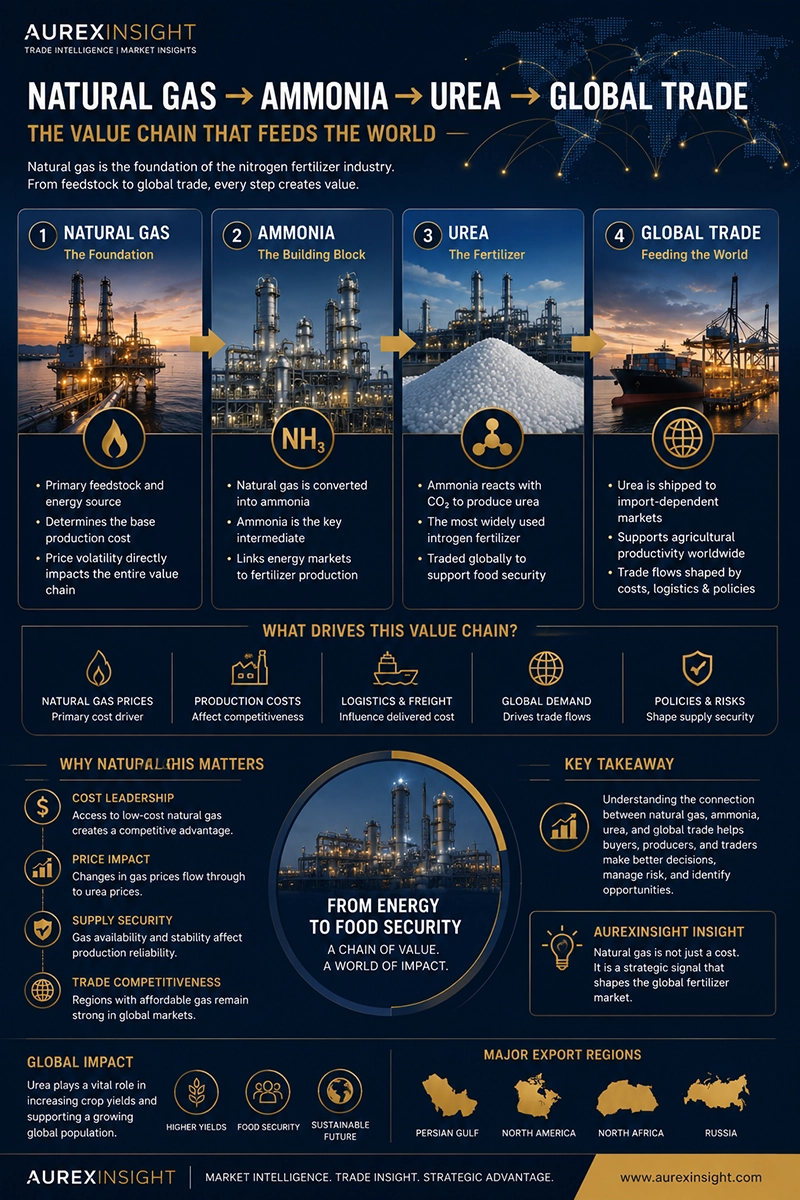
Figure 1. Natural Gas → Ammonia → Urea → Global Trade: A simplified view of how energy markets influence fertilizer production, export competitiveness, and international trade flows.
Regional Cost Differences and Export Competitiveness
One of the key reasons some countries remain highly competitive in global fertilizer trade is their access to natural gas.
Not all producers face the same feedstock costs.
Regions with abundant and competitively priced natural gas often benefit from lower production costs and stronger export competitiveness.
| Region | Competitive Position | Key Advantage | |---|---| | Persian Gulf | Strong | Low-cost gas and export infrastructure | | North America | Strong | Large gas reserves and developed markets | | Russia | Strong | Extensive gas resources | | North Africa | Moderate to Strong | Regional gas availability and proximity to Europe | | Europe | Challenging during high gas prices | Exposure to elevated energy costs | | East Asia | Mixed | Large production base with variable energy economics |
These regional differences are especially important when analyzing Persian Gulf producers, where natural gas availability plays a central role in fertilizer competitiveness.
For a country-specific view of how natural gas, petrochemical infrastructure, and Persian Gulf positioning support Iran's role in global urea trade, see:
👉🏻 Why Iran Matters in Global Urea Trade
However, cost advantage alone does not guarantee market success.
Export performance also depends on:
- Logistics infrastructure
- Port access
- Freight availability
- Trade policies
- Supplier reliability
- Access to major demand centers
This is why natural gas analysis should be combined with trade-flow analysis.
For a deeper look at the export side of the market, read:
👉🏻 Top Urea Exporting Countries in 2026
Why Some Exporters Remain Competitive During Volatile Markets
The most competitive exporters often combine several advantages simultaneously:
- Access to competitively priced natural gas
- Reliable export infrastructure
- Efficient logistics networks
- Strong supplier track records
- Access to major importing markets
This combination becomes particularly important during periods of market volatility.
A producer may have attractive production economics, but if logistics constraints, export restrictions, or supply-chain disruptions affect deliveries, buyers may still face significant procurement risk.
For this reason, international buyers increasingly evaluate both production competitiveness and supply reliability.
In practice, the most competitive suppliers are not always those with the lowest production costs.
They are often those that combine cost competitiveness with reliable execution.
To turn cost analysis into practical procurement decisions, buyers should also evaluate supplier reliability, documentation capability, logistics performance, and commercial transparency.
👉🏻 How to Evaluate Urea Suppliers in International Markets
Natural Gas as a Strategic Market Signal
For buyers, traders, and procurement teams, natural gas prices can act as an early warning system.
Changes in energy markets often appear before corresponding changes emerge in fertilizer pricing.
This makes natural gas one of the most valuable market intelligence indicators available to fertilizer buyers.
| Market Signal | Potential Buyer Interpretation |
|---|---|
| Rising gas prices | Potential cost pressure on producers |
| Gas supply disruption | Increased production risk |
| Regional gas-price divergence | Shifting export competitiveness |
| Stable gas access in export hubs | Stronger supply reliability |
| Elevated gas prices in importing regions | Greater dependence on imports |
Buyers who monitor these signals may identify emerging risks earlier than those who focus only on spot fertilizer prices.
To understand how these cost advantages are distributed across major exporting regions, see:
👉🏻 Top Urea Exporting Countries in 2026
AurexInsight Insight
Natural gas should not be viewed simply as a production input.
It is a strategic indicator that helps explain why some exporters remain competitive, why trade flows evolve, and why supply conditions can change before market prices fully reflect those developments.
From a trade intelligence perspective, understanding natural gas markets provides deeper insight into future sourcing conditions than monitoring fertilizer prices alone.
For market participants, the objective is not only to understand where prices are today.
The objective is to understand the underlying forces that may influence tomorrow's market conditions.
What This Means for Buyers and Importers
For fertilizer buyers, monitoring spot urea prices alone is no longer sufficient.
Many procurement risks emerge before they appear in market quotations. Rising natural gas costs, changing export competitiveness, freight volatility, and supply-chain disruptions can all influence fertilizer availability and delivered costs.
Importers and procurement teams should therefore evaluate both pricing and the underlying market conditions that influence supply reliability.
Practical actions include:
- Monitoring natural gas markets alongside fertilizer prices.
- Evaluating supplier reliability in addition to pricing.
- Diversifying sourcing strategies where possible.
- Tracking major procurement tenders from large importing countries.
- Following freight and shipping market developments.
- Maintaining contingency sourcing plans during periods of market uncertainty.
In volatile markets, procurement decisions based solely on price may expose buyers to greater supply risks than expected.
For a wider view of supply risks, trade flows, and the role of the Persian Gulf in global fertilizer markets, read:
👉🏻 Global Urea Market Outlook 2026
AurexInsight Risk Matrix
The relationship between natural gas and fertilizer markets creates several risks that buyers should actively monitor.
| Risk Factor | Probability | Market Impact |
|---|---|---|
| Natural Gas Price Surge | High | High |
| Regional Gas Supply Disruption | Medium | High |
| Export Restrictions | Medium | High |
| Freight Market Volatility | High | Medium |
| Production Curtailments | Medium | High |
| Demand Shock from Major Importers | Medium | Medium |
These risks rarely occur in isolation.
For example, a regional gas supply disruption may increase production costs, reduce operating rates, tighten export availability, and ultimately affect global fertilizer pricing.
Understanding these connections is one of the key advantages of trade intelligence.
AurexInsight Opportunity View
Periods of market uncertainty create both risks and opportunities.
Producers
Producers with stable access to natural gas and export infrastructure may strengthen their market position during periods of energy market volatility.
Traders
Market volatility often increases demand for sourcing expertise, supplier intelligence, and market research.
Logistics Providers
As fertilizer supply chains become more complex, reliable logistics providers may become increasingly valuable to buyers seeking supply continuity.
Market Development Firms
Organizations that help buyers identify, evaluate, and connect with reliable suppliers may benefit from growing demand for supply-chain visibility.
New Market Entrants
Market disruptions frequently reveal gaps in existing trade relationships and create opportunities for alternative suppliers to enter international markets.
The most significant opportunities often emerge from helping market participants navigate uncertainty more effectively.
AurexInsight Executive Insight
The most important takeaway from this analysis is that natural gas is not merely a production cost.
It is one of the foundations of global fertilizer competitiveness.
Many market participants focus on urea prices when evaluating future market conditions. However, price movements are often the result of developments occurring much earlier in the value chain.
Changes in natural gas markets can influence:
- Production economics
- Export competitiveness
- Supplier positioning
- Trade flows
- Supply availability
- Procurement risk
This distinction matters.
Organizations that understand upstream market drivers are often better positioned to anticipate changes before they become visible in fertilizer pricing.
From an AurexInsight perspective, competitive advantage increasingly belongs to organizations capable of combining:
- Market Intelligence
- Trade-Flow Analysis
- Supplier Validation
- Risk Assessment
into a single decision-making framework.
The objective is not simply to understand where prices are today.
The objective is to understand why they may change tomorrow.
Outlook for the Remainder of 2026
Natural gas is expected to remain one of the most influential variables in global fertilizer markets throughout the remainder of 2026.
Market participants should continue monitoring:
- Natural gas pricing trends
- Regional energy supply conditions
- Export availability
- Freight markets
- Procurement activity from major importing countries
- Global fertilizer demand
While short-term price movements may be difficult to predict, the structural relationship between natural gas and urea production is unlikely to change.
As a result, energy markets will continue to play a central role in shaping fertilizer competitiveness and global trade flows.
FAQ
Why does natural gas affect urea prices?
Natural gas serves both as an energy source and as a feedstock for ammonia production, making it the most important cost driver in urea manufacturing.
Is natural gas the largest cost component in urea production?
In many producing regions, natural gas represents the largest single production cost and has a significant influence on overall fertilizer economics.
Can urea prices rise even if natural gas prices remain stable?
Yes. Freight costs, export restrictions, supply-chain disruptions, procurement activity, and regional market conditions can also influence urea prices.
Which regions benefit most from low-cost natural gas?
The Persian Gulf, North America, Russia, and parts of North Africa often benefit from access to competitively priced natural gas resources.
Why do fertilizer buyers monitor energy markets?
Energy markets provide early signals regarding production costs, export competitiveness, and potential changes in fertilizer supply conditions.
How does natural gas influence global fertilizer trade?
Natural gas affects production economics, which in turn influences export competitiveness, trade flows, supplier positioning, and market pricing.
Sources Used in This Analysis
- International Fertilizer Association (IFA)
- International Energy Agency (IEA)
- U.S. Energy Information Administration (EIA)
- UN Comtrade Database
- International Trade Centre (ITC) Trade Map
- World Bank Commodity Markets Outlook
- FAOSTAT
- Reuters Commodities Coverage
Internal Reading Recommendations
- Global Urea Market Outlook 2026
- Top Urea Exporting Countries in 2026
- Middle East Urea Suppliers in 2026
- Why Iran Matters in Global Urea Trade
- How to Evaluate Urea Suppliers in International Markets
About AurexInsight
AurexInsight is an independent market intelligence platform focused on international trade, supplier evaluation, market research, and opportunity development.
Our research helps buyers, producers, traders, and market participants make more informed commercial decisions through data-driven analysis, trade intelligence, and market insights.
Disclaimer
This report is provided for informational and market intelligence purposes only.
It should not be considered investment, legal, financial, or procurement advice. Market conditions may change rapidly and affect future outcomes.
Written and reviewed by
AurexInsight Research
AurexInsight publishes market intelligence, supplier validation insights, trade-flow analysis and opportunity-focused research for international business decision-makers.
View profile and research standardsRelated Research
Continue exploring this market theme
These related insights help build a clearer view of the market context, supply-chain risks and commercial opportunities connected to this analysis.
Top Urea Exporters in 2026: Trade Leaders, Supply Risks and What Buyers Should Watch
An analysis of the world’s leading urea exporting countries, global trade flows, supply-chain risks, and what fertilizer buyers should monitor in 2026.
Read insightMarket OutlookGlobal Urea Market Outlook 2026: Prices, Supply Risks and Trade Flows
A market intelligence outlook on rising urea prices, global fertilizer trade flows, supply-chain risks, and Iran's position within the Persian Gulf fertilizer corridor.
Read insightMarket OutlookMiddle East Urea Suppliers in 2026: How International Buyers Should Compare Iran, Qatar, Saudi Arabia and Oman
A buyer-focused comparison of Middle East urea suppliers in 2026, examining how Iran, Qatar, Saudi Arabia, and Oman differ in reliability, logistics, compliance complexity, and destination-market fit.
Read insight