

Global Urea Market Outlook 2026: Prices, Supply Risks and Trade Flows
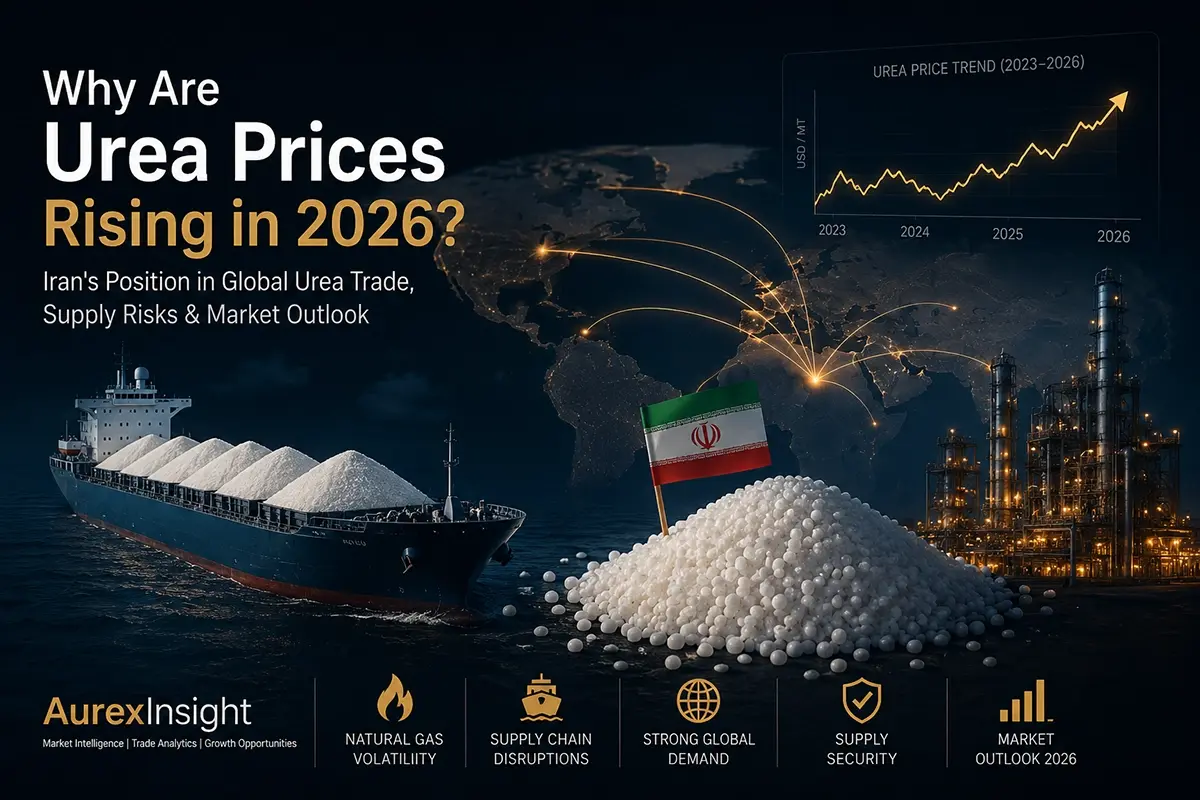
A market intelligence outlook on rising urea prices, global fertilizer trade flows, supply-chain risks, and Iran's position within the Persian Gulf fertilizer corridor.
Last updated: June 12, 2026
Editorial standard
Reviewed by AurexInsight Research
Last updated: June 12, 2026
AUREXINSIGHT RESEARCH
Global Urea Market Outlook 2026: Prices, Supply Risks and Trade Flows
A market intelligence outlook on rising urea prices, global fertilizer trade flows, supply-chain risks, and Iran's position within the Persian Gulf fertilizer corridor.
Executive summary
Urea prices are rising in 2026 due to a combination of natural gas market volatility, supply-chain disruptions, freight constraints, strong import demand, and increasing concerns regarding fertilizer availability. While production remains substantial across major producing regions, buyers are paying greater attention to supply reliability and trade-flow risks. As a significant producer within the Persian Gulf fertilizer corridor, Iran remains an important part of the broader global urea trade landscape.
Research method and limitations
This summary is based on the full AurexInsight report, trade and industry data, and reputable public sources. Market data may be delayed, incomplete, or methodologically inconsistent; independent due diligence is essential before commercial decisions.
Written and reviewed by: AurexInsight Research
Full report and sources: https://aurexinsight.com/en/insights/global-urea-market-outlook-2026
Research method
This analysis triangulates reputable public sources, trade and industry data, institutional reports, and consistency checks. Material source conflicts, limitations, and uncertainty are stated explicitly.
Data limitations
Trade and market data may be delayed, incomplete, or methodologically inconsistent. This report does not replace independent legal, financial, procurement, or commercial due diligence.
Quick Answer
Urea prices are rising in 2026 due to a combination of natural gas market volatility, supply-chain disruptions, freight constraints, strong import demand, and increasing concerns regarding fertilizer availability. While production remains substantial across major producing regions, buyers are paying greater attention to supply reliability and trade-flow risks. As a significant producer within the Persian Gulf fertilizer corridor, Iran remains an important part of the broader global urea trade landscape.
Executive Summary
The global urea market entered 2026 under increasing pressure from multiple directions. Energy market uncertainty, logistics challenges, growing import demand, and concerns over export availability have all contributed to a more volatile pricing environment.
Unlike many commodities, urea pricing is influenced not only by production capacity but also by the ability to move product efficiently through international trade networks. Fertilizer supply chains depend on natural gas, export infrastructure, shipping availability, and uninterrupted trade routes.
Recent developments have highlighted the importance of the Persian Gulf region in global fertilizer markets. The region remains one of the world's most important export hubs, serving major importing countries across Asia, Latin America, and Africa.
For importers, traders, and procurement teams, understanding trade flows may now be just as important as understanding production volumes.
This market outlook examines the key drivers behind rising urea prices, Iran's position within global urea trade, major market risks, and the implications for buyers and suppliers throughout 2026.
Key Takeaways
- Urea prices remain highly sensitive to natural gas markets.
- Supply-chain reliability is becoming more important than production volume alone.
- The Persian Gulf remains one of the world's most important fertilizer export hubs.
- India and Brazil continue to drive a significant share of global import demand.
- Trade-flow disruptions can rapidly influence global price formation.
- Buyers increasingly prioritize supply security alongside pricing.
- Market intelligence and supplier assessment are becoming critical procurement tools.
Executive Snapshot
| Key Question | Short Answer |
|---|---|
| Why are urea prices rising? | Supply risks, natural gas volatility, freight constraints, and strong import demand. |
| Why does Iran matter? | Iran is part of one of the world's important fertilizer-exporting regions. |
| Who is most affected? | Importers, agricultural producers, traders, and procurement teams. |
| What should buyers monitor? | Trade flows, natural gas prices, freight markets, and export availability. |
| Outlook for 2026 | Continued volatility with increasing focus on supply security. |
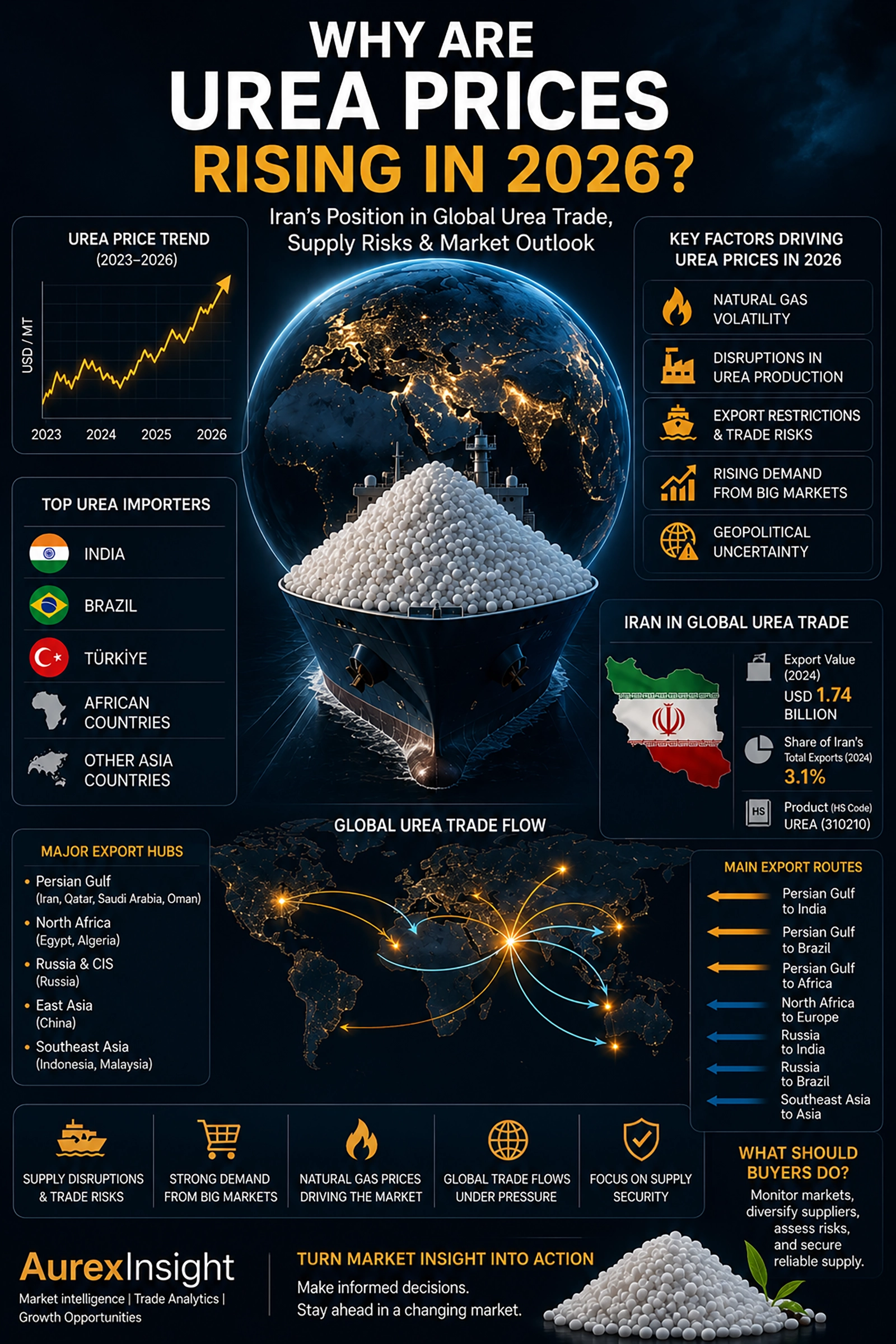
Global Urea Market Snapshot 2026
Urea remains the most widely used nitrogen fertilizer globally and plays a critical role in supporting agricultural productivity.
Several market forces currently influence pricing:
| Market Factor | Importance |
|---|---|
| Natural Gas Costs | Very High |
| Export Availability | Very High |
| Freight & Logistics | High |
| Agricultural Demand | High |
| Government Procurement Programs | Medium-High |
| Trade Restrictions | High |
One of the defining characteristics of the urea market is that production is concentrated in a relatively limited number of exporting regions, while demand is distributed across large agricultural economies worldwide.
This creates structural sensitivity to disruptions in trade flows.
Why Are Urea Prices Rising in 2026?
Natural Gas Market Volatility
Natural gas remains the primary feedstock used in urea production.
Any significant increase in natural gas prices directly affects production economics. Since energy costs represent a major component of urea manufacturing expenses, fertilizer markets tend to respond quickly to changes in gas markets.
In recent years, market participants have increasingly recognized the close relationship between energy markets and fertilizer pricing.
For this reason, natural gas remains one of the most important leading indicators for future urea price movements.
For a deeper analysis of the relationship between energy markets and fertilizer pricing, see:
👉🏻 How Natural Gas Prices Affect Urea Markets
Supply-Chain Disruptions
Global fertilizer markets depend heavily on logistics.
Shipping delays, freight rate increases, port congestion, vessel availability, and disruptions affecting major trade routes can all influence delivered fertilizer costs.
Even when production remains stable, logistical challenges may reduce effective supply availability and increase procurement uncertainty.
This is particularly important for countries that depend heavily on imported fertilizers.
Strong Import Demand
Several major agricultural economies continue to require significant fertilizer imports.
Large procurement tenders from major buyers can quickly tighten market conditions and increase competition for available export volumes.
When multiple importing countries enter the market simultaneously, suppliers often gain pricing power.
Market Uncertainty
Commodity markets frequently react to expectations rather than current conditions alone.
Concerns regarding future supply disruptions, shipping constraints, export restrictions, or energy market instability can support higher prices even before physical shortages occur.
As a result, market sentiment plays an increasingly important role in fertilizer pricing.
Major Drivers Behind Rising Urea Prices
| Driver | Impact on Market |
|---|---|
| Natural Gas Volatility | Very High |
| Supply Disruptions | Very High |
| Shipping Constraints | High |
| Import Demand from India | High |
| Import Demand from Brazil | High |
| Export Availability | High |
Global Urea Export Flow Map
Understanding trade flows is essential for understanding the fertilizer market.
Price movements are often driven not by production shortages but by disruptions affecting international supply routes.
Major Export Hubs
| Exporting Region | Key Exporters | Main Destination Markets |
|---|---|---|
| Persian Gulf | Iran, Qatar, Saudi Arabia, Oman | India, Brazil, Türkiye, Africa |
| North Africa | Egypt, Algeria | Europe, Türkiye, Brazil |
| Russia & CIS | Russia | India, Brazil, Europe |
| East Asia | China | Regional Asian Markets |
| Southeast Asia | Indonesia, Malaysia | Asia-Pacific Markets |
Simplified Trade Flow View
| Export Corridor | Typical Destination Markets |
|---|---|
| Persian Gulf | India, Brazil, Türkiye, Africa |
| North Africa | Europe, Türkiye, Brazil |
| Russia & CIS | India, Brazil, Europe |
| East Asia | Regional Asian markets |
| Southeast Asia | Asia-Pacific markets |
To better understand which countries dominate global urea exports and how international trade corridors are evolving, see:
👉🏻 Top Urea Exporting Countries in 2026
Why Trade Flows Matter More Than Ever
One of the most overlooked characteristics of the global fertilizer market is the concentration of export supply.
A relatively small number of producing regions account for a significant share of internationally traded urea.
This means that disruptions affecting shipping routes, export terminals, freight availability, or regional logistics can have a disproportionate impact on global prices.
Market participants who focus exclusively on production capacity often underestimate the importance of trade-flow risks.
Iran's Position in Global Urea Trade
Iran occupies an important position within the broader Persian Gulf fertilizer ecosystem.
The country's access to natural gas resources and established petrochemical infrastructure support its role within regional fertilizer production and export activity.
Rather than viewing Iran as an isolated market, it is more useful to consider its position within the wider Gulf export corridor that supplies major importing markets.
For a deeper country-specific analysis of Iran's production capacity, export potential, and strategic market position, see:
👉🏻 Why Iran Matters in Global Urea Trade
For a broader view of the major exporting countries shaping global urea trade, see:
👉🏻 Top Urea Exporting Countries in 2026
For a buyer-side comparison of the main Gulf sourcing options, see:
👉🏻 Middle East Urea Suppliers in 2026
Iran Market Profile
| Factor | Statement |
|---|---|
| Product Category | Urea, HS Code 310210 |
| Export Value 2024 | Approximately USD 1.74 billion |
| Share of Iran's Total Exports | Approximately 3.1% |
| Competitive Advantage | Natural gas-based production |
| Strategic Position | Significant exporter within the Gulf fertilizer corridor |
The strategic importance of Iran extends beyond domestic production volumes. Developments affecting the region can influence market expectations regarding fertilizer availability, logistics, and future trade flows.
Why Global Buyers Are Watching the Gulf Region
The Persian Gulf remains one of the most important fertilizer-exporting regions in the world.
Several factors explain this importance:
- Large concentration of fertilizer production.
- Strong integration with global energy markets.
- Access to major importing regions.
- Strategic maritime trade routes.
For importers, this creates both opportunities and risks.
A supply corridor may offer competitive availability, but it may also expose buyers to freight volatility, maritime risk, export timing uncertainty, and changing procurement conditions.
Why Supplier Reliability Matters in Volatile Fertilizer Markets
In volatile fertilizer markets, production capacity alone is not enough.
A supplier may have access to product, but that does not automatically mean the buyer faces low procurement risk. Reliability depends on a wider set of factors.
Buyers should evaluate:
- Export history.
- Documentation capability.
- Consistency of product availability.
- Access to logistics and freight coordination.
- Ability to respond during tight market conditions.
- Experience with international buyers.
- Transparency around timing, specifications, and delivery terms.
In practical procurement, the cheapest supplier is not always the lowest-risk option.
When prices are rising and availability is uncertain, supplier reliability becomes part of the real cost of procurement.
For buyers who want to move from market analysis to supplier-level decision-making, a structured supplier evaluation framework can help assess export experience, documentation capability, logistics performance, supply reliability, and commercial transparency.
👉🏻 How to Evaluate Urea Suppliers in International Markets
AurexInsight Risk Matrix 2026
| Risk Factor | Probability | Market Impact |
|---|---|---|
| Natural Gas Price Surge | High | High |
| Shipping Disruptions | High | High |
| Export Restrictions | Medium | High |
| Production Outages | Medium | High |
| Demand Surge from India | High | Medium |
| Demand Surge from Brazil | Medium | Medium |
What This Means for Buyers and Importers
For fertilizer buyers, focusing solely on spot prices may no longer be sufficient.
Procurement teams should consider:
- Diversifying sourcing strategies.
- Monitoring natural gas markets.
- Evaluating supplier reliability.
- Reviewing export track records.
- Following major procurement tenders.
- Monitoring freight markets.
- Maintaining contingency sourcing plans.
In volatile markets, the cheapest supplier may not always represent the lowest-risk option.
Supply reliability increasingly influences procurement decisions.
AurexInsight Opportunity View
Periods of uncertainty create both challenges and opportunities.
Producers
Reliable producers may benefit from increased demand for secure supply.
Traders
Market volatility increases demand for sourcing expertise and market intelligence.
Logistics Providers
Supply-chain complexity creates opportunities for firms capable of ensuring reliable delivery.
Market Development Firms
Organizations that help buyers identify, assess, and connect with suppliers may become increasingly valuable.
New Market Entrants
Periods of disruption often reveal gaps in existing trade relationships and create opportunities for alternative suppliers.
The most significant opportunities often emerge not from higher prices themselves, but from helping market participants navigate uncertainty more effectively.
AurexInsight Executive Insight
The most important takeaway from the global urea market in 2026 is that supply-chain concentration may matter more than production capacity alone.
A relatively small number of exporting regions account for a large share of global fertilizer trade. Consequently, disruptions affecting logistics, freight availability, shipping routes, or export infrastructure can influence prices even when global production remains relatively stable.
Organizations that combine market intelligence, supplier validation, trade-flow analysis, and risk assessment are likely to be better positioned to navigate future market volatility.
Future competitive advantage may belong less to those with the lowest prices and more to those with the best visibility into supply-chain risks and opportunities.
Outlook for the Remainder of 2026
The urea market is expected to remain sensitive to:
- Natural gas prices.
- Agricultural demand.
- Export availability.
- Freight costs.
- Regional supply risks.
- Government procurement activity.
Market participants should expect continued volatility and a growing emphasis on supply security.
For buyers, understanding trade flows and risk exposure will likely become as important as monitoring prices themselves.
FAQ
Why are urea prices rising in 2026?
Urea prices are rising in 2026 because of higher natural gas cost sensitivity, supply-chain disruptions, freight constraints, strong import demand, and concerns about future export availability.
How does natural gas affect urea prices?
Natural gas is the primary feedstock used in urea production. When natural gas prices rise, urea production costs increase, which can support higher fertilizer prices.
Why is the Persian Gulf important to the urea market?
The Persian Gulf is important because it hosts significant fertilizer production capacity and serves as a major export corridor for international fertilizer markets.
Which countries are major urea importers?
Large agricultural economies such as India and Brazil remain among the most important importers of urea and other nitrogen fertilizers.
What is the biggest risk facing the urea market?
One of the biggest risks facing the urea market is disruption to supply chains and export flows. Logistics, freight availability, export infrastructure, and regional supply risks can all affect price formation.
How do freight costs affect urea prices?
Freight costs affect delivered urea prices because fertilizer trade depends heavily on international shipping. When freight rates rise or vessel availability tightens, the landed cost of fertilizer can increase even if production costs remain stable.
What should fertilizer buyers monitor in 2026?
Fertilizer buyers should monitor natural gas prices, export availability, freight markets, procurement tenders, supplier reliability, and trade-flow disruptions.
Is Iran important in global urea trade?
Iran is important because it is part of the Persian Gulf fertilizer corridor and has natural gas-based petrochemical production capacity. Its role should be understood within the wider regional export ecosystem.
For a deeper analysis of Iran's role in production capacity, export potential, and Persian Gulf trade flows, read:
👉🏻 Why Iran Matters in Global Urea Trade
Sources Used in This Analysis
- International Fertilizer Association
- International Food Policy Research Institute
- World Bank Commodity Markets
- UN Comtrade Database
- International Trade Centre Trade Map
- FAOSTAT
- Reuters Commodities Coverage
- U.S. Energy Information Administration
Internal Reading Recommendations
Related AurexInsight research:
- How Natural Gas Prices Affect Urea Markets
- Top Urea Exporting Countries in 2026
- Middle East Urea Suppliers in 2026
- Why Iran Matters in Global Urea Trade
- How to Evaluate Urea Suppliers in International Markets
Disclaimer
This report is provided for informational and market intelligence purposes only. It should not be considered investment, legal, financial, or procurement advice. Market conditions may change rapidly and affect future outcomes.
Watch the Brief Video
Written and reviewed by
AurexInsight Research
AurexInsight publishes market intelligence, supplier validation insights, trade-flow analysis and opportunity-focused research for international business decision-makers.
View profile and research standardsRelated Research
Continue exploring this market theme
These related insights help build a clearer view of the market context, supply-chain risks and commercial opportunities connected to this analysis.
Top Urea Exporters in 2026: Trade Leaders, Supply Risks and What Buyers Should Watch
An analysis of the world’s leading urea exporting countries, global trade flows, supply-chain risks, and what fertilizer buyers should monitor in 2026.
Read insightMarket OutlookIran Urea Production and Exports in 2026: Capacity, Trade Routes and Buyer Risks
Explore why Iran remains an important player in global urea trade, examining production capacity, export potential, natural gas advantages, and its strategic position within the Persian Gulf fertilizer corridor.
Read insightMarket OutlookNatural Gas and Urea Prices: Production Costs, Trade and Buyer Risks
An analysis of how natural gas prices influence urea production costs, global fertilizer trade, supplier competitiveness, and procurement decisions.
Read insight