

Middle East Urea Suppliers in 2026: How International Buyers Should Compare Iran, Qatar, Saudi Arabia and Oman
A buyer-focused comparison of Middle East urea suppliers in 2026, examining how Iran, Qatar, Saudi Arabia, and Oman differ in reliability, logistics, compliance complexity, and destination-market fit.
Last updated: July 15, 2026

Editorial standard
Reviewed by AurexInsight Research
Last updated: July 15, 2026
AUREXINSIGHT RESEARCH
Middle East Urea Suppliers in 2026: How International Buyers Should Compare Iran, Qatar, Saudi Arabia and Oman
A buyer-focused comparison of Middle East urea suppliers in 2026, examining how Iran, Qatar, Saudi Arabia, and Oman differ in reliability, logistics, compliance complexity, and destination-market fit.
Executive summary
For most international buyers in 2026, Qatar, Saudi Arabia, and Oman generally offer the lowest-friction sourcing routes within the Middle East urea corridor, while Iran may remain commercially relevant where buyers can lawfully manage compliance, payment, documentation, and logistics complexity.
That does not make one country universally “best.” The right origin depends on the buyer’s destination market, risk tolerance, trade-finance constraints, lead-time requirements, and whether the procurement objective is lowest landed risk or lowest quoted price.
Research method and limitations
This summary is based on the full AurexInsight report, trade and industry data, and reputable public sources. Market data may be delayed, incomplete, or methodologically inconsistent; independent due diligence is essential before commercial decisions.
Written and reviewed by: AurexInsight Research
Full report and sources: https://aurexinsight.com/en/insights/middle-east-urea-suppliers-2026
Research method
This analysis triangulates reputable public sources, trade and industry data, institutional reports, and consistency checks. Material source conflicts, limitations, and uncertainty are stated explicitly.
Data limitations
Trade and market data may be delayed, incomplete, or methodologically inconsistent. This report does not replace independent legal, financial, procurement, or commercial due diligence.
Quick Answer
For most international buyers in 2026, Qatar, Saudi Arabia, and Oman generally offer the lowest-friction sourcing routes within the Middle East urea corridor, while Iran may remain commercially relevant where buyers can lawfully manage compliance, payment, documentation, and logistics complexity.
That does not make one country universally “best.” The right origin depends on the buyer’s destination market, risk tolerance, trade-finance constraints, lead-time requirements, and whether the procurement objective is lowest landed risk or lowest quoted price.
Executive Summary
The Middle East remains one of the most important urea export corridors in the world because it combines gas-based production economics with access to key maritime routes serving India, Brazil, East Africa, Türkiye, and other import-dependent markets.
However, buyers should not treat the region as a single, interchangeable supply pool.
Qatar, Saudi Arabia, Oman, and Iran participate in the same broad fertilizer corridor, but they differ in several buyer-critical ways:
- export structure
- documentation consistency
- sanctions and compliance exposure
- logistics predictability
- trade-finance accessibility
- destination-market suitability
That means supplier selection should move beyond country reputation and headline pricing.
In practice, buyers are comparing two questions at once:
- Which origin looks commercially attractive on paper?
- Which origin can actually deliver compliant, financeable, and reliable supply to the intended end market?
This report answers that second question.
It complements AurexInsight’s existing urea cluster by focusing specifically on buyer-side supplier comparison inside the Middle East, rather than global export rankings alone.
For broader market context, see:
- Global Urea Market Outlook 2026
- Top Urea Exporting Countries in 2026
- How to Evaluate Urea Suppliers in International Markets
Key Takeaways
- The Middle East remains one of the most strategically important urea supply regions because of gas-based production and strong maritime positioning.
- Qatar and Saudi Arabia generally present the strongest combination of scale, export structure, and lower transaction friction.
- Oman often stands out for practical destination fit, especially where buyers prioritize stable logistics and straightforward commercial execution.
- Iran may still be price-competitive, but the buyer-risk profile is materially different because compliance, trade-finance, and documentation constraints can outweigh price advantages.
- Buyers should compare origins on landed-risk-adjusted value, not FOB price alone.
- For importers serving India, Brazil, East Africa, and nearby regional markets, route efficiency and execution quality can matter as much as production economics.
- Public capacity and export figures are not always harmonized across official company disclosures and trade databases, so relative buyer-facing comparison is more defensible than a single headline ranking.
Middle East Urea Supplier Snapshot
| Country | Buyer View in 2026 | Main Strength | Main Constraint |
|---|---|---|---|
| Qatar | Low-friction core exporter | Export focus and established global trade position | Buyers still face freight and tender-timing volatility |
| Saudi Arabia | Scaled integrated supplier base | Industrial integration and strong commercial systems | Pricing may not always be the cheapest regional option |
| Oman | Efficient practical sourcing option | Logistics simplicity and export orientation | Smaller scale than the biggest Gulf suppliers |
| Iran | Situationally relevant but higher-risk origin | Cost competitiveness and regional position | Compliance, payment, and documentation complexity |
This snapshot is not a substitute for supplier-specific due diligence. It is a market-intelligence starting point for comparing country-level sourcing conditions.
Why This Comparison Matters for Buyers
Many importers already know that the Persian Gulf is an important fertilizer-export region.
What they often need next is a more practical answer:
If multiple Gulf-origin offers are available, how should they be compared?
That decision usually depends on five variables:
- feedstock and production economics
- export infrastructure and shipping execution
- documentation and compliance capability
- access to trade finance and counterparties
- fit with the buyer’s destination market and contract structure
The answer is rarely “choose the lowest offer.”
In fertilizer procurement, the gap between quoted price and delivered commercial outcome can become expensive very quickly.
Middle East Urea Supplier Comparison Infographic
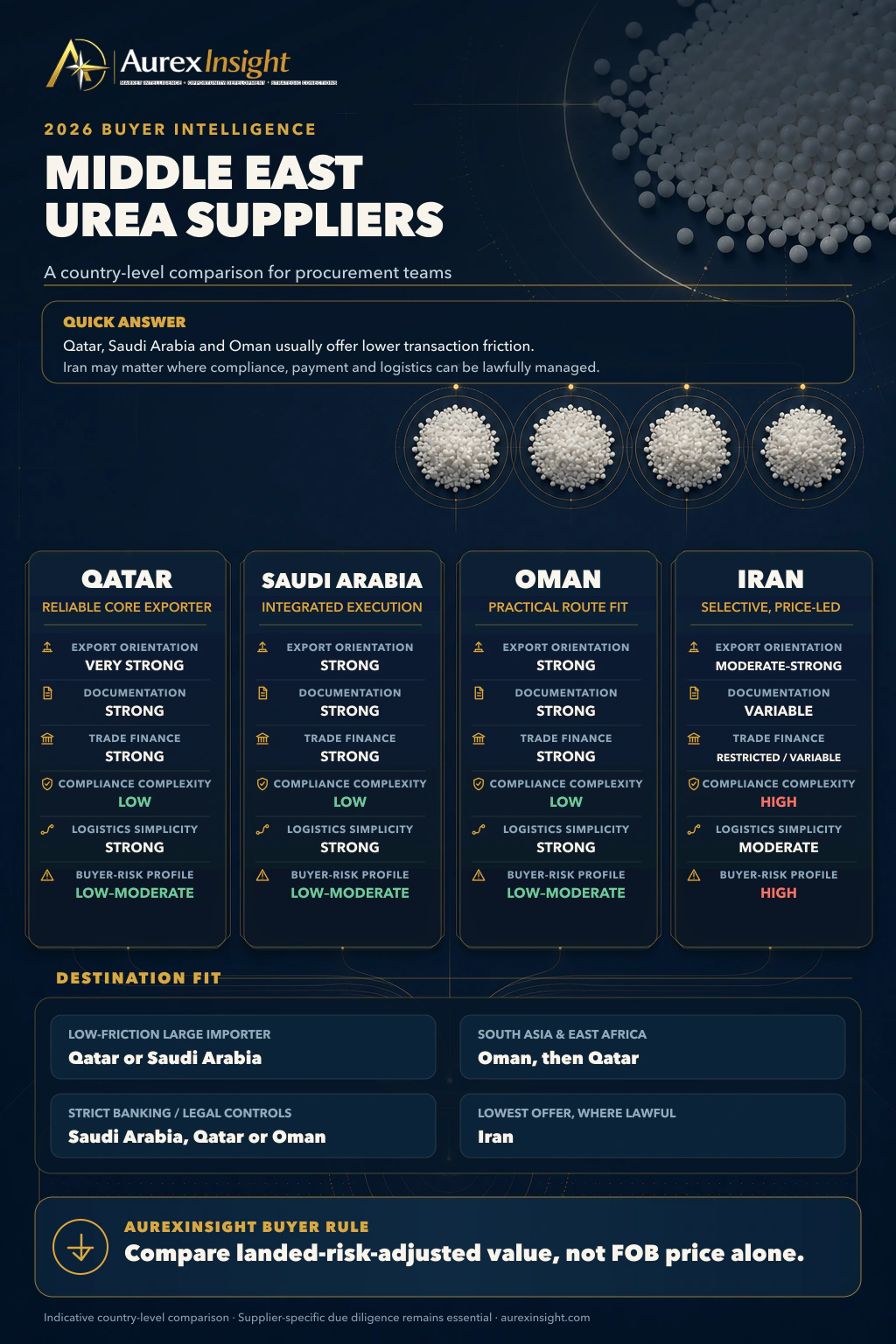
Figure 1. An indicative buyer-side comparison of Qatar, Saudi Arabia, Oman, and Iran across six procurement criteria and four destination-market scenarios.
Method note: This is a qualitative country-level framework, not a supplier rating or legal determination. Buyers must still perform counterparty-specific commercial, technical, sanctions, banking, insurance, and logistics due diligence.
The Right Comparison Framework
1. Production Economics Are Necessary, Not Sufficient
Middle East urea production benefits from access to natural gas-based feedstock economics, which is one reason the region remains so relevant to global buyers.
But strong production economics do not automatically produce the same procurement outcome for all origins.
A buyer still needs to ask:
- Is supply consistently exportable?
- Can shipments be financed and documented smoothly?
- Can the supplier perform reliably under real market conditions?
For the upstream cost driver behind regional competitiveness, see:
2. Export Execution Often Matters More Than Capacity Headlines
Buyers frequently overfocus on national production size and underfocus on execution quality.
In practice, procurement outcomes are shaped by:
- terminal access
- vessel scheduling
- contract administration
- inspection coordination
- document readiness
- counterparty responsiveness
This is why the best sourcing origin is not always the one associated with the largest headline output.
3. Compliance Friction Can Redefine “Competitive Price”
Some origins are easier to finance, insure, document, and clear through internal compliance systems than others.
That matters because a nominally cheaper offer can become more expensive once buyers include:
- compliance review time
- legal screening
- restricted banking options
- documentation exceptions
- counterparty replacement risk
For buyers operating under strict internal governance or Western financial controls, this factor can dominate the purchasing decision.
Country-by-Country Comparison
Qatar
Qatar remains one of the strongest Middle East urea origins for international buyers because the country combines export-oriented fertilizer production with a long-established role in seaborne nitrogen trade.
From a buyer perspective, Qatar’s advantages usually include:
- strong export orientation
- established participation in international fertilizer flows
- broad market familiarity among importers and traders
- relatively straightforward commercial execution compared with higher-friction origins
Where Qatar Fits Best
Qatar is often well suited to buyers that want:
- standard commercial structures
- easier internal approval
- strong tender participation credibility
- lower documentation uncertainty than more complex origins
What Buyers Should Still Watch
Qatar is not risk-free. Buyers should still monitor freight costs, allocation timing, tender competition from India and other large importers, and regional shipping disruption risk.
Saudi Arabia
Saudi Arabia benefits from large-scale industrial integration and a well-established commercial reputation in global fertilizer markets.
For buyers, Saudi-origin urea is often associated with:
- strong industrial systems
- established export capability
- comparatively dependable documentation and execution
- broad acceptability across banks, insurers, and compliance teams
Where Saudi Arabia Fits Best
Saudi-origin supply is often attractive for:
- buyers with strict compliance frameworks
- importers prioritizing repeatable contract execution
- procurement teams that value ease of financing and document processing
What Buyers Should Still Watch
Saudi Arabia is not always the cheapest option on an offer sheet. Buyers should assess whether a higher initial quote is offset by lower compliance friction, better transaction certainty, and lower execution risk.
Oman
Oman often receives less attention than Qatar or Saudi Arabia in broad fertilizer commentary, but from a buyer’s perspective it can be one of the most practical origins in the region.
Its importance comes from export orientation, maritime accessibility, and relative simplicity of commercial execution.
In many procurement situations, Oman compares favorably where buyers need:
- dependable export logistics
- efficient shipping to South Asia or East Africa
- lower execution friction than more complex origins
- a balance between reliability and competitive commercial positioning
Where Oman Fits Best
Oman can be especially relevant for:
- buyers serving India or nearby Asian demand centers
- importers focused on East Africa
- procurement teams seeking a pragmatic alternative to the largest Gulf exporters
What Buyers Should Still Watch
The main constraint is not necessarily reliability but scale versus the biggest regional suppliers. In tighter markets, buyers should still assess allocation availability, lead times, and competition from larger-volume destinations.
Iran
Iran remains strategically relevant to the Middle East urea trade because of gas-based production, petrochemical infrastructure, and location within the Persian Gulf fertilizer corridor.
However, from a buyer standpoint, Iran cannot be evaluated on production economics alone.
Its commercial profile is different because buyers may face higher complexity in:
- sanctions and legal review
- banking and payment channels
- vessel and insurance arrangements
- document consistency
- counterparty structure
This does not mean Iranian-origin supply is irrelevant. It means it must be evaluated through a stricter decision framework.
Where Iran Fits Best
Iran may remain relevant where buyers:
- are legally able to transact
- understand the compliance environment
- can manage non-standard trade-finance structures
- have a clear reason to pursue cost competitiveness
What Buyers Should Still Watch
For many organizations, the real question is not whether Iranian urea can be offered, but whether it can be sourced in a way that is legally compliant, operationally executable, and commercially defensible.
That distinction is critical.
For a deeper Iran-specific analysis, see:
Comparative Table: How Buyers Should Compare the Four Origins
| Factor | Qatar | Saudi Arabia | Oman | Iran |
|---|---|---|---|---|
| Export Orientation | Very strong | Strong | Strong | Moderate to strong |
| Documentation Consistency | Strong | Strong | Strong | Variable |
| Banking / Trade Finance Accessibility | Strong | Strong | Strong | Restricted / variable |
| Compliance Complexity | Low | Low | Low | High |
| Logistics Simplicity | Strong | Strong | Strong | Moderate |
| Buyer-Risk Profile | Low to moderate | Low to moderate | Low to moderate | High |
| Typical Strategic Appeal | Reliable core supply | Integrated commercial execution | Practical route-fit sourcing | Price-led selective opportunities |
This table is deliberately comparative rather than numeric. Publicly available figures for capacity, export value, and actual shipped availability do not always align cleanly across trade databases, annual reports, and company disclosures.
Destination-Market Fit
The most suitable origin may change depending on where the cargo is going.
| Buyer Situation | Origin Usually Worth Prioritizing First | Reason |
|---|---|---|
| Large importer needing low-friction execution | Qatar or Saudi Arabia | Easier commercial approval and established export-market role |
| Buyer prioritizing route efficiency into South Asia or East Africa | Oman, then Qatar | Practical shipping fit and export orientation |
| Buyer optimizing for lowest headline offer where compliance capacity exists | Iran | Potential price competitiveness may offset added friction |
| Buyer under strict banking / legal controls | Saudi Arabia, Qatar, Oman | Lower internal approval risk |
The correct decision is therefore destination-specific and governance-specific, not simply country-specific.
What Buyers Should Ask Before Selecting a Middle East Supplier
- Is the offer financeable under our bank and internal compliance rules?
- Is the counterparty structure transparent?
- Can the supplier demonstrate repeat export performance into similar markets?
- How much additional documentation work is likely after fixture?
- Does the offered origin fit our lead-time and destination-port constraints?
- What is the true landed-risk-adjusted cost if execution delays occur?
For a full procurement checklist, see:
AurexInsight Executive Insight
The biggest mistake buyers make in the Gulf urea corridor is assuming that all gas-advantaged origins should be compared mainly on price.
That is not how commercial risk behaves in 2026.
The better framework is:
- compare transaction friction
- compare documentation quality
- compare compliance burden
- compare destination fit
- compare replacement risk if a shipment fails
Under that framework, Qatar, Saudi Arabia, and Oman often compete as lower-friction origins, while Iran competes as a higher-complexity origin that may still matter in selective cases.
That is a more realistic decision model than any single “best supplier country” claim.
Outlook
For the rest of 2026, Middle East urea sourcing decisions are likely to remain sensitive to:
- natural gas market shifts
- tender activity from major importers
- freight-rate volatility
- maritime risk in Gulf shipping routes
- compliance and payment-channel constraints
The region should remain central to global urea trade, but buyers that separate quoted competitiveness from executable competitiveness will usually make stronger procurement decisions.
FAQ
Which Middle East country is the safest urea sourcing option for most buyers?
In many cases, Qatar, Saudi Arabia, and Oman present the lowest transaction friction for international buyers because compliance, finance, and documentation pathways are generally more straightforward than Iranian-origin trade.
Is Iranian urea always cheaper?
Not necessarily in every transaction, and even when quoted lower, the buyer should assess whether added compliance, banking, insurance, and execution complexity changes the real landed value.
Why does Oman matter if Qatar and Saudi Arabia are larger names?
Because buyers do not purchase brand recognition. They purchase executable supply. Oman can be commercially attractive where route efficiency, export orientation, and simpler execution matter more than headline scale.
Should buyers compare suppliers or countries first?
Both. Country-level comparison helps identify structural sourcing conditions, while supplier-level evaluation determines whether an individual counterparty can actually perform.
What is the biggest mistake when comparing Middle East urea offers?
Using FOB price as the main decision metric. Buyers should compare landed-risk-adjusted value, including logistics, compliance, documentation quality, and replacement risk.
Which destinations are most affected by Gulf supplier differences?
India, Brazil, East Africa, Türkiye, and other import-dependent markets can all feel the effect of Gulf-origin differences, especially when freight, tender timing, or regional disruption changes procurement conditions.
References
- International Fertilizer Association (IFA) – global fertilizer market resources (accessed July 15, 2026)
- UN Comtrade Database – international trade data (accessed July 15, 2026)
- International Trade Centre Trade Map – trade flow data (accessed July 15, 2026)
- World Bank Commodity Markets – fertilizer and energy market context (accessed July 15, 2026)
- Industries Qatar – company information and group structure including QAFCO (accessed July 15, 2026)
- SABIC Agri-Nutrients (accessed July 15, 2026)
- Oman India Fertiliser Company (OMIFCO) (accessed July 15, 2026)
Related AurexInsight Research
- Global Urea Market Outlook 2026
- Top Urea Exporting Countries in 2026
- How Natural Gas Prices Affect Urea Markets
- Why Iran Matters in Global Urea Trade
- How to Evaluate Urea Suppliers in International Markets
About AurexInsight
AurexInsight is an independent market intelligence platform focused on international trade, supplier evaluation, market research, trade-flow analysis, and commercial opportunity mapping.
Our research is designed for buyers, importers, manufacturers, traders, and procurement teams that need clearer commercial visibility in cross-border commodity markets.
Disclaimer
This report is provided for informational and market intelligence purposes only. It is not legal, sanctions, banking, procurement, or investment advice.
Trade with restricted or higher-risk origins should be reviewed with qualified legal, compliance, finance, and logistics specialists before any commercial action is taken.
Written and reviewed by
AurexInsight Research
AurexInsight publishes market intelligence, supplier validation insights, trade-flow analysis and opportunity-focused research for international business decision-makers.
View profile and research standardsRelated Research
Continue exploring this market theme
These related insights help build a clearer view of the market context, supply-chain risks and commercial opportunities connected to this analysis.
How to Evaluate Urea Suppliers in International Markets: A Buyer's Guide for 2026
A practical framework for evaluating urea suppliers in international markets, reducing procurement risk, and improving sourcing decisions in 2026.
Read insightMarket OutlookIran Urea Production and Exports in 2026: Capacity, Trade Routes and Buyer Risks
Explore why Iran remains an important player in global urea trade, examining production capacity, export potential, natural gas advantages, and its strategic position within the Persian Gulf fertilizer corridor.
Read insightMarket OutlookTop Urea Exporters in 2026: Trade Leaders, Supply Risks and What Buyers Should Watch
An analysis of the world’s leading urea exporting countries, global trade flows, supply-chain risks, and what fertilizer buyers should monitor in 2026.
Read insight