

How to Evaluate Sulfur Suppliers in International Markets: A Buyer's Due-Diligence Framework for 2026
A practical framework for evaluating sulfur suppliers through product-form fit, lot-level quality evidence, logistics controls, export-route risk, and counterparty discipline.
Last updated: July 17, 2026
Editorial standard
Reviewed by AurexInsight Research
Last updated: July 17, 2026
AUREXINSIGHT RESEARCH
How to Evaluate Sulfur Suppliers in International Markets: A Buyer's Due-Diligence Framework for 2026
A practical framework for evaluating sulfur suppliers through product-form fit, lot-level quality evidence, logistics controls, export-route risk, and counterparty discipline.
Executive summary
To evaluate a sulfur supplier, verify six things before treating a quotation as procurement-ready:
1. The sulfur form matches the end use: granular, pastilles, lump, powder, or molten sulfur are not commercially interchangeable. 2. The specification is buyer-defined: purity, moisture, particle-size expectations, contamination limits, packaging, and test methods must be written into the transaction. 3. The lot evidence is traceable: the COA, SDS, packing description, source declaration, and shipment documents must point to the same product and seller. 4. The laboratory evidence is competent: when third-party testing matters, the laboratory's ISO/IEC 17025 scope must cover the required sulfur tests. 5. The logistics chain is workable: sulfur handling risks differ sharply between molten cargoes and solid cargoes, and the route must fit the destination's discharge capability. 6. The commerc
Research method and limitations
This summary is based on the full AurexInsight report, trade and industry data, and reputable public sources. Market data may be delayed, incomplete, or methodologically inconsistent; independent due diligence is essential before commercial decisions.
Written and reviewed by: AurexInsight Research
Full report and sources: https://aurexinsight.com/en/insights/how-to-evaluate-sulfur-suppliers-in-international-markets
Research method
This analysis triangulates reputable public sources, trade and industry data, institutional reports, and consistency checks. Material source conflicts, limitations, and uncertainty are stated explicitly.
Data limitations
Trade and market data may be delayed, incomplete, or methodologically inconsistent. This report does not replace independent legal, financial, procurement, or commercial due diligence.
Quick Answer
To evaluate a sulfur supplier, verify six things before treating a quotation as procurement-ready:
- The sulfur form matches the end use: granular, pastilles, lump, powder, or molten sulfur are not commercially interchangeable.
- The specification is buyer-defined: purity, moisture, particle-size expectations, contamination limits, packaging, and test methods must be written into the transaction.
- The lot evidence is traceable: the COA, SDS, packing description, source declaration, and shipment documents must point to the same product and seller.
- The laboratory evidence is competent: when third-party testing matters, the laboratory's ISO/IEC 17025 scope must cover the required sulfur tests.
- The logistics chain is workable: sulfur handling risks differ sharply between molten cargoes and solid cargoes, and the route must fit the destination's discharge capability.
- The commercial chain is consistent: seller, source, bank beneficiary, origin logic, and shipping plan should corroborate one another rather than conflict.
This matters more in 2026 because sulfur procurement sits inside a tighter market-risk system than many buyers assume. The IEA's June 2026 Global Critical Minerals Outlook notes that the Middle East accounts for roughly one-quarter of global sulfur supply and around half of global seaborne sulfur trade passes through the Strait of Hormuz.[1] The World Bank also reported that fertilizer prices rose more than 12% in the first quarter of 2026 as Gulf shipping disruption tightened markets.[2]
For broader market context, start with Global Sulfur Market Outlook 2026 and Why the Strait of Hormuz Matters for Global Commodity Trade in 2026.
Executive Summary
Sulfur supplier due diligence is often underestimated because sulfur is frequently discussed as a by-product commodity rather than a product with its own handling logic, delivery constraints, and end-use-specific acceptance criteria.
That is a mistake.
A fertilizer blender buying granular sulfur, an acid producer buying molten sulfur, and a distributor buying bagged solid sulfur are not solving the same procurement problem even when the material is all described simply as "sulfur." Product form, logistics, safety controls, lot traceability, and destination infrastructure all matter as much as headline price.
Three current realities define sulfur procurement in 2026:
- Route concentration is material. The Middle East remains central to seaborne sulfur availability, so buyers cannot separate supplier evaluation from maritime route risk.[1]
- Fertilizer-market volatility still matters. Sulfur demand is closely linked to sulfuric acid and phosphate fertilizer production, while fertilizer pricing remains sensitive to freight and geopolitical disruption.[2]
- Single-year trade rankings can mislead. WTO and WITS trade data are valuable, but buyers should not treat one HS line or one reporting year as a definitive proxy for supplier quality or availability across all sulfur forms.[4]
This report therefore approaches sulfur sourcing as a chain-of-evidence exercise. A strong supplier is not merely a legal entity with a website and a quotation. A strong supplier can demonstrate product-form fit, lot-specific quality evidence, handling discipline, workable delivery mechanics, and a transaction structure that remains coherent from quotation to shipment.
For exporter context, readers should also review Top Sulfur Exporting Countries in 2026, Why Sulfur Matters in Global Fertilizer Markets, and Iran's Role in Global Sulfur Trade.
Key Takeaways
- Sulfur due diligence must begin with end use and product form, not with supplier marketing material.
- There is rarely a single universal commercial specification suitable for every sulfur transaction; buyers should define their own acceptance criteria explicitly.
- Current export data can help buyers understand concentration and route exposure, but trade rankings do not prove supplier reliability.
- COAs, SDSs, packing details, source declarations, and transport documents should form one consistent evidence chain.
- For material-risk transactions, ISO/IEC 17025 matters only when the laboratory's accredited scope covers the actual sulfur tests being ordered.
- Molten sulfur procurement is a heating-and-discharge execution problem as much as a chemistry problem.
- Solid sulfur procurement is frequently a packaging, dust, contamination, and unloading problem as much as a price problem.
- In 2026, a risk-adjusted landed-cost model is more useful than quotation-price comparison alone.
Executive Snapshot
| Procurement Factor | Why It Matters in 2026 |
|---|---|
| Core sourcing hubs | Middle East, Central Asia, North America remain important supply bases |
| Current route risk | Elevated because Gulf shipping disruption still affects sulfur availability and fertilizer-linked pricing[1][2][3] |
| Most important document set | Specification, COA, SDS, packing details, origin logic, shipment documents |
| Most common buyer error | Treating sulfur as one interchangeable product regardless of form and destination use |
| Most important technical question | Does the offered sulfur form fit the buyer's plant, handling system, and downstream process? |
| Most important commercial question | Are the seller, source, bank, route, and documents mutually consistent? |
Why Sulfur Supplier Evaluation Is Different from Generic Commodity Sourcing
Sulfur's commercial risk begins with its physical form.
One buyer may need granular sulfur for agricultural blending. Another may need molten sulfur for sulfuric acid production. A third may require bagged solid sulfur with tighter contamination controls for resale or specialized industrial use. These are different procurement cases with different technical and logistics controls.
That is why a sulfur quotation should never be accepted at face value without clarifying:
- form: granular, pastilles, lump, powder, or molten
- intended downstream use
- packaging or transport model
- destination unloading capability
- heating, dust-control, or contamination-control requirements
- lot-level quality evidence and acceptance rules
This product-form discipline is what prevents buyers from comparing unlike offers as if they were directly substitutable.
For demand-side context, see Why Sulfur Matters in Global Fertilizer Markets. For the broader market structure, see Global Sulfur Market Outlook 2026.
The AurexInsight 100-Point Supplier Evaluation Framework
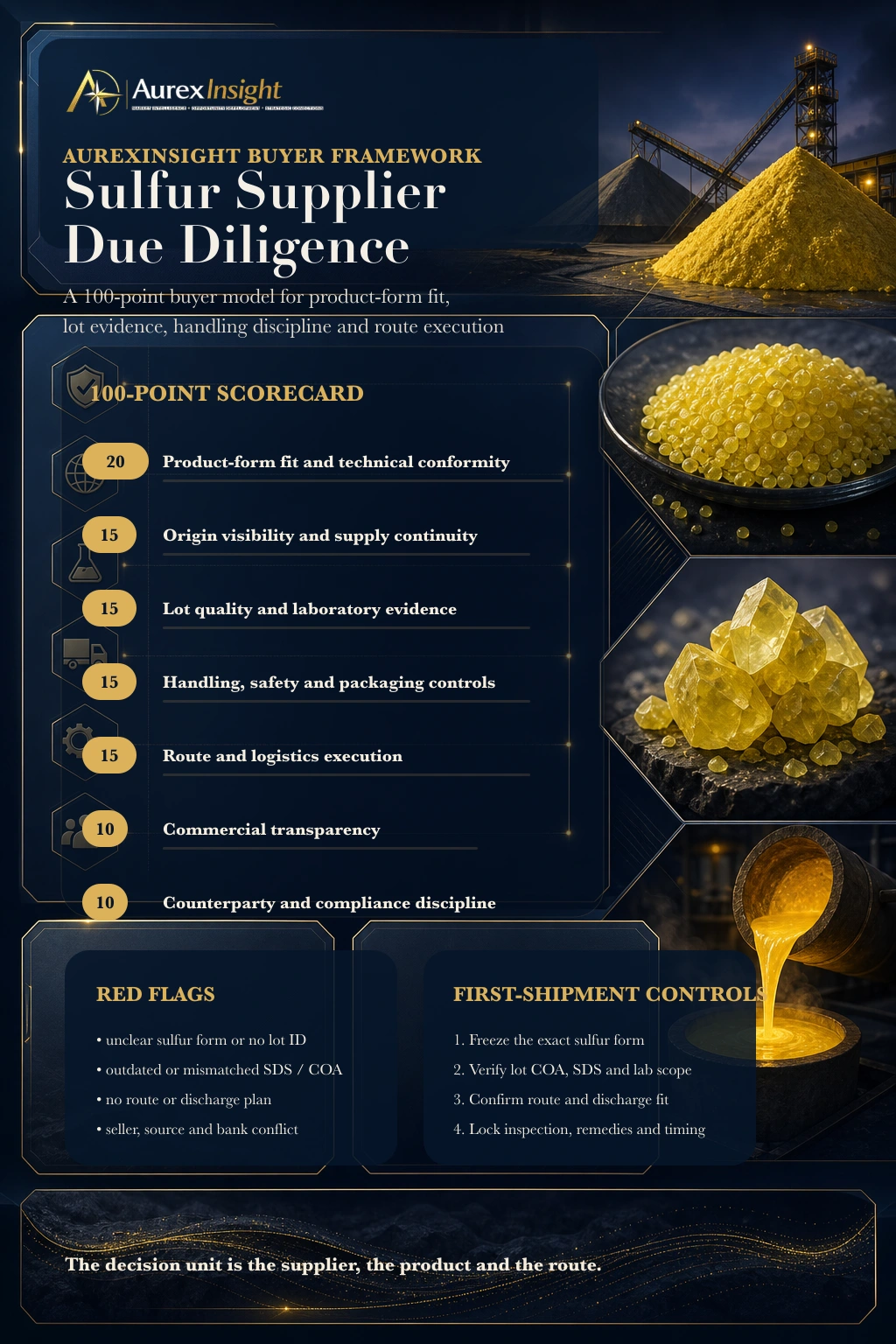
Figure 1. AurexInsight's sulfur-supplier due-diligence framework. The weights are a decision-support model, not a certification or universal procurement standard.
| Evaluation Dimension | Weight | What a Strong Supplier Demonstrates |
|---|---|---|
| Product-form fit and technical conformity | 20 | Exact sulfur form, buyer-aligned specification, clear acceptance basis |
| Origin visibility and supply continuity | 15 | Source logic, realistic availability, dated allocation or loading evidence |
| Lot quality and laboratory evidence | 15 | Lot-linked COA, competent testing scope, sample traceability |
| Handling, safety, and packaging controls | 15 | Fit-for-purpose packaging or molten handling plan, current SDS, cargo discipline |
| Route and logistics execution | 15 | Realistic loading, freight, discharge, and destination-fit plan |
| Commercial transparency | 10 | Complete quote, named place/port, validity, inspection and payment clarity |
| Counterparty and compliance discipline | 10 | Consistent seller identity, beneficiary, shipment parties, and screening logic |
| Total | 100 | Balanced technical and commercial reliability |
Interpreting the Score
| Score | Indicative Decision | Required Response |
|---|---|---|
| 85-100 | Strong candidate | Proceed subject to contract and shipment-specific checks |
| 70-84 | Potentially acceptable | Close evidence gaps; consider trial parcel or tighter inspection |
| 55-69 | Elevated risk | Escalate internally; do not rely on price advantage alone |
| Below 55 | Weak candidate | Suspend qualification unless decisive evidence changes the case |
Critical failures should override total score. A supplier should not be approved if the product form does not fit the buyer's process, the identity chain is inconsistent, or the transaction cannot be executed within the destination's handling constraints.
1. Define the Product Before You Evaluate the Seller
The first due-diligence document should be the buyer's own purchase specification.
Without it, suppliers are often being compared against different assumptions. One offer may refer to bulk granular sulfur, another to bagged pastilles, and another to molten sulfur, while the buyer mistakenly treats the quotations as equivalent because the material name is the same.
At minimum, define:
- sulfur form and intended end use
- purity or assay expectation where relevant
- moisture and contamination tolerances
- particle-size expectation for solid sulfur where operationally relevant
- packaging or transport method
- unloading and storage conditions at destination
- sample point, sample retention, and acceptance rules
- required document set
Product-Form Check
| Typical End Use | Commonly Preferred Form | Procurement Questions That Matter Most |
|---|---|---|
| Fertilizer blending / agricultural distribution | Granular sulfur, pastilles, or lump depending on plant setup | Particle consistency, caking behavior, dust, bagging or bulk unload practicality |
| Sulfuric acid production | Molten sulfur or bulk solid depending on plant design | Heating chain, discharge rate, storage temperature, contamination risk |
| Trading / redistribution | Bagged or bulk solid sulfur | Packaging integrity, rehandling, traceability, resale documentation |
Many failed sulfur transactions start here: the offered form is technically saleable but operationally inconvenient or commercially wrong for the destination.
2. Evaluate Country-of-Origin and Route Exposure Without Confusing It with Supplier Quality
Trade data do not tell buyers which supplier to trust, but they do help answer a different question: how concentrated is the export context behind the offer?
The WTO and WITS datasets are useful for that purpose because they show how reported sulfur trade is distributed across suppliers and routes.[4]
2024 HS 250310 Snapshot
The table below uses WITS country pages for HS 250310, "Sulphur, crude or unrefined," to illustrate why buyers should read export data carefully.[5][6][7][8][9]
| Reporter | 2024 Export Value | 2024 Reported Quantity | What Buyers Should Infer |
|---|---|---|---|
| Qatar | $321.5 million | 3.13 million tonnes | Large Gulf export base with strong maritime-route dependence[5] |
| Kazakhstan | $320.0 million | 5.04 million tonnes | Very high reported volume, but route practicality depends on destination and logistics chain[6] |
| Canada | $292.8 million | 2.96 million tonnes | Important diversified-origin option for some Atlantic and Pacific buyers[7] |
| United States | $195.0 million | 1.84 million tonnes | Significant regional exporter, especially relevant for American basin trade[8] |
| Saudi Arabia | $46.5 million | 0.39 million tonnes | Lower value in this specific HS line than many buyer assumptions suggest, underscoring form/reporting differences[9] |
These figures do not mean Qatar is automatically a better supplier than Kazakhstan, or that Saudi Arabia is commercially unimportant in sulfur. They mean that one specific trade classification and one reporting year already show significant variance. Buyers should therefore use exporter data as context, not as a substitute for transaction-level due diligence.
For a broader exporter discussion, see Top Sulfur Exporting Countries in 2026. For Iranian sourcing context within Gulf trade, see Iran's Role in Global Sulfur Trade.
3. Verify Lot Quality, Document Integrity, and Laboratory Competence
A sulfur supplier's paperwork should behave like a coherent evidence package rather than a stack of unrelated attachments.
The buyer should expect consistency across:
- quotation and specification
- COA
- SDS
- packing list
- source declaration where relevant
- inspection report where contracted
- bill of lading or other transport document
What to Check in the Evidence Package
| Document | What It Should Prove | Common Failure Mode |
|---|---|---|
| COA | Lot-linked quality evidence with date, identifier, method, result, and issuer | Generic template reused across shipments |
| SDS | Current hazard and handling information tied to the actual product identity | Outdated SDS from another seller or another sulfur form |
| Packing specification | How the product is actually shipped and protected | Packaging description omitted or too vague to be operationally useful |
| Source or loading declaration | Commercial logic from seller to cargo | Seller cannot explain origin, terminal, or loading mechanics |
| Third-party test report | Independent result for a defined sample | Scope of testing irrelevant to the buyer's real risk |
The European Chemicals Agency notes that Safety Data Sheets are required for hazardous substances supplied in the EU and must communicate handling and risk information clearly.[13] OSHA's Appendix D to 29 CFR 1910.1200 provides a similarly structured SDS framework in the United States.[14] That makes the SDS a procurement document, not merely a post-sale compliance form.
When laboratory testing matters, ISO/IEC 17025 should be interpreted correctly: accreditation is relevant only when the laboratory's scope covers the specific sulfur tests the buyer is relying upon.[10]
4. Test Handling, Packaging, and Safety Readiness
Sulfur procurement can fail even when the chemistry is acceptable.
The ILO/WHO International Chemical Safety Card for sulfur identifies sulfur as a combustible solid and warns about dust-explosion risk in powder form and hazardous decomposition products during burning.[11] For buyers, the implication is straightforward: the handling model is part of supplier evaluation.
Handling Questions by Delivery Model
| Delivery Model | Main Strength | Due-Diligence Questions |
|---|---|---|
| Molten sulfur | Efficient for large acid-industry or industrial users | Heating continuity, tank suitability, venting, discharge rate, temperature control |
| Bulk granular / pastilles | Efficient for large solid-product users | Dust control, screening consistency, caking, unloading and storage capability |
| Bagged solid sulfur | Useful where bulk handling is limited | Bag quality, palletization, moisture exposure, rehandling loss, warehouse conditions |
For solid bulk cargoes, the IMO's International Maritime Solid Bulk Cargoes Code remains a central reference for carriage requirements and cargo safety logic.[12] Buyers do not need to become ship operators, but they do need confidence that the seller's promised shipment mode is compatible with sulfur's handling profile and the discharge conditions at destination.
5. Stress-Test the Route and Delivery Plan
In sulfur, route risk is not abstract.
The IEA's June 2026 Oil Market Report noted that oil and tanker flows through the Gulf recovered only partially after the low point reached in late May, with regional ship traffic still adjusting even as volumes improved into June.[3] The market implication for sulfur buyers is that freight normalization cannot be assumed simply because the headline crisis phase has eased.
That connects directly to sulfur because the Gulf remains disproportionately important to seaborne supply.[1]
The buyer should therefore ask:
- What is the exact loading point?
- What is the actual shipment model: bulk vessel, bags in containers, breakbulk, tank, or truck?
- Is the route still commercially workable for the target market this month, not merely in principle?
- Does the destination have the equipment and storage conditions to receive this sulfur form?
- What happens if loading, routing, or discharge shifts by several days or weeks?
For corridor context, see Why the Strait of Hormuz Matters for Global Commodity Trade in 2026 and How Regional Tensions Are Reshaping Global Commodity Markets in 2026.
6. Read the Commercial Offer as a Risk Document
A sulfur quotation should be complete enough to let the buyer identify hidden execution risk.
At minimum, a comparable quotation should state:
- sulfur form and buyer-relevant specification
- quantity and tolerance
- packaging or shipment model
- unit price and currency
- named Incoterms place or port
- shipment window and offer validity
- inspection basis
- payment terms and bank beneficiary
- documentary set required for release or payment
The practical comparison is not quotation price alone.
Risk-adjusted landed cost = product + packaging + inland logistics + export charges + freight + insurance + inspection + financing + destination cost + expected failure cost
This last factor is the one many first-time sulfur buyers omit. A slightly cheaper quotation can become materially more expensive if the sulfur arrives in the wrong form, cakes during transit, cannot be unloaded efficiently, or requires unplanned rebagging, reheating, retesting, or claim handling.
7. Watch for Red Flags Before You Negotiate on Price
Technical Red Flags
- sulfur form is described vaguely or inconsistently
- COA has no lot identifier or no method basis
- SDS appears outdated or mismatched to the seller/product identity
- seller cannot explain how the destination will physically receive the material
- third-party testing is discouraged without explanation
Identity and Transaction Red Flags
- seller, producer, and beneficiary names do not align
- source changes repeatedly during negotiation
- loading point is left intentionally vague
- bank details change late without clear documentary justification
- shipment route is presented as routine even though the corridor is visibly disrupted
Operational Red Flags
- supplier offers immediate large volume without packaging or loading detail
- transit assumptions ignore destination constraints
- buyer is pressured to pay before verification points are completed
- the offer relies on "standard sulfur" without clarifying what that means for the plant or project
No single red flag proves misconduct. But each one increases the probability that the quotation is incomplete, the cargo is mismatched, or the transaction controls are too weak.
Buyer Workflow
| Stage | Buyer Action | Decision Gate |
|---|---|---|
| 1. Define | Freeze product form, end use, and unloading requirements | Are the offers truly comparable? |
| 2. Screen | Verify seller identity, source logic, route plausibility, and beneficiary consistency | Is the counterparty reviewable? |
| 3. Validate | Review COA, SDS, packaging, and test scope | Is the cargo evidence credible? |
| 4. Score | Apply the 100-point framework and record open issues | Does the supplier pass critical controls? |
| 5. Contract | Lock sampling, inspection, quantity, acceptance, and remedies | Are the transaction controls enforceable? |
| 6. Monitor | Track loading, shipping, arrival, and first-delivery performance | Should the supplier be approved, conditional, or suspended? |
AurexInsight Executive Insight
The strongest sulfur procurement teams do not ask, "Who is cheapest today?"
They ask, "Which supplier can still deliver the right sulfur, in the right form, through the right route, with the fewest unresolved contradictions?"
That shift matters because sulfur buying sits at the intersection of commodity trade, industrial handling, and route risk. A supplier can look attractive on price and still fail on operational fit. Another can look expensive in a quotation table and prove lower-risk after freight, unloading, document integrity, and claim probability are included.
For that reason, the correct unit of analysis is not the supplier profile alone. It is the supplier-plus-cargo-plus-route package.
Outlook for 2026 and Beyond
The 2026 direction is clear: sulfur buying is becoming less tolerant of generic offers and more dependent on evidence-led qualification.
Buyers should expect greater emphasis on:
- product-form-specific RFQs rather than generic sulfur inquiries
- stricter laboratory-scope review
- stronger SDS and handling-document discipline
- route-risk monitoring tied to Gulf shipping and fertilizer-market volatility
- approved-supplier lists based on delivery performance, not only quotation history
That makes sulfur supplier evaluation less about checking a company profile and more about confirming whether a transaction can survive real-world execution.
Frequently Asked Questions
What documents should a sulfur supplier provide?
At minimum, the buyer should expect a quotation or signed specification, a lot-specific COA, a current SDS, packing details, shipment terms, and the commercial document set required for payment and customs. Higher-risk transactions may also require independent inspection and retained samples.
Why doesn't exporter ranking prove supplier quality?
Country export rankings describe a trade pattern, not a specific seller's operating discipline. A country can be a major exporter while an individual supplier still has weak paperwork, poor packaging controls, or route execution problems.
Is molten sulfur always better than solid sulfur?
No. Molten sulfur can be efficient for the right industrial user, but it creates heating, tank, discharge, and timing requirements that many destinations cannot manage. The best form depends on the buyer's downstream system.
Why is the SDS important in a procurement decision?
Because sulfur handling risk is part of commercial performance. An accurate SDS helps the buyer confirm storage, handling, emergency, and packaging assumptions before the cargo moves, rather than after a problem appears.
How should a buyer reduce first-shipment risk?
Use a narrower first transaction where practical, define inspection and acceptance clearly, retain reference samples, verify laboratory scope, and compare total landed risk rather than only the offered price.
References
Accessed 17 July 2026.
- International Energy Agency — Global Critical Minerals Outlook 2026, Market Overview
- World Bank — Fertilizer prices surge as Strait of Hormuz disruptions tighten supplies
- International Energy Agency — Oil Market Report, June 2026
- World Trade Organization — Tariff and trade data platform
- World Integrated Trade Solution — Qatar exports of Sulphur, crude or unrefined in 2024
- World Integrated Trade Solution — Kazakhstan exports of Sulphur, crude or unrefined in 2024
- World Integrated Trade Solution — Canada exports of Sulphur, crude or unrefined in 2024
- World Integrated Trade Solution — United States exports of Sulphur, crude or unrefined in 2024
- World Integrated Trade Solution — Saudi Arabia exports of Sulphur, crude or unrefined in 2024
- ISO — ISO/IEC 17025:2017, General requirements for the competence of testing and calibration laboratories
- International Labour Organization / World Health Organization — ICSC 1166: Sulphur
- International Maritime Organization — International Maritime Solid Bulk Cargoes (IMSBC) Code and Supplement, 2024 Edition
- European Chemicals Agency — Safety data sheets
- OSHA — Appendix D to 29 CFR 1910.1200 - Safety Data Sheets
Related AurexInsight Research
- Global Sulfur Market Outlook 2026
- Top Sulfur Exporting Countries in 2026
- Why Sulfur Matters in Global Fertilizer Markets
- Iran's Role in Global Sulfur Trade
- Why the Strait of Hormuz Matters for Global Commodity Trade in 2026
- How Regional Tensions Are Reshaping Global Commodity Markets in 2026
About AurexInsight
AurexInsight is an independent market-intelligence platform focused on international trade, commodity markets, supplier evaluation, trade-flow analysis, and opportunity development.
Our mission is to transform market intelligence into trusted business opportunities through evidence-based research, transparent methods, and practical decision frameworks.
Disclaimer
This report is provided for informational and market-intelligence purposes only. It is not legal, technical, financial, compliance, procurement, or commercial advice, and it does not certify, endorse, rank, or approve any supplier.
Standards, trade controls, banking requirements, freight conditions, and product specifications change. Buyers should obtain current technical standards, conduct transaction-specific due diligence, use qualified laboratories and inspectors, and seek appropriate professional advice before contracting, paying, shipping, or accepting sulfur cargoes.
Written and reviewed by
AurexInsight Research
AurexInsight publishes market intelligence, supplier validation insights, trade-flow analysis and opportunity-focused research for international business decision-makers.
View profile and research standardsRelated Research
Continue exploring this market theme
These related insights help build a clearer view of the market context, supply-chain risks and commercial opportunities connected to this analysis.
How to Evaluate Bitumen Suppliers in International Markets: A Buyer's Due-Diligence Framework for 2026
A practical, standards-based framework for verifying bitumen suppliers, product quality, batch documentation, logistics capability, and contract risk in international procurement.
Read insightMarket OutlookTop Sulfur Exporting Countries in 2026: Production, Trade Flows and Competitive Analysis
A market-intelligence analysis of the top sulfur exporting countries in 2026, covering production strength, export infrastructure, trade flows, competitive advantages, and buyer considerations.
Read insightMarket OutlookGlobal Sulfur Market Outlook 2026: Prices, Supply Risks and Trade Flows
Where is the sulfur market heading in 2026? Explore price drivers, supply risks, fertilizer demand, trade flows, major exporters and the signals buyers should monitor.
Read insight