

Why the Strait of Hormuz Matters for Global Commodity Trade in 2026
Explore why the Strait of Hormuz remains one of the world's most important trade corridors and how it influences energy markets, fertilizers, shipping costs, and global commodity flows in 2026.
Last updated: July 28, 2026
Editorial standard
Reviewed by AurexInsight Research
Last updated: July 28, 2026
AUREXINSIGHT RESEARCH
Why the Strait of Hormuz Matters for Global Commodity Trade in 2026
Explore why the Strait of Hormuz remains one of the world's most important trade corridors and how it influences energy markets, fertilizers, shipping costs, and global commodity flows in 2026.
Executive summary
The Strait of Hormuz remains one of the most strategically important maritime corridors in the world.
A substantial share of global energy exports and a significant volume of fertilizers, petrochemicals, sulfur, refined products, and industrial commodities move through this narrow waterway each year.
As a result, even modest increases in shipping risk, insurance costs, or logistical uncertainty can influence commodity prices, freight markets, procurement decisions, and global trade flows.
Research method and limitations
This summary is based on the full AurexInsight report, trade and industry data, and reputable public sources. Market data may be delayed, incomplete, or methodologically inconsistent; independent due diligence is essential before commercial decisions.
Written and reviewed by: AurexInsight Research
Full report and sources: https://aurexinsight.com/en/insights/why-the-strait-of-hormuz-matters-for-global-commodity-trade-2026
Research method
This analysis triangulates reputable public sources, trade and industry data, institutional reports, and consistency checks. Material source conflicts, limitations, and uncertainty are stated explicitly.
Data limitations
Trade and market data may be delayed, incomplete, or methodologically inconsistent. This report does not replace independent legal, financial, procurement, or commercial due diligence.
Quick Answer
The Strait of Hormuz remains one of the most strategically important maritime corridors in the world.
A substantial share of global energy exports and a significant volume of fertilizers, petrochemicals, sulfur, refined products, and industrial commodities move through this narrow waterway each year.
As a result, even modest increases in shipping risk, insurance costs, or logistical uncertainty can influence commodity prices, freight markets, procurement decisions, and global trade flows.
For importers, exporters, traders, and procurement teams, understanding the Strait of Hormuz has become essential for evaluating supply-chain resilience and market risk in 2026.
July 2026 Operational Update: LNG, Fertilizer, Bitumen and Freight
The current question for commercial teams is no longer only whether the Strait matters. It is whether a specific voyage, shipment window and receiving plan remain executable under changing security, insurance and carrier conditions.
The International Maritime Organization (IMO) continues to describe the regional situation as rapidly evolving and publishes operational guidance for vessels, flag states and operators. This makes verified voyage planning more important than assumptions based on a standard transit schedule.
For LNG, the transmission mechanism can be immediate. The U.S. Energy Information Administration reported in April 2026 that benchmark LNG futures in Europe and East Asia rose after disruption to Strait traffic, while the U.S. benchmark moved differently. The lesson for buyers is not to rely on one gas benchmark: destination market, shipping availability and delivery timing matter together.
For fertilizers, sulfur, petrochemicals and bitumen, the first impact may appear in delivered cost and execution rather than in the producer's ex-works offer. UNCTAD has highlighted the interaction between shipping disruption, tanker freight, war-risk insurance and marine-fuel costs. Bulk and project cargo buyers should therefore evaluate the full delivered chain, including loading window, vessel acceptance, insurance conditions and destination storage.
Practical Procurement Checks During Heightened Risk
- Confirm the carrier's current transit policy and the vessel's realistic loading and discharge window.
- Re-price freight, war-risk insurance, bunkering and demurrage exposure separately from the commodity price.
- Review Incoterms, payment milestones, force-majeure language and cargo-insurance exclusions with qualified advisers.
- Check whether the buyer has enough inventory cover if a shipment is delayed, diverted or rescheduled.
- Keep an alternative supplier, port or delivery sequence ready where the specification and regulations allow it.
- Use current official maritime notices and verified carrier information; do not make operational decisions from unverified reports.
This is not a forecast that every shipment will be interrupted. It is a procurement discipline: when corridor conditions change, the shipment plan must be validated as carefully as the supplier and product specification.
Executive Summary
Global commodity markets increasingly depend on efficient logistics networks rather than production capacity alone.
While commodity production remains critical, the ability to move products safely and predictably across international markets has become equally important.
Few locations illustrate this reality better than the Strait of Hormuz.
Connecting the Persian Gulf to international waters, the Strait serves as a critical export gateway for some of the world's most important commodity-producing regions.
Its importance extends well beyond crude oil.
The corridor supports the movement of:
- Crude oil
- Liquefied Natural Gas (LNG)
- Fertilizers
- Sulfur
- Petrochemicals
- Refined petroleum products
- Bitumen and asphalt materials
Because many major producers depend on this route, developments affecting maritime operations can quickly influence freight costs, insurance premiums, procurement strategies, and commodity-market sentiment.
For decision-makers, understanding the Strait of Hormuz is no longer a niche geopolitical topic.
It has become a practical business consideration with direct implications for supply-chain planning, sourcing strategies, and risk management.
This report explores why the Strait of Hormuz matters, how it influences global commodity markets, and what market participants should monitor throughout 2026.
Key Takeaways
- The Strait of Hormuz remains one of the world's most important commodity-trade corridors.
- Energy exports are only one part of its broader economic significance.
- Fertilizers, sulfur, petrochemicals, and bitumen also rely heavily on regional shipping infrastructure.
- Maritime risk can affect commodity prices even when production remains stable.
- Freight and insurance costs are becoming increasingly important market indicators.
- Supply-chain resilience is gaining importance across global procurement teams.
- Trade-flow intelligence provides an increasingly valuable competitive advantage.
Strait of Hormuz Market Snapshot
| Market Factor | Strategic Importance |
|---|---|
| Energy Export Flows | Very High |
| LNG Trade | Very High |
| Fertilizer Exports | High |
| Petrochemical Trade | High |
| Sulfur Trade | High |
| Maritime Logistics | Very High |
| Freight Markets | High |
| Supply-Chain Risk | High |
The interaction of these factors helps explain why developments in the Strait of Hormuz attract attention from commodity buyers, traders, governments, and logistics providers worldwide.
Even when production remains stable, changes in shipping conditions can influence delivered costs and market sentiment.
Where Is the Strait of Hormuz?
The Strait of Hormuz is a narrow maritime passage connecting the Persian Gulf to the Gulf of Oman and the Arabian Sea.
Although geographically small, its economic significance is enormous.
The corridor serves as the primary export route for several major commodity-producing countries across the Persian Gulf region.
For many producers, access to global markets depends heavily on uninterrupted maritime movement through this waterway.
This makes the Strait one of the most closely monitored trade corridors in the world.
Why It Matters Beyond Energy
Many discussions about the Strait of Hormuz focus exclusively on oil exports.
However, global commodity markets are affected through a much broader range of products.
The corridor supports international trade in:
- Crude oil
- LNG
- Fertilizers
- Sulfur
- Petrochemicals
- Refined products
- Bitumen
- Industrial feedstocks
As a result, developments affecting shipping conditions can create ripple effects across multiple industries simultaneously.
For commodity buyers, understanding these interconnections is increasingly important.
The Shift from Production Risk to Trade-Flow Risk
Historically, commodity-market analysis focused heavily on production capacity.
Today, market participants increasingly recognize another source of vulnerability:
Trade-flow risk.
The question is often no longer:
"Can enough product be produced?"
Instead, market participants increasingly ask:
"Can the product move efficiently through global supply chains?"
This shift has transformed how procurement teams evaluate risk.
In many sectors, logistics resilience and trade accessibility have become just as important as production economics.
For a broader analysis of how regional tensions influence commodity markets, readers may also explore:
👉🏻 How Regional Tensions Are Reshaping Global Commodity Markets in 2026
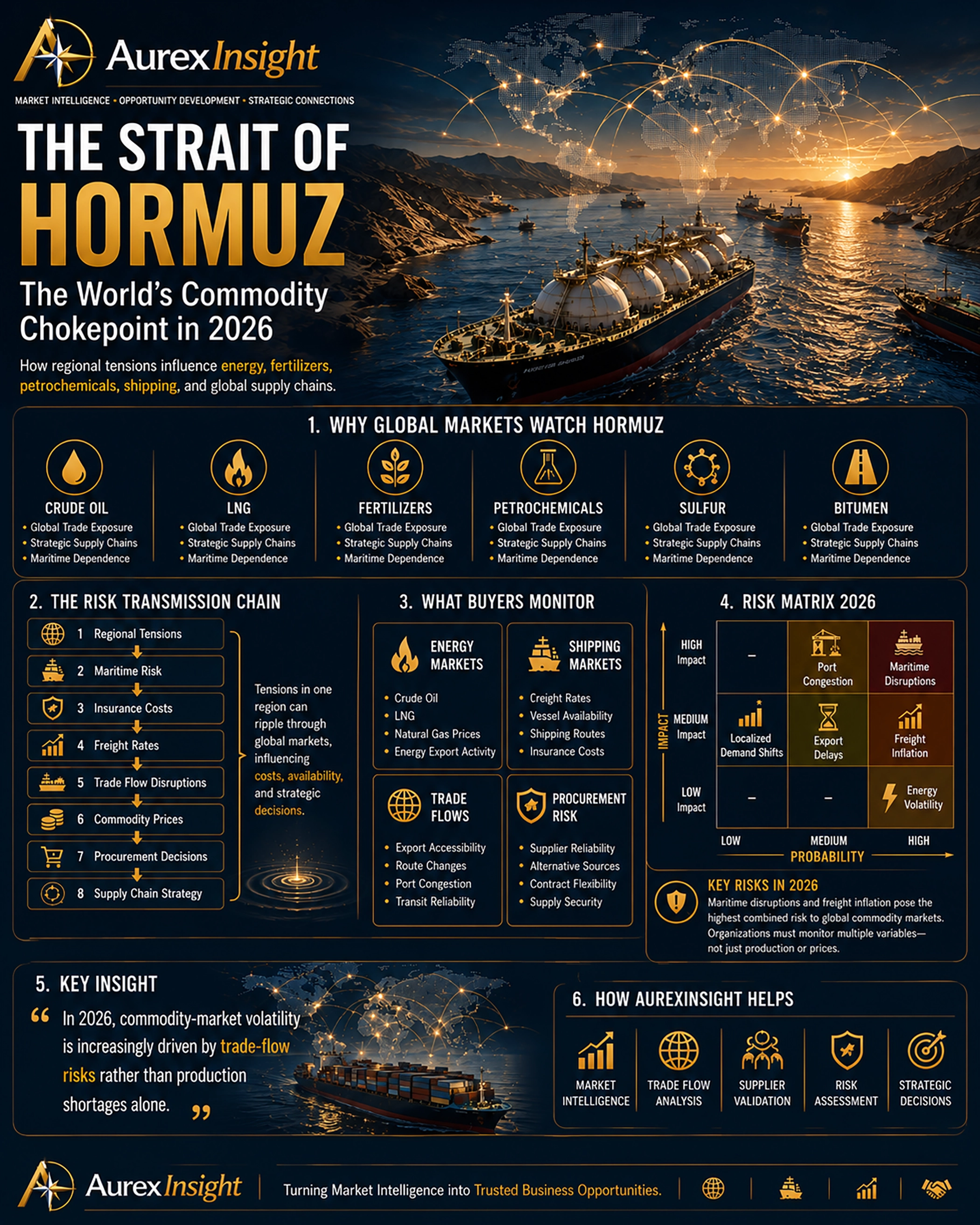
Figure 1. The Strait of Hormuz influences global commodity trade through energy flows, LNG exports, fertilizer trade, petrochemicals, sulfur, bitumen, freight markets, insurance costs, and supply-chain risk.
Energy Trade Flows and Global Market Sensitivity
The Strait of Hormuz is often described as one of the most important energy chokepoints in the world.
A substantial share of internationally traded energy products moves through this corridor before reaching buyers across Asia, Europe, and other global markets.
Because energy remains a foundational input for industrial production, transportation, agriculture, and manufacturing, changes affecting energy flows often extend beyond the energy sector itself.
Market participants closely monitor:
- Export volumes
- Vessel movements
- Shipping activity
- Freight availability
- Insurance costs
- Regional logistics conditions
Even when physical exports continue uninterrupted, changes in perceived risk can influence market expectations and pricing behavior.
Why Energy Markets React Quickly
Energy markets are highly interconnected.
Buyers, traders, refiners, and financial institutions continuously evaluate potential supply risks.
As uncertainty increases, markets may react to:
- Expected supply constraints
- Freight-market pressures
- Changes in transportation costs
- Insurance premium increases
- Potential delays in cargo delivery
Because expectations often influence purchasing behavior before actual supply disruptions occur, energy markets can experience volatility even when production remains stable.
For commodity buyers, understanding this relationship is essential.
In many cases, logistics concerns affect market sentiment before they affect physical supply.
The Strategic Importance of LNG Trade
Liquefied Natural Gas (LNG) has become one of the most strategically important commodities in international energy markets.
The Persian Gulf plays a major role in supplying LNG to importing markets across Asia and Europe.
Unlike many commodities, LNG depends on specialized infrastructure throughout the supply chain.
This includes:
- Liquefaction facilities
- LNG carriers
- Import terminals
- Storage infrastructure
- Regasification capacity
As a result, disruptions affecting maritime transportation can have significant implications for market confidence.
Why LNG Matters Beyond Energy
Natural gas influences multiple sectors simultaneously:
- Electricity generation
- Fertilizer production
- Industrial manufacturing
- Petrochemical production
- Energy-security planning
This means LNG market volatility can create ripple effects across broader commodity markets.
LNG Risk Factors
| Risk Factor | Potential Market Impact |
|---|---|
| Shipping disruption | Higher LNG prices |
| Vessel delays | Supply uncertainty |
| Freight shortages | Increased transportation costs |
| Insurance increases | Higher delivered costs |
| Route congestion | Longer transit times |
| Market uncertainty | Increased volatility |
For importing economies, LNG market stability remains a major strategic concern throughout 2026.
Why Fertilizer Markets Care About Hormuz
Among non-energy commodities, fertilizer markets are particularly sensitive to developments affecting both energy costs and maritime trade routes.
This is especially true for nitrogen fertilizers such as urea.
Urea production depends heavily on natural gas.
Meanwhile, international fertilizer trade depends on efficient shipping networks.
As a result, fertilizer buyers often monitor both energy markets and transportation conditions simultaneously.
Key Factors Affecting Fertilizer Markets
- Natural gas prices
- Export accessibility
- Shipping costs
- Freight availability
- Delivery reliability
- Procurement timing
When uncertainty increases across these areas, fertilizer buyers often reassess sourcing strategies and procurement schedules.
Major Fertilizer Importing Regions
Several major agricultural markets depend heavily on imported fertilizers.
These include:
- India
- Brazil
- Southeast Asia
- Africa
- Parts of Europe
Because many fertilizer shipments originate from producers connected to Persian Gulf export infrastructure, developments affecting regional logistics can influence global fertilizer-market sentiment.
For a deeper understanding of fertilizer-market fundamentals, readers may also explore:
👉🏻 Global Urea Market Outlook 2026
👉🏻 Top Urea Exporting Countries in 2026
👉🏻 How Natural Gas Prices Affect Urea Markets
Sulfur Markets and Export Connectivity
Sulfur is a critical industrial commodity with important applications across agriculture and manufacturing.
Large volumes of sulfur are consumed in:
- Phosphate fertilizer production
- Chemical manufacturing
- Industrial processing
- Mining operations
Because sulfur trade depends heavily on export logistics and maritime transportation, shipping efficiency remains a major determinant of market accessibility.
Why Sulfur Matters
Although sulfur receives less media attention than oil or LNG, it remains an essential component of global industrial supply chains.
Changes affecting export logistics can influence:
- Product availability
- Delivery timelines
- Freight economics
- Regional competitiveness
For buyers, sulfur-market monitoring has become increasingly important as supply chains grow more interconnected.
Petrochemical Trade and Maritime Infrastructure
Petrochemical products form the foundation of countless industrial value chains.
They support industries ranging from plastics manufacturing to packaging, construction, automotive production, and consumer goods.
Because petrochemical exports depend heavily on maritime infrastructure, trade-route efficiency plays a critical role in market performance.
Factors Influencing Petrochemical Trade
- Feedstock availability
- Export-terminal access
- Vessel capacity
- Freight-market conditions
- Port efficiency
- International demand
When uncertainty increases, buyers often prioritize reliability and supply continuity alongside pricing considerations.
Impact on Global Procurement Strategies
The growing importance of logistics has fundamentally changed procurement decision-making.
Historically, buyers focused primarily on obtaining the lowest available price.
Today, procurement teams increasingly evaluate:
- Supply reliability
- Logistics resilience
- Supplier credibility
- Trade-route accessibility
- Freight conditions
- Risk exposure
This shift reflects the growing recognition that delivered cost is influenced by much more than production economics alone.
For many organizations, supply-chain visibility has become a strategic asset.
Bitumen Trade Flows and Export Connectivity
While bitumen markets receive less media coverage than crude oil or LNG, they remain highly dependent on international logistics networks and maritime transportation.
Many infrastructure projects rely on predictable delivery schedules, stable freight conditions, and reliable export channels.
As a result, changes affecting shipping efficiency can directly influence project economics and procurement planning.
Why Bitumen Markets Are Sensitive
Bitumen trade depends on:
- Export-terminal accessibility
- Vessel availability
- Bulk and container logistics
- Freight-market stability
- Construction-season demand
- Supply-chain reliability
For many importers, transportation costs represent a significant portion of total procurement expenses.
This means logistics disruptions can influence competitiveness even when production costs remain unchanged.
What Bitumen Buyers Monitor
- Freight-rate movements
- Vessel availability
- Port congestion
- Shipping schedules
- Insurance costs
- Export-terminal activity
For a broader perspective on commodity trade flows, readers may also explore:
👉🏻 How Regional Tensions Are Reshaping Global Commodity Markets in 2026
Shipping, Freight, and Insurance Markets
One of the earliest market reactions to elevated regional uncertainty often appears in freight and insurance markets.
Unlike physical production disruptions, freight and insurance costs can respond almost immediately to changing risk perceptions.
This makes them valuable indicators for commodity buyers and market analysts.
Why Freight Costs Matter
Every internationally traded commodity depends on transportation.
When freight rates increase, delivered commodity costs rise even if production costs remain stable.
This dynamic affects:
- Energy products
- Fertilizers
- Petrochemicals
- Sulfur
- Industrial minerals
- Bitumen
- Agricultural commodities
As transportation becomes more expensive, buyers may reconsider sourcing strategies and procurement timing.
Insurance Premiums as an Early Warning Signal
Insurance markets often react before commodity prices.
Rising premiums can indicate:
- Increased operational uncertainty
- Higher transportation risk
- Route complexity
- Potential delivery delays
- Elevated supply-chain exposure
For procurement teams, monitoring insurance markets can provide valuable insight into future cost pressures before they become visible in commodity pricing.
Alternative Export Routes: Can They Replace Hormuz?
One common question among market participants is whether alternative export routes could fully replace the Strait of Hormuz if trade conditions become more challenging.
In practice, the answer is complex.
While some alternative routes and infrastructure projects exist, many commodity flows remain optimized around existing regional export systems.
Challenges Facing Alternative Routes
Alternative logistics solutions often involve:
- Higher transportation costs
- Longer transit distances
- Capacity limitations
- Infrastructure constraints
- Reduced operational efficiency
As a result, even when alternatives are available, they may not fully offset disruptions affecting major trade corridors.
This helps explain why global markets continue to pay close attention to developments affecting the Strait of Hormuz.
Why Buyers Continuously Monitor Hormuz
For commodity buyers, monitoring the Strait of Hormuz is not primarily a geopolitical exercise.
It is a supply-chain management exercise.
The corridor influences several factors that directly affect procurement outcomes.
Key Indicators Buyers Track
- Vessel traffic patterns
- Freight-rate trends
- Insurance costs
- Export-terminal activity
- Shipping schedules
- Port operations
- Trade-flow changes
Together, these indicators help organizations evaluate potential supply risks before they materialize into operational challenges.
From Cost Optimization to Supply Resilience
Historically, procurement strategies focused heavily on minimizing purchase costs.
Today, many organizations are adopting a broader perspective.
The question is no longer simply:
"Who offers the lowest price?"
Increasingly, buyers ask:
"Who can reliably deliver under changing market conditions?"
This shift has elevated the importance of:
- Supplier validation
- Trade-flow analysis
- Logistics visibility
- Risk diversification
- Market intelligence
Organizations that integrate these capabilities into procurement processes may be better positioned to navigate uncertainty.
AurexInsight Risk Matrix for 2026
The Strait of Hormuz influences multiple interconnected market risks.
These risks rarely occur independently.
Instead, they often reinforce one another through broader supply-chain dynamics.
| Risk Factor | Probability | Potential Market Impact |
|---|---|---|
| Maritime trade disruption | Medium | High |
| Rising freight costs | High | High |
| Insurance-cost increases | High | Medium to High |
| LNG market volatility | Medium | High |
| Fertilizer-market uncertainty | Medium | Medium to High |
| Export delays | Medium | High |
| Port congestion | Medium | Medium |
| Trade-flow concentration | High | High |
| Supplier accessibility issues | Medium | Medium |
| Procurement uncertainty | High | Medium |
Understanding how these risks interact is becoming increasingly important for procurement teams and commodity-market participants.
The Strategic Value of Trade-Flow Intelligence
One of the most important developments in commodity markets is the growing importance of trade-flow intelligence.
Historically, organizations focused heavily on production statistics and price trends.
Today, many leading market participants also analyze:
- Shipping activity
- Vessel tracking
- Freight conditions
- Export accessibility
- Port performance
- Supply-chain resilience
This broader perspective often provides earlier warning signals than production data alone.
Trade-flow intelligence helps organizations identify risks before they affect availability, pricing, or procurement outcomes.
AurexInsight Executive Insight
The most important lesson from the Strait of Hormuz is not simply that geography matters.
It is that connectivity matters.
Global commodity markets increasingly depend on a relatively small number of highly efficient trade corridors.
When these corridors function smoothly, commodities move predictably from producers to consumers.
When uncertainty increases, the effects can spread across multiple industries—even without significant changes in production levels.
From an AurexInsight perspective, future competitive advantages will increasingly belong to organizations capable of combining:
- Market Intelligence
- Trade Flow Analysis
- Supplier Validation
- Opportunity Assessment
- Risk Management
into a unified decision-making framework.
The organizations that understand how commodities move—not just how they are produced—may be best positioned to navigate future market volatility.
What to Watch During the Remainder of 2026
Market participants should continue monitoring several indicators that may influence commodity flows, freight markets, and procurement conditions.
While individual events are difficult to predict, these indicators often provide early signals regarding changing market dynamics.
Energy Markets
- Crude oil prices
- LNG market developments
- Natural gas price movements
- Regional energy-export activity
Maritime Trade
- Vessel traffic volumes
- Shipping-route accessibility
- Freight-market conditions
- Insurance-cost trends
Supply Chains
- Export-terminal activity
- Port congestion levels
- Supplier availability
- Logistics-network performance
Commodity Markets
- Fertilizer demand
- Petrochemical exports
- Sulfur trade flows
- Bitumen market activity
Monitoring these indicators together often provides a more complete picture than tracking commodity prices alone.
Outlook for the Remainder of 2026
Global commodity markets are expected to remain highly interconnected throughout the remainder of 2026.
While production capacity remains a critical factor, logistics performance, trade-route accessibility, and supply-chain resilience are likely to play an increasingly important role in market outcomes.
Several long-term trends appear likely to continue:
- Greater emphasis on supply security
- Increased focus on supplier reliability
- Higher importance of freight-market monitoring
- More sophisticated procurement strategies
- Growing use of trade-flow intelligence
- Increased investment in supply-chain resilience
Organizations capable of combining market visibility with operational flexibility may be better positioned to manage uncertainty.
For buyers, traders, producers, and market-development organizations, understanding how commodities move may become just as important as understanding how commodities are produced.
Frequently Asked Questions
Why is the Strait of Hormuz important for global trade?
The Strait of Hormuz connects the Persian Gulf to international shipping routes and serves as a major corridor for energy products, fertilizers, petrochemicals, sulfur, bitumen, and other industrial commodities.
Does the Strait of Hormuz only affect oil markets?
No.
While oil receives the most attention, the corridor also influences LNG, fertilizers, sulfur, petrochemicals, refined products, bitumen, and broader maritime trade.
Can commodity prices rise even if production remains stable?
Yes.
Freight-rate increases, insurance costs, shipping delays, and logistics disruptions can influence delivered commodity prices without significant changes in production levels.
Why do procurement teams monitor maritime risk?
Because shipping conditions directly affect delivery reliability, transportation costs, sourcing decisions, and supply-chain performance.
How does the Strait of Hormuz affect fertilizer markets?
The corridor supports trade flows connected to major fertilizer-exporting regions and influences freight costs, shipping accessibility, and overall supply-chain efficiency.
What are the biggest risks associated with global commodity trade in 2026?
Key risks include:
- Maritime disruptions
- Freight-market volatility
- Insurance-cost increases
- Energy-market uncertainty
- Export restrictions
- Supply-chain concentration
Why is trade-flow analysis becoming more important?
Because understanding how commodities move through global supply chains often provides earlier warning signals than production data alone.
References
- U.S. Energy Information Administration (EIA) – World Oil Transit Chokepoints
- EIA – International LNG prices rise amid Strait of Hormuz closure
- International Maritime Organization – Middle East and Strait of Hormuz updates
- UNCTAD – Strait of Hormuz disruptions and global trade
- International Energy Agency (IEA)
- United Nations Conference on Trade and Development (UNCTAD) – Review of Maritime Transport
- International Chamber of Shipping (ICS)
- World Bank – Commodity Markets Outlook
- International Monetary Fund (IMF)
- UN Comtrade Database
- International Trade Centre (ITC) Trade Map
- World Trade Organization (WTO)
- Reuters Commodities & Energy Markets
Related AurexInsight Research
About AurexInsight
AurexInsight is an independent Market Intelligence platform focused on international trade, supplier evaluation, market research, trade-flow analysis, and opportunity development.
Our mission is to help buyers, producers, traders, and decision-makers transform market intelligence into trusted business opportunities through data-driven insights, market research, and practical analysis.
Disclaimer
This report is provided for informational and market-intelligence purposes only.
It should not be considered investment, legal, financial, procurement, or commercial advice. Market conditions can change rapidly and may affect future outcomes.
Readers should conduct independent due diligence before making business or investment decisions.
Short Video Summary
Written and reviewed by
AurexInsight Research
AurexInsight publishes market intelligence, supplier validation insights, trade-flow analysis and opportunity-focused research for international business decision-makers.
View profile and research standardsRelated Research
Continue exploring this market theme
These related insights help build a clearer view of the market context, supply-chain risks and commercial opportunities connected to this analysis.
Commodity Trade Risks in 2026: Iran, the Strait of Hormuz and Shipping Disruption
An analysis of how regional tensions, maritime risks, Iran's export position, and the Strait of Hormuz are influencing global commodity markets, trade flows, and supply-chain decisions in 2026.
Read insightMarket OutlookIran's Role in Global LNG Trade: Gas Resources, Export Potential and Market Outlook 2026
An analysis of Iran's role in global LNG trade, examining natural gas resources, export potential, infrastructure constraints, regional position, and market outlook in 2026.
Read insightMarket OutlookGlobal Bitumen Market Outlook 2026: Supply, Demand, Trade Flows and Price Drivers
An in-depth analysis of the global bitumen market in 2026, covering supply, demand, refining economics, trade flows, pricing drivers, major exporters, and the Strait of Hormuz risk factor.
Read insight