

Iran's Role in Global LNG Trade: Gas Resources, Export Potential and Market Outlook 2026
An analysis of Iran's role in global LNG trade, examining natural gas resources, export potential, infrastructure constraints, regional position, and market outlook in 2026.
Last updated: June 27, 2026
Editorial standard
Reviewed by AurexInsight Research
Last updated: June 27, 2026
AUREXINSIGHT RESEARCH
Iran's Role in Global LNG Trade: Gas Resources, Export Potential and Market Outlook 2026
An analysis of Iran's role in global LNG trade, examining natural gas resources, export potential, infrastructure constraints, regional position, and market outlook in 2026.
Executive summary
Iran has one of the world's most important natural gas resource bases, but it is not yet a major LNG exporter.
Iran matters to global LNG trade because of its gas reserves, geographic position, proximity to Asian and European demand centers, and location within the Persian Gulf energy system. However, its LNG market role remains limited by infrastructure constraints, investment requirements, technology access, financing challenges, and export-route considerations.
For buyers, traders, energy analysts, and market-development firms, Iran should be viewed as a strategic gas-resource country with long-term LNG potential rather than a fully established LNG supply hub.
Research method and limitations
This summary is based on the full AurexInsight report, trade and industry data, and reputable public sources. Market data may be delayed, incomplete, or methodologically inconsistent; independent due diligence is essential before commercial decisions.
Written and reviewed by: AurexInsight Research
Full report and sources: https://aurexinsight.com/en/insights/irans-role-in-global-lng-trade-export-potential-market-outlook-2026
Research method
This analysis triangulates reputable public sources, trade and industry data, institutional reports, and consistency checks. Material source conflicts, limitations, and uncertainty are stated explicitly.
Data limitations
Trade and market data may be delayed, incomplete, or methodologically inconsistent. This report does not replace independent legal, financial, procurement, or commercial due diligence.
Quick Answer
Iran has one of the world's most important natural gas resource bases, but it is not yet a major LNG exporter.
This distinction is essential.
Iran matters to global LNG trade because of its gas reserves, geographic position, proximity to Asian and European demand centers, and location within the Persian Gulf energy system. However, its LNG market role remains limited by infrastructure constraints, investment requirements, technology access, financing challenges, and export-route considerations.
For buyers, traders, energy analysts, and market-development firms, Iran should be viewed as a strategic gas-resource country with long-term LNG potential rather than a fully established LNG supply hub.
In 2026, Iran's relevance to LNG markets is best understood through three lenses:
- natural gas resource potential
- export infrastructure limitations
- strategic position within Persian Gulf energy trade
Executive Summary
Global LNG markets are entering a period of major structural change.
Demand from Asia and Europe remains important, new liquefaction capacity is expected to enter the market, and buyers are paying closer attention to supply security, route risk, and long-term contract flexibility.
Within this environment, Iran occupies a complicated but strategically important position.
On one hand, Iran holds substantial natural gas resources and sits close to some of the world's most important energy trade routes.
On the other hand, the country has not developed into a major LNG exporter at the same level as Qatar, the United States, Australia, or other established suppliers.
This gap between resource potential and export performance is the core issue.
Iran's LNG story is not simply about how much gas the country has.
It is about whether that gas can be converted into internationally traded LNG through liquefaction capacity, project financing, technology access, export logistics, and reliable commercial structures.
For this reason, Iran's role in global LNG trade should be analyzed carefully.
It is neither irrelevant nor fully realized.
It is a market with significant long-term potential, but also significant execution barriers.
This report examines Iran's role in global LNG trade, including its natural gas base, export potential, infrastructure constraints, regional position, and what market participants should monitor in 2026.
For a broader analysis of how regional trade routes affect global commodity markets, see:
👉🏻 Why the Strait of Hormuz Matters for Global Commodity Trade in 2026
Key Takeaways
- Iran has major natural gas resources, but limited operational LNG export capacity.
- LNG export influence depends on infrastructure, financing, technology, and reliable execution—not resources alone.
- Iran's position in the Persian Gulf gives it strategic relevance to energy trade analysis.
- The Strait of Hormuz remains important for regional LNG and energy flows.
- Iran's LNG potential should be analyzed separately from its current LNG export performance.
- Asian and European buyers continue to monitor Persian Gulf gas and LNG developments.
- Market intelligence should evaluate both opportunity and constraint when assessing Iran's LNG outlook.
Iran LNG Market Snapshot
| Factor | Market Relevance |
|---|---|
| Core Resource | Natural Gas |
| Current LNG Role | Limited |
| Long-Term Potential | Significant |
| Key Constraint | Liquefaction and Export Infrastructure |
| Strategic Region | Persian Gulf |
| Buyer Relevance | Future Supply Optionality |
| Main Market Lens | Export Potential vs Execution Risk |
Iran's LNG relevance is therefore not defined by current export volume alone.
It is defined by the gap between resource potential and market execution.
Understanding that gap is essential for any serious analysis of Iran's position in global LNG trade.
Why Iran Matters in LNG Discussions
Iran matters in LNG discussions because natural gas is one of the foundations of global energy security.
Countries with large gas resources, strategic geography, and access to maritime trade routes naturally attract attention from energy buyers and analysts.
Iran has all three characteristics.
However, LNG markets reward more than resource ownership.
To become an influential LNG exporter, a country needs:
- developed gas production capacity
- liquefaction facilities
- export terminals
- specialized shipping access
- project financing
- commercial credibility
- stable buyer relationships
- long-term operational reliability
This is where Iran's position becomes more complex.
The country has the resource base, but its LNG export infrastructure has not developed at the same pace as its theoretical potential.
For market participants, this creates both opportunity and uncertainty.
Resource Potential vs LNG Export Reality
One of the most common mistakes in LNG market analysis is assuming that large gas reserves automatically translate into LNG export power.
They do not.
Natural gas must move through several stages before it becomes internationally traded LNG.
| Stage | Requirement | Market Importance |
|---|---|---|
| Gas Resources | Proven reserves and production base | Creates long-term potential |
| Gas Processing | Treatment and preparation | Supports export quality |
| Liquefaction | Conversion into LNG | Enables seaborne trade |
| Export Terminal | Loading and storage infrastructure | Supports shipment execution |
| LNG Shipping | Specialized LNG carriers | Connects supply to buyers |
| Buyer Contracts | Commercial offtake agreements | Supports project finance |
Iran's challenge is not simply the existence of gas.
The challenge is converting gas resources into reliable LNG export flows.
This distinction is critical.
A country can be highly important from a resource perspective while still having limited near-term influence in LNG spot trade.
Why LNG Is Different from Pipeline Gas
LNG and pipeline gas are often discussed together, but they operate under different commercial and infrastructure models.
Pipeline gas depends on fixed regional infrastructure.
LNG depends on liquefaction plants, specialized vessels, receiving terminals, and global shipping networks.
This makes LNG more flexible than pipeline gas, but also more capital-intensive.
Pipeline Gas
Pipeline exports are usually regional.
They depend on:
- neighboring markets
- cross-border pipeline systems
- bilateral agreements
- long-term infrastructure stability
LNG
LNG exports can reach global buyers.
They depend on:
- liquefaction capacity
- LNG carriers
- export terminals
- import terminals
- global buyer networks
For Iran, this distinction matters because the country has experience with regional gas exports, but LNG requires a different level of infrastructure development and commercial integration.
Why LNG Matters for Global Energy Security
LNG has become a strategic energy commodity because it allows natural gas to move across oceans.
This makes it especially important for countries that cannot rely entirely on domestic production or pipeline imports.
Major LNG buyers monitor the market because LNG influences:
- electricity generation
- industrial production
- winter energy security
- fertilizer production
- petrochemical feedstock availability
- energy diversification strategies
In 2026, buyers are not only asking where LNG is cheapest.
They are asking where LNG is reliable.
This shift has made supply security, route stability, contract flexibility, and supplier credibility more important than before.
For a broader view of how maritime routes affect energy and commodity markets, read:
👉🏻 How Regional Tensions Are Reshaping Global Commodity Markets in 2026
Iran's Position in the Persian Gulf Energy System
Iran's LNG potential cannot be separated from the Persian Gulf.
The region is one of the most important energy-exporting systems in the world.
It includes major producers of:
- crude oil
- LNG
- natural gas liquids
- petrochemicals
- sulfur
- fertilizers
- refined products
Iran's geographic position places it near several major energy corridors and demand routes.
This creates strategic relevance even when its current LNG export role remains limited.
For market analysts, Iran's position matters because developments in the Persian Gulf can influence:
- LNG shipping sentiment
- energy security discussions
- freight-market expectations
- buyer risk perception
- long-term sourcing strategies
In other words, Iran affects LNG analysis not only through current LNG volumes, but also through regional risk, geography, and future supply optionality.
The Strait of Hormuz Connection
The Strait of Hormuz plays a central role in Persian Gulf energy trade.
A significant share of regional energy exports moves through this narrow maritime corridor before reaching global markets.
For LNG markets, the Strait matters because shipping access, route security, freight conditions, and insurance costs can affect delivered prices and buyer confidence.
Iran's proximity to this corridor adds another layer to its LNG market relevance.
Even if Iran is not currently a major LNG exporter, its location within the same strategic maritime system makes it important to broader LNG risk analysis.
For a deeper analysis of this trade corridor, see:
👉🏻 Why the Strait of Hormuz Matters for Global Commodity Trade in 2026
Global LNG Supply Landscape
Although LNG trade is increasingly global, production remains concentrated among a relatively small number of exporting countries.
Several producers have invested heavily in liquefaction capacity, export terminals, LNG carriers, and long-term commercial partnerships over the past two decades.
As a result, today's LNG market is shaped not only by natural gas reserves but also by infrastructure, investment, technology, and commercial execution.
Among the world's leading LNG exporters are:
- Qatar
- United States
- Australia
- Malaysia
- Russia
- Nigeria
- Algeria
These countries illustrate an important reality.
Large natural gas resources alone do not create LNG market leadership.
Successful LNG exporters combine:
- abundant gas resources
- large-scale liquefaction facilities
- reliable export infrastructure
- long-term buyer contracts
- efficient logistics
- stable commercial frameworks
This distinction helps explain why some resource-rich countries have become major LNG suppliers while others remain largely domestic gas producers.
Where Iran Fits Within the Global LNG Market
Iran occupies a unique position within this landscape.
Unlike several leading LNG exporters, Iran possesses enormous natural gas reserves but relatively limited operational LNG export infrastructure.
This creates a significant contrast between theoretical export capability and actual market participation.
From a Market Intelligence perspective, Iran should therefore be evaluated across three separate dimensions:
Resource Strength
Iran possesses one of the world's largest proven natural gas resource bases.
This provides substantial long-term strategic potential.
Infrastructure Readiness
Large-scale LNG exports require:
- liquefaction plants
- storage facilities
- export terminals
- specialized LNG shipping
- commercial integration
Infrastructure development has progressed more slowly than Iran's resource potential.
Market Accessibility
Successful LNG exports depend not only on production but also on:
- international financing
- technology partnerships
- commercial agreements
- shipping access
- long-term buyers
These factors ultimately determine how much gas reaches international LNG markets.
LNG Value Chain
Natural gas passes through several highly specialized stages before reaching international buyers as LNG.
Understanding this value chain helps explain why LNG projects require substantial capital investment and long development timelines.
| Stage | Purpose |
|---|---|
| Gas Production | Extract natural gas |
| Gas Processing | Remove impurities |
| Liquefaction | Cool gas into liquid form |
| LNG Storage | Temporary storage before export |
| Marine Loading | Transfer LNG to carriers |
| Ocean Transportation | Deliver LNG globally |
| Regasification | Convert LNG back to gas |
| Final Distribution | Supply industries and consumers |
Unlike crude oil, LNG cannot simply be loaded onto conventional tankers.
Every stage depends upon highly specialized infrastructure.
This complexity explains why LNG projects often require years of planning and billions of dollars in investment.
Why LNG Infrastructure Matters More Than Reserves
Many observers focus primarily on proven natural gas reserves when evaluating LNG markets.
However, reserves represent only the starting point.
Commercial LNG exports require an integrated system capable of moving gas efficiently from underground reservoirs to international buyers.
For this reason, market participants evaluate additional indicators such as:
- liquefaction capacity
- export terminal availability
- LNG carrier fleet access
- project financing
- operational reliability
- long-term contract portfolio
Countries that perform well across these areas generally become more competitive LNG exporters regardless of reserve size.
Regional Competition in LNG
Iran operates within one of the world's most competitive energy regions.
Several neighboring countries have invested aggressively in LNG infrastructure over the past two decades.
Competition increasingly revolves around:
- export efficiency
- production costs
- infrastructure quality
- delivery reliability
- commercial flexibility
- customer relationships
For buyers, evaluating regional competitiveness requires more than comparing production volumes.
Reliability throughout the entire supply chain often becomes equally important.
Asian Demand Continues to Shape LNG Markets
Asia remains the center of global LNG demand.
Major importing countries continue investing in LNG infrastructure to strengthen energy security and diversify supply sources.
Large LNG buyers include:
- China
- Japan
- South Korea
- India
- Taiwan
These markets closely monitor:
- LNG availability
- long-term supply contracts
- freight markets
- shipping routes
- energy prices
- geopolitical developments
Because much of global LNG trade ultimately serves Asian demand, developments affecting Persian Gulf energy routes receive significant international attention.
Europe After the Energy Transition Shock
Europe has significantly reshaped its LNG procurement strategy during recent years.
Energy security has become a central policy objective.
Many European buyers have increased emphasis on:
- diversified LNG sourcing
- supply security
- flexible procurement
- infrastructure expansion
- storage capacity
- long-term resilience
Although Europe is not geographically close to many LNG-producing regions, its purchasing decisions continue influencing global LNG trade flows.
LNG Shipping and Freight Markets
LNG shipping differs substantially from conventional commodity shipping.
Transporting LNG requires purpose-built vessels equipped with advanced containment systems capable of maintaining extremely low temperatures.
As a result, freight availability can become a major market variable.
Buyers monitor:
- LNG carrier availability
- freight rates
- shipping schedules
- insurance costs
- vessel-routing changes
- port congestion
In many cases, transportation constraints influence delivered LNG costs as much as commodity prices themselves.
Iran's Long-Term LNG Opportunity
Despite current limitations, many analysts continue monitoring Iran because long-term LNG potential remains closely linked to its resource base.
Several factors could strengthen Iran's future position over time:
- continued upstream gas development
- investment in export infrastructure
- technological advancement
- stronger commercial partnerships
- improved logistics integration
- expanding regional energy demand
Whether these factors materialize depends on future investment, infrastructure development, commercial conditions, and broader market dynamics.
For this reason, Iran should be viewed neither as an established LNG export leader nor as an insignificant market participant.
Instead, it represents one of the world's most important long-term LNG opportunity markets whose future role will largely depend on execution rather than resource availability alone.
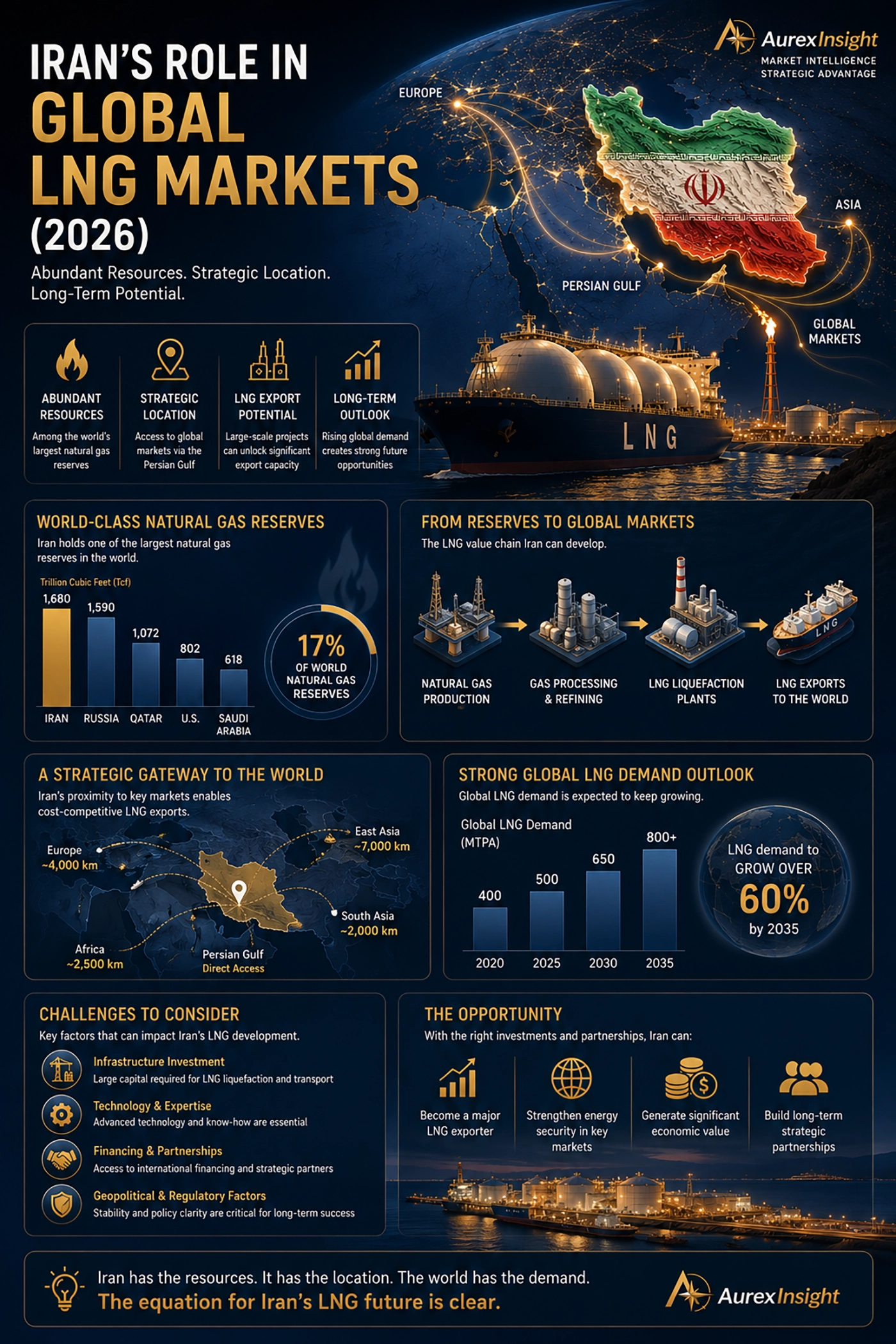
Figure 1. Overview of Iran's position in global LNG trade, including natural gas resources, the LNG value chain, infrastructure constraints, the strategic role of the Persian Gulf and Strait of Hormuz, and key long-term market opportunities.
Challenges Facing Iran's LNG Development
Natural gas resources alone are not enough to establish a competitive LNG export industry.
Transforming gas reserves into internationally traded LNG requires substantial investment, advanced engineering, integrated infrastructure, and long-term commercial planning.
For Iran, the discussion is therefore not whether natural gas resources exist.
The more relevant question is how efficiently those resources can be converted into globally traded LNG.
Several structural factors continue to influence Iran's long-term LNG outlook.
Infrastructure Development
LNG production depends on large-scale industrial infrastructure.
This includes:
- Liquefaction facilities
- LNG storage tanks
- Marine export terminals
- Specialized loading systems
- Pipeline integration
- Supporting utility infrastructure
Developing these assets requires significant capital investment and long project-development timelines.
Unlike conventional natural gas production, LNG infrastructure cannot be expanded quickly.
Many projects require years before becoming commercially operational.
Technology Requirements
Liquefaction is one of the most technologically sophisticated processes in the global energy industry.
Modern LNG plants rely on advanced refrigeration systems, process optimization, engineering expertise, and highly specialized equipment.
Successful LNG projects typically require:
- advanced engineering capability
- process technology
- operational expertise
- maintenance support
- high safety standards
Technology therefore remains a major component of LNG competitiveness.
Investment and Commercial Structure
Large LNG developments are among the most capital-intensive energy projects in the world.
Beyond construction costs, successful projects also require:
- long-term financing
- commercial partnerships
- bankable project structures
- stable revenue expectations
- long-term purchase agreements
For investors, commercial certainty is often as important as geological potential.
Without reliable commercial structures, large-scale LNG projects become significantly more difficult to develop.
Export Logistics
Producing LNG is only part of the value chain.
The product must also reach international buyers efficiently.
Export logistics involve:
- LNG carrier availability
- terminal operations
- shipping schedules
- freight markets
- insurance
- maritime accessibility
This explains why logistics frequently become just as important as production itself.
For countries located in the Persian Gulf, maritime trade conditions remain an essential part of LNG competitiveness.
Why the Strait of Hormuz Still Matters
Even though Iran is not currently a major LNG exporter, the Strait of Hormuz remains highly relevant to any discussion about its future LNG potential.
The Strait connects the Persian Gulf to international shipping lanes and serves as one of the world's most important maritime energy corridors.
For LNG markets, buyers continuously monitor:
- shipping conditions
- freight costs
- insurance premiums
- vessel traffic
- export accessibility
- maritime security
Changes in any of these factors may influence market sentiment long before physical LNG supply changes occur.
For a detailed discussion, see:
👉🏻 Why the Strait of Hormuz Matters for Global Commodity Trade in 2026
Iran and Regional Energy Competition
Iran operates within one of the world's most competitive energy-exporting regions.
Neighboring producers have invested heavily in LNG infrastructure, export capacity, logistics, and long-term customer relationships.
Competition increasingly depends upon:
- operational efficiency
- export reliability
- infrastructure quality
- customer confidence
- commercial flexibility
- logistics performance
Future competitiveness will therefore depend not only on natural gas availability but also on execution across the entire LNG value chain.
Opportunities for International Buyers
Although Iran's LNG market participation remains limited today, market participants continue monitoring the country because of its long-term resource potential.
For buyers and energy companies, Iran represents a market worth observing for several reasons:
- one of the world's largest natural gas resource bases
- strategic location within the Persian Gulf
- proximity to major Asian energy markets
- long-term production potential
- regional energy importance
Rather than focusing only on current export volumes, many analysts evaluate how future infrastructure development could reshape regional LNG supply.
What Buyers Should Monitor
Organizations following LNG markets during 2026 should monitor a combination of production, logistics, and commercial indicators.
Important indicators include:
Resource Development
- upstream gas investment
- production growth
- field development projects
Infrastructure
- LNG project announcements
- liquefaction capacity developments
- export terminal construction
- storage expansion
Trade and Logistics
- shipping activity
- freight markets
- LNG carrier availability
- insurance costs
- Strait of Hormuz developments
Commercial Activity
- long-term LNG contracts
- international partnerships
- investment announcements
- regional energy cooperation
Monitoring these indicators together provides a far more complete picture than following natural gas production alone.
AurexInsight Executive Insight
Iran's position in global LNG discussions is defined by potential rather than current export leadership.
This distinction is important.
Many resource-rich countries possess abundant natural gas.
Far fewer successfully convert those resources into internationally competitive LNG industries.
For market participants, the key question is therefore not simply how much gas Iran possesses.
The more important question is how infrastructure, investment, logistics, technology, and commercial partnerships evolve over time.
From an AurexInsight perspective, future LNG competitiveness will increasingly depend upon an organization's ability to evaluate:
- resource quality
- infrastructure readiness
- trade accessibility
- logistics resilience
- commercial execution
- long-term market opportunity
Understanding the relationship between these factors provides a more realistic view of Iran's position within the evolving global LNG market than reserve statistics alone.
What to Watch During the Remainder of 2026
Market participants should continue monitoring developments across several interconnected areas.
Natural Gas
- production trends
- upstream investment
- field development
LNG Markets
- global LNG demand
- liquefaction capacity
- contract activity
- spot market trends
Shipping
- LNG freight rates
- vessel availability
- insurance markets
- shipping routes
Regional Energy
- Persian Gulf developments
- Strait of Hormuz conditions
- regional infrastructure
- export logistics
Changes across these areas may shape future LNG market dynamics during the remainder of 2026.
Outlook for the Remainder of 2026
Iran is expected to remain strategically relevant to global natural gas discussions throughout 2026.
Although current LNG export participation remains limited, its resource base, geographic location, and position within the Persian Gulf ensure continued interest from energy analysts and market observers.
Long-term developments will depend on infrastructure investment, commercial partnerships, technological progress, and evolving market conditions.
For buyers, traders, and market intelligence professionals, understanding both Iran's opportunities and its constraints will remain essential when evaluating future LNG markets.
Frequently Asked Questions
Is Iran currently a major LNG exporter?
No.
Despite possessing one of the world's largest natural gas resource bases, Iran is not currently among the world's leading LNG exporters. Its LNG role is constrained primarily by liquefaction infrastructure, investment requirements, technology access, and commercial project development rather than resource availability alone.
Why does Iran matter to global LNG markets?
Iran matters because of its substantial natural gas reserves, strategic location within the Persian Gulf, and proximity to major international energy trade routes.
Its long-term importance lies more in its future export potential than its current LNG export volume.
How does the Strait of Hormuz affect LNG trade?
The Strait of Hormuz serves as one of the world's most important maritime energy corridors.
A significant share of global LNG and energy exports passes through this route.
Changes in shipping conditions, insurance costs, freight rates, or maritime accessibility can influence delivered LNG prices and buyer confidence even when production remains unchanged.
What factors determine LNG export competitiveness?
Successful LNG exports depend on much more than natural gas reserves.
Important factors include:
- liquefaction capacity
- export infrastructure
- LNG shipping availability
- long-term commercial contracts
- logistics efficiency
- project financing
- operational reliability
Which countries dominate global LNG exports?
Global LNG exports are led by countries with well-developed liquefaction infrastructure and established export systems, including Qatar, the United States, Australia, Malaysia, Russia, Nigeria, and Algeria.
Why is LNG strategically important?
LNG allows natural gas to be transported globally by sea rather than through fixed pipeline systems.
It plays a critical role in:
- electricity generation
- industrial production
- fertilizer manufacturing
- petrochemical industries
- energy-security planning
This flexibility makes LNG one of the world's most strategically important energy commodities.
What should LNG buyers monitor during 2026?
Buyers should continuously monitor:
- global natural gas prices
- LNG demand growth
- liquefaction capacity additions
- freight markets
- LNG carrier availability
- insurance costs
- Strait of Hormuz developments
- supplier reliability
- long-term contract activity
References
- International Energy Agency (IEA)
- U.S. Energy Information Administration (EIA)
- International Gas Union (IGU)
- Gas Exporting Countries Forum (GECF)
- World Bank – Commodity Markets Outlook
- International Monetary Fund (IMF)
- UN Comtrade Database
- International Trade Centre (ITC) Trade Map
- Reuters Commodities & Energy
- World Trade Organization (WTO)
Related AurexInsight Research
-
Why the Strait of Hormuz Matters for Global Commodity Trade in 2026
-
How Regional Tensions Are Reshaping Global Commodity Markets in 2026
About AurexInsight
AurexInsight is an independent Market Intelligence platform focused on international trade, commodity markets, supplier evaluation, trade-flow analysis, and opportunity development.
Our mission is to help buyers, producers, traders, and decision-makers transform market intelligence into trusted business opportunities through data-driven insights, practical market analysis, and strategic decision support.
Disclaimer
This report is provided for informational and market-intelligence purposes only.
It should not be considered investment, legal, financial, procurement, or commercial advice.
Commodity markets, infrastructure projects, energy policies, and international trade conditions can evolve rapidly. Readers should conduct independent research and professional due diligence before making business or investment decisions.
Short Video Summary
Written and reviewed by
AurexInsight Research
AurexInsight publishes market intelligence, supplier validation insights, trade-flow analysis and opportunity-focused research for international business decision-makers.
View profile and research standardsRelated Research
Continue exploring this market theme
These related insights help build a clearer view of the market context, supply-chain risks and commercial opportunities connected to this analysis.
Why the Strait of Hormuz Matters for Global Commodity Trade in 2026
Explore why the Strait of Hormuz remains one of the world's most important trade corridors and how it influences energy markets, fertilizers, shipping costs, and global commodity flows in 2026.
Read insightMarket OutlookIran's Role in Global Sulfur Trade: Production, Export Potential and Market Outlook 2026
An in-depth analysis of Iran's role in global sulfur trade, production capacity, export potential, downstream demand, infrastructure, and market outlook in 2026.
Read insightMarket OutlookCommodity Trade Risks in 2026: Iran, the Strait of Hormuz and Shipping Disruption
An analysis of how regional tensions, maritime risks, Iran's export position, and the Strait of Hormuz are influencing global commodity markets, trade flows, and supply-chain decisions in 2026.
Read insight