

How Strait of Hormuz Disruption Affects Fertilizer Supply to India, Pakistan and East Africa
How disruption in the Strait of Hormuz changes fertilizer availability, freight exposure and procurement decisions for buyers in India, Pakistan and East Africa.
Last updated: July 28, 2026
Editorial standard
Reviewed by AurexInsight Research
Last updated: July 28, 2026
AUREXINSIGHT RESEARCH
How Strait of Hormuz Disruption Affects Fertilizer Supply to India, Pakistan and East Africa
How disruption in the Strait of Hormuz changes fertilizer availability, freight exposure and procurement decisions for buyers in India, Pakistan and East Africa.
Executive summary
Disruption in the Strait of Hormuz can affect fertilizer buyers in India, Pakistan and East Africa before it appears in a producer's quoted price. The first signals are often delayed vessel availability, changing freight and war-risk terms, tighter shipment windows and uncertainty around arrival dates. Buyers should treat product availability, shipping execution and farm-season timing as one decision.
The Food and Agriculture Organization of the United Nations (FAO) has identified fertilizer and energy trade as directly exposed to disruption in the corridor, with import-dependent countries in Asia and Africa especially vulnerable. This does not mean every shipment will fail. It means a purchase order needs a verified delivery path, sufficient inventory cover and realistic alternatives.
Research method and limitations
This summary is based on the full AurexInsight report, trade and industry data, and reputable public sources. Market data may be delayed, incomplete, or methodologically inconsistent; independent due diligence is essential before commercial decisions.
Written and reviewed by: AurexInsight Research
Full report and sources: https://aurexinsight.com/en/insights/how-strait-of-hormuz-disruption-affects-fertilizer-supply-india-pakistan-east-africa-2026
Research method
This analysis triangulates reputable public sources, trade and industry data, institutional reports, and consistency checks. Material source conflicts, limitations, and uncertainty are stated explicitly.
Data limitations
Trade and market data may be delayed, incomplete, or methodologically inconsistent. This report does not replace independent legal, financial, procurement, or commercial due diligence.
Quick Answer
Disruption in the Strait of Hormuz can affect fertilizer buyers in India, Pakistan and East Africa before it appears in a producer's quoted price. The first signals are often delayed vessel availability, changing freight and war-risk terms, tighter shipment windows and uncertainty around arrival dates. Buyers should treat product availability, shipping execution and farm-season timing as one decision.
The Food and Agriculture Organization of the United Nations (FAO) has identified fertilizer and energy trade as directly exposed to disruption in the corridor, with import-dependent countries in Asia and Africa especially vulnerable. This does not mean every shipment will fail. It means a purchase order needs a verified delivery path, sufficient inventory cover and realistic alternatives.
Executive Summary
India, Pakistan and East African markets do not have identical fertilizer needs or purchasing systems, but they share a practical exposure: import programs depend on timely movement of nitrogen, phosphate, potash and sulfur-based products, together with the energy and shipping services required to deliver them.
For 2026, the key commercial risk is a sequence rather than a single price event:
- maritime security or transit restrictions change vessel scheduling;
- freight, insurance and fuel costs alter delivered economics;
- shipment timing becomes uncertain during a crop-input window;
- distributors, governments and farmers adjust inventories, tenders or application plans.
FAO has warned that disruption to Gulf supply chains can raise energy and fertilizer costs and affect import-dependent agricultural systems. UNCTAD likewise identifies freight, war-risk insurance and marine-fuel costs as transmission channels from maritime disruption into trade and vulnerable economies.
Why These Markets Need Different Procurement Plans
India: Scale, tender timing and nutrient balance
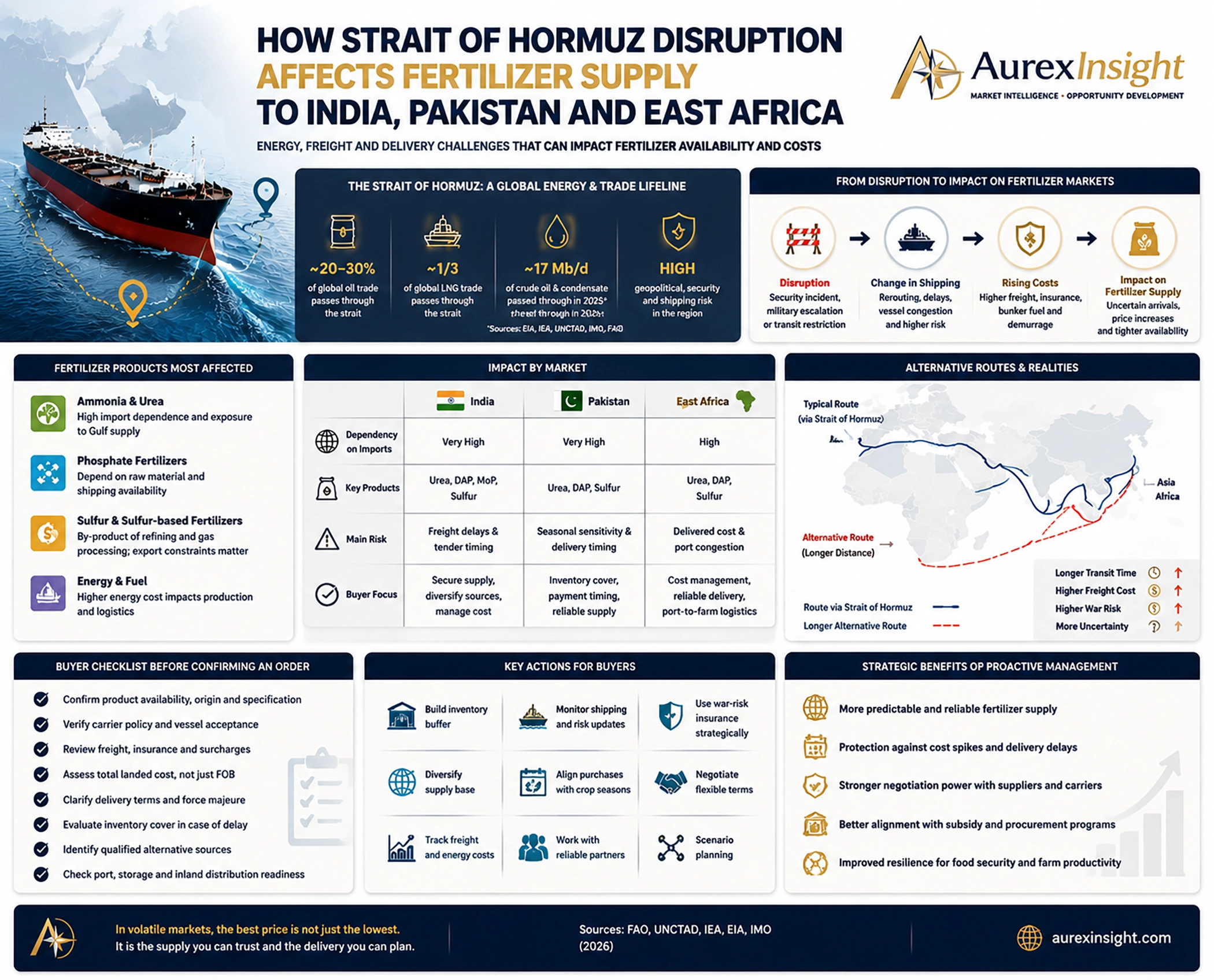
India's fertilizer market is large, seasonal and closely connected to crop calendars, public policy and a broad distributor network. A buyer or supplier should not assess risk from urea alone. The relevant question is whether the required nutrient program can arrive in the correct form and within the application window.
The procurement plan should therefore compare delivered availability across nitrogen, phosphate, potash and sulfur-containing products; identify alternative origins where specifications allow; and distinguish a temporary freight shock from a true volume shortfall.
Pakistan: Timing and input-cost sensitivity
Pakistan is exposed to the same combination of fertilizer availability, energy cost and maritime execution. Delays can be commercially important when they intersect with seasonal buying, dealer inventory and farmer application timing. Procurement teams should secure a clear loading window, payment timetable and discharge plan rather than relying on a nominal ETA.
East Africa: Delivered cost and inventory cover
East Africa is not a single fertilizer market. Port choice, inland logistics, currency exposure, tender design, subsidy programs and crop mix can differ sharply by country. Yet many buyers share a high sensitivity to delivered cost and port-to-farm delays. In this setting, a low FOB offer can be misleading if it does not include realistic freight, insurance, demurrage and inland-distribution assumptions.
What Products and Costs Are Exposed?
The risk is broader than a single nutrient. Depending on origin and route, buyers may need to monitor:
- ammonia and urea for nitrogen programs;
- phosphate fertilizers and related raw materials;
- sulfur and sulfur-based fertilizers;
- fuel and marine-energy costs that influence both production and transport;
- bulk-vessel availability, war-risk insurance and port congestion.
The exact exposure varies by contract and origin. A disruption affecting Gulf-origin cargoes does not automatically remove every alternative supply source, but it can raise delivered costs and consume the time needed to qualify a substitute.
Buyer Checklist: From Quote to Arrival
Before confirming a fertilizer order during heightened corridor risk, ask:
- Is the quoted product available at the stated origin, specification and shipment month?
- Has the carrier confirmed its current transit policy and vessel acceptance?
- What is included in freight, war-risk cover, bunker adjustment and demurrage exposure?
- Does the contract define realistic delivery, force-majeure and notification obligations?
- How many weeks of inventory cover are available if the shipment is delayed or diverted?
- Is there an approved substitute by nutrient analysis, not merely by product name?
- Can the receiving port, warehouse and inland network absorb a delayed or bunching arrival?
Data Limits and What This Brief Does Not Predict
Public reports can describe corridor-level disruption and broad market exposure, but they cannot confirm the status of a specific vessel, tender or cargo. Actual delivery depends on carrier decisions, insurance terms, port conditions, payment performance and the contract. This brief does not provide a fertilizer price forecast or an agronomic application recommendation.
For broader context, see Why the Strait of Hormuz Matters for Global Commodity Trade, Global Urea Market Outlook 2026 and Why Sulfur Matters in Global Fertilizer Markets.
Frequently Asked Questions
Does a Hormuz disruption mean fertilizer will be unavailable in India, Pakistan or East Africa?
Not necessarily. It means supply reliability, freight cost and arrival timing should be revalidated. Alternative origins or routes may exist, but qualification and delivery time matter.
Which fertilizer products should buyers monitor first?
Start with products essential to the current nutrient program and crop window, including nitrogen, phosphate, potash and sulfur-containing products where relevant. Evaluate the full nutrient analysis rather than substituting by product name alone.
What is the most important commercial metric during disruption?
The most useful metric is delivered, usable nutrient on time. A low headline FOB price loses value if the vessel, insurance, port or inland-delivery plan cannot be executed.
References
- FAO: Global Agrifood Implications of the 2026 Conflict in the Middle East
- FAO: Implications of Hormuz disruptions for agricultural and fertilizer markets
- FAO: Emergency measures for energy and fertilizer supply chains
- UNCTAD: Strait of Hormuz disruptions and global trade
- International Maritime Organization: Middle East and Strait of Hormuz updates
Disclaimer
This report is market intelligence, not legal, insurance, maritime, procurement or agronomic advice. Validate current route, product, regulatory and contractual conditions with qualified specialists before making a commercial decision.
Written and reviewed by
AurexInsight Research
AurexInsight publishes market intelligence, supplier validation insights, trade-flow analysis and opportunity-focused research for international business decision-makers.
View profile and research standardsRelated Research
Continue exploring this market theme
These related insights help build a clearer view of the market context, supply-chain risks and commercial opportunities connected to this analysis.
Global Crude Oil Market Outlook 2026: Supply, Demand, Trade Flows and Energy Risks
A comprehensive analysis of the global crude oil market in 2026, examining supply dynamics, demand trends, trade flows, refinery economics and energy risks shaping commodity markets.
Read insightMarket OutlookOil Price Volatility in 2026: Supply Disruptions, Market Reactions and What Comes Next
An analysis of oil price volatility in 2026, examining supply disruptions, market reactions, Persian Gulf risks, shipping conditions, and the implications for bitumen, sulfur and global commodity procurement.
Read insightMarket OutlookCommodity Trade Risks in 2026: Iran, the Strait of Hormuz and Shipping Disruption
An analysis of how regional tensions, maritime risks, Iran's export position, and the Strait of Hormuz are influencing global commodity markets, trade flows, and supply-chain decisions in 2026.
Read insight